
Moving from United States to Alaska
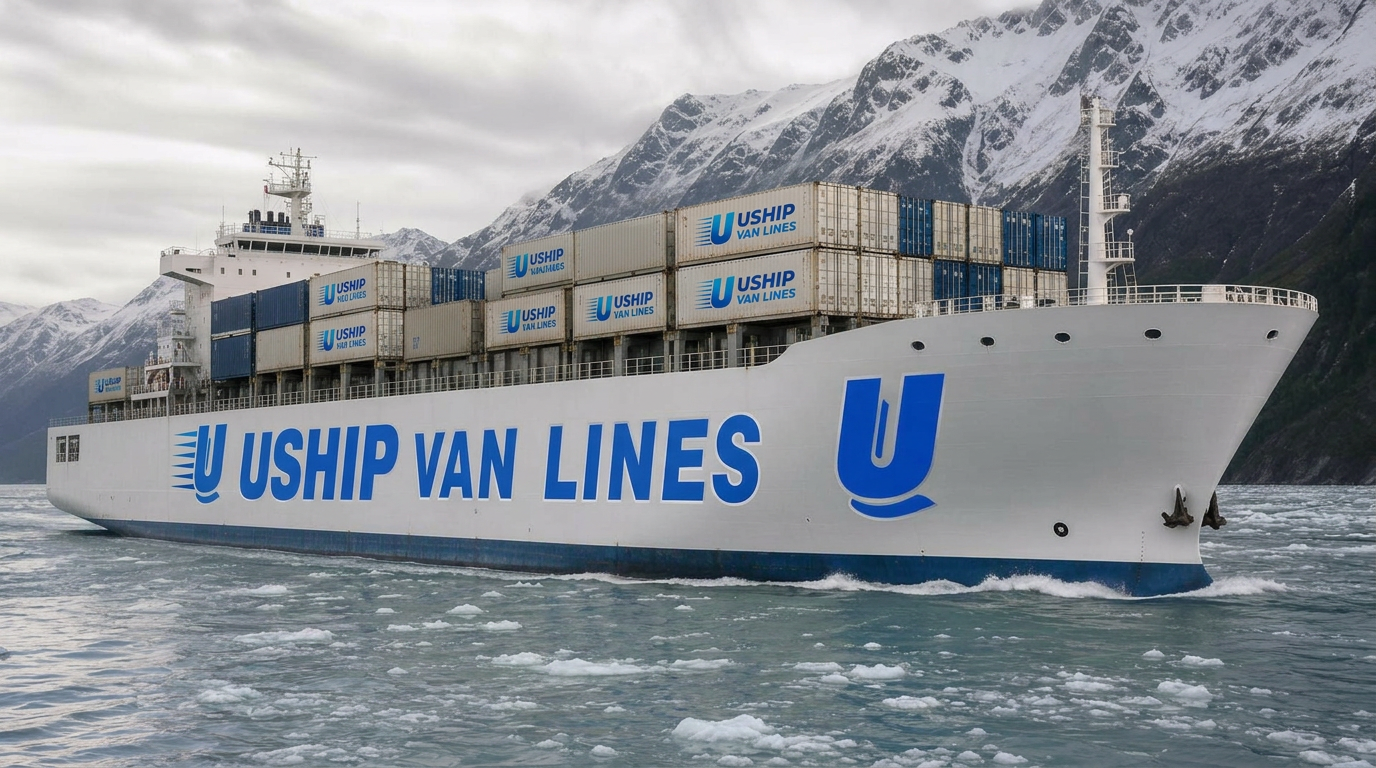
Relocating from the Lower 48 to Alaska requires specialized logistics that standard moving companies simply can't handle. Your household goods travel by truck to the Port of Tacoma, cross the Gulf of Alaska via ocean barge, and arrive at the Port of Anchorage before final delivery to your new home—whether that's in Anchorage, Fairbanks, the Mat-Su Valley, Kenai Peninsula, or remote bush communities.
Best Alaska & Hawaii Movers, powered by UShip Van Lines, coordinates every phase of this multi-modal journey with precision. We've refined the Alaska barge route over thousands of successful moves, ensuring your belongings arrive intact while you focus on the adventure ahead. Ready to start planning your move north? Request a detailed quote today.
Route overview
How Your Belongings Reach Alaska
The continental U.S. to Alaska moving route follows a well-established path that combines overland trucking with marine transportation. Your household goods are loaded at your current residence anywhere in the Lower 48, consolidated at our partner facility, then transported by truck to the Port of Tacoma, Washington—the primary embarkation point for Alaska-bound freight.
From Tacoma, cargo barges operated by established maritime carriers make the 1,500-mile voyage across the Gulf of Alaska to the Port of Anchorage. These barges run on published weekly schedules during peak season (May through September) and less frequently during winter months. Once your shipment clears the port, we coordinate final delivery to your destination, whether that's a downtown Anchorage apartment, a homestead in the Mat-Su Valley, or a cabin accessible only by seasonal roads.
This barge-based system is the most cost-effective method for moving full households to Alaska. While air freight exists for urgent small shipments, 99% of residential moves utilize the ocean route due to dramatic cost savings and the ability to transport vehicles, furniture, and large appliances that would be prohibitively expensive to fly.
How the moving process works
Step-by-Step Alaska Moving Process
-
In-Home or Virtual Survey — We assess your inventory volume (typically measured in cubic feet rather than weight for Alaska moves) and identify items requiring special handling or those restricted by Alaska's strict biosecurity laws.
-
Packing and Loading at Origin — Professional movers pack your belongings using marine-grade materials designed to withstand ocean transit, humidity changes, and multiple handling points. Everything is loaded into containers or onto pallets at your current home.
-
Overland Transport to Port of Tacoma — Your shipment travels by truck to our consolidation facility near Tacoma, where it's staged for the next available barge sailing. Transit time from most states ranges from 3–7 days.
-
Marine Shipping to Port of Anchorage — Your goods sail on scheduled barge service, spending 5–10 days at sea depending on weather conditions and the carrier's route (some barges make intermediate stops at Kodiak or Dutch Harbor).
-
Port Clearance and Customs — While Alaska is part of the United States and doesn't require customs clearance, port paperwork and cargo release typically take 1–2 business days after the barge docks.
-
Last-Mile Delivery — We coordinate final trucking from the Port of Anchorage to your new address. Deliveries to Anchorage proper occur within 2–3 days; Fairbanks adds 3–5 days; remote locations may require additional scheduling based on road conditions and accessibility.
-
Unloading and Placement — Our team unloads and places furniture in designated rooms, removes packing materials, and conducts a final walkthrough to ensure everything arrived as expected.
Estimated moving costs
What Alaska Moves Cost
Moving a typical 2–3 bedroom household from the continental United States to Alaska ranges from $6,500 to $14,000 depending on your origin state, total cubic footage, packing services, and destination accessibility. Cross-country moves from the East Coast trend toward the higher end, while Pacific Northwest origins (Washington, Oregon, Northern California) fall at the lower range.
Primary cost drivers include:
- Volume: Alaska moves are priced by cubic feet rather than weight. A 1,200 sq ft home typically generates 800–1,200 cubic feet of cargo.
- Distance to Tacoma: Overland trucking costs from your origin to the Port of Tacoma vary significantly—expect $1,500–$4,000 for this leg alone.
- Barge freight rates: Ocean shipping represents $2,500–$5,000 of your total, with rates fluctuating seasonally (peak summer rates run 15–25% higher than winter).
- Final delivery complexity: Anchorage deliveries add minimal cost; Fairbanks adds $800–$1,500; remote locations requiring barge, bush plane, or winter ice road access can add $2,000–$5,000.
- Packing services: Full professional packing adds $800–$2,000 but provides essential protection for ocean transit.
- Vehicle shipping: Adding a car or truck costs $1,800–$3,200 extra via the same barge route.
We provide detailed, itemized quotes with no hidden fees. Costs are locked in at booking, protecting you from market fluctuations between reservation and move date. Every quote includes $100,000 baseline cargo insurance; additional coverage is available for high-value items.
Estimated transit times
Alaska Move Timeline
Door-to-door transit from the Lower 48 to Alaska typically requires 14–28 days, with variability based on your origin location, barge schedules, and final destination.
Timeline breakdown by phase:
- Pickup to Port of Tacoma: 2–7 days depending on origin state (West Coast moves often consolidate directly; East Coast and Midwest shipments require cross-country trucking).
- Port staging and barge departure: 2–10 days, highly dependent on barge sailing schedules. Peak summer months (June–August) offer near-weekly departures; winter months may have 2–3 week gaps between sailings.
- Ocean voyage: 5–10 days at sea. Direct Anchorage sailings take 5–7 days in good conditions; barges making intermediate stops at Kodiak, Dutch Harbor, or other ports extend to 8–10 days.
- Port clearance: 1–3 business days for cargo release and documentation processing at the Port of Anchorage.
- Last-mile delivery: Same-day to 7 days. Anchorage deliveries often occur within 24–48 hours of port release; Fairbanks adds 3–5 days; Kenai Peninsula and Mat-Su Valley typically add 2–4 days; remote bush locations depend entirely on seasonal access and weather.
Expedited options: While we can't accelerate ocean transit, priority staging at Tacoma can reduce port wait time. Summer moves book weeks in advance, so early reservation is critical for preferred timing. Winter moves offer more scheduling flexibility but face longer gaps between sailings and potential weather delays.
Regional logistics
Alaska-Specific Moving Logistics
Port Operations: The Port of Anchorage is Alaska's primary deepwater port and receives the vast majority of Lower 48 household goods. Barges dock at the freight terminal, and your shipment typically clears within 1–3 business days. You don't need to be present at the port—we handle all cargo release paperwork. The Port of Tacoma serves as the southern staging point, where shipments consolidate from across the continental U.S.
Vehicle Shipping: Most Alaska movers drive the Alaska-Canada Highway (ALCAN), but shipping your vehicle on the same barge as your household goods saves 2,500+ miles of driving, wear and tear, and potential breakdown risks. Vehicles ship in drive-on/drive-off roll-on-roll-off (RORO) format or in enclosed containers. Cost runs $1,800–$3,200 per vehicle. You'll need title, registration, and proof of insurance. Fuel tanks must be less than 1/4 full. Processing time matches your household goods.
Restricted Items: Alaska enforces strict biosecurity to protect agriculture and ecosystems. Absolutely prohibited: soil, potted plants with soil, firewood, certain seeds, and agricultural products. Fresh fruits and vegetables face inspection. Firearms and ammunition are legal but require specific declaration and packaging. Hazardous materials (propane tanks, paint, aerosols, cleaning chemicals) cannot ship via barge—plan to dispose of these before your move or purchase new upon arrival.
Remote and Bush Deliveries: Locations off the road system require additional logistics. Some bush communities receive barge service only during ice-free months (typically June–September). Others require small plane, winter ice road, or seasonal ferry access. We coordinate these complex deliveries but encourage 8–12 weeks advance planning for off-grid locations. Costs vary dramatically—request detailed quotes for destinations like Bethel, Nome, Barrow, Southeast Alaska islands, or Aleutian communities.
Storage Options: If your new home isn't ready or you're building new construction, we offer climate-controlled storage near Anchorage. Month-to-month contracts available. Storage is particularly common for military families with delayed housing assignments or those arriving ahead of their household goods to secure employment and housing.
Seasonal considerations
Planning Your Alaska Move by Season
Summer (May–September): Peak moving season to Alaska coincides with peak barge schedules—weekly or twice-weekly sailings from Tacoma provide maximum flexibility. Demand is highest, so book 6–8 weeks in advance. Weather is most predictable, with minimal risk of delivery delays from snow or ice. Expect premium rates 15–25% above winter pricing. Ideal for families moving before the school year or those wanting to settle in before winter.
Fall (October–November): Shoulder season offers reduced rates and lighter booking volume. Barge frequency decreases to every 7–14 days. Weather becomes less predictable—early snowfall can complicate deliveries to interior Alaska and remote locations. Good option for cost-conscious movers with flexible timelines who can accommodate potential weather delays.
Winter (December–March): Lowest rates of the year, sometimes 20–30% below peak summer costs. Barge sailings run every 2–3 weeks, requiring careful timeline planning. Arctic weather creates genuine delivery challenges: Fairbanks temperatures can hit -40°F, remote locations may become inaccessible until spring thaw, and daylight hours are extremely limited. Only recommended for experienced Alaskans or those with flexible arrival dates. Many barges reduce service or pause entirely during the darkest weeks.
Spring (April–May): Rates begin climbing as barge schedules increase. Weather improves but "breakup" season (when winter ice thaws) can make rural roads impassable—some remote locations are paradoxically more accessible in deep winter via ice roads than during spring mud season. Excellent window for those wanting better weather without peak-summer pricing. Book 4–6 weeks ahead as schedules fill quickly leading into summer.
Why choose Best Alaska & Hawaii Movers
Why Choose Best Alaska & Hawaii Movers
-
Alaska Route Specialists — We focus exclusively on Alaska and Hawaii moving logistics, unlike general brokers who hand off complex non-contiguous routes to subcontractors. Our team knows Tacoma port schedules, Anchorage delivery zones, and the reality of moving to Fairbanks in February.
-
Transparent Pricing, Zero Hidden Fees — Your detailed quote includes every cost: origin pickup, Tacoma trucking, barge freight, port fees, last-mile delivery, and baseline insurance. The price we quote is the price you pay, locked in at booking.
-
Powered by UShip Van Lines — We leverage UShip Van Lines' nationwide network for seamless pickup anywhere in the Lower 48, combined with our specialized Alaska expertise for the marine leg and final delivery.
-
White-Glove Packing for Ocean Transit — Ocean crossings demand superior packing. We use marine-grade materials, moisture barriers, and reinforced crating for fragile items. Your belongings face multiple handling points and significant humidity changes—we pack accordingly.
-
Real-Time Tracking and Communication — Know exactly where your shipment is: loaded at origin, staged at Tacoma, aboard the barge (with vessel name and sailing date), cleared at Anchorage, or en route for final delivery. Our customer service team provides regular updates and responds quickly to questions throughout your 3–4 week journey north.