
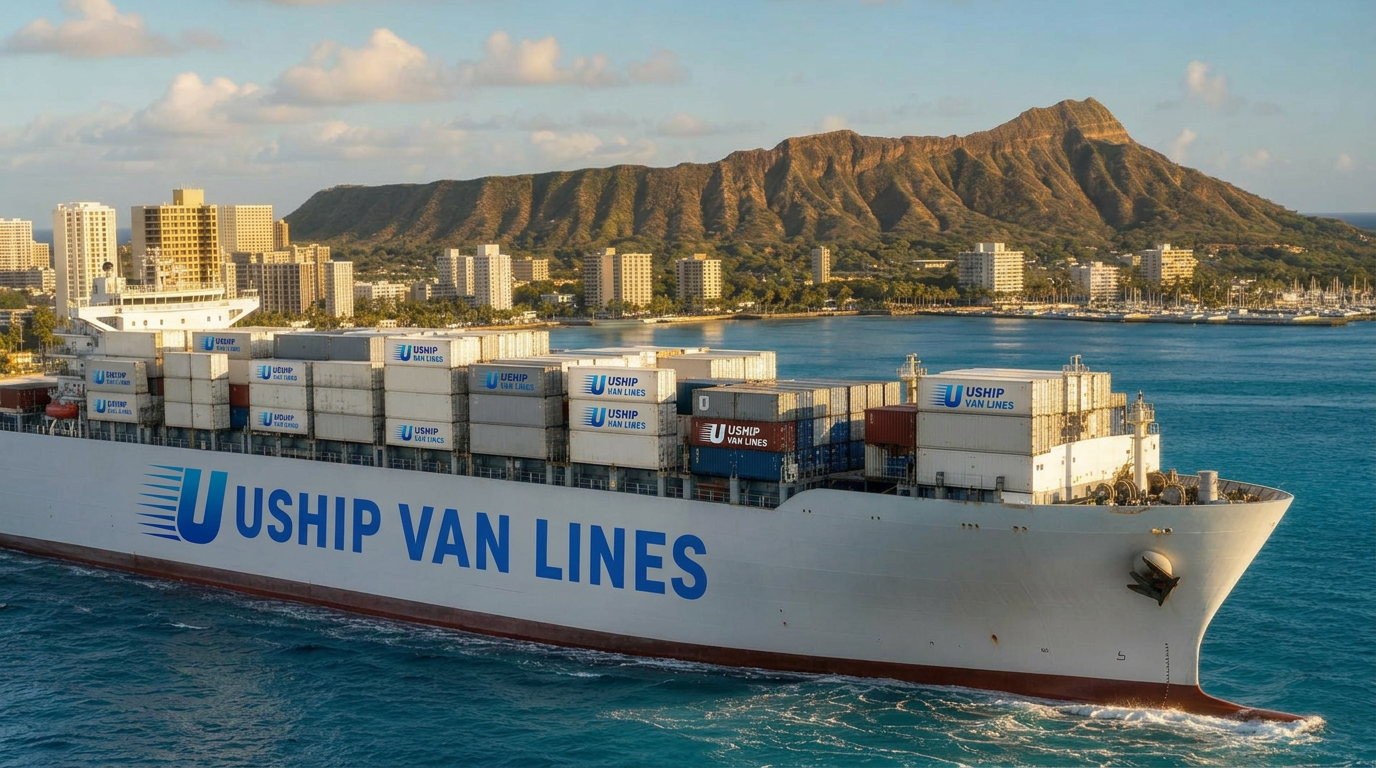
Moving from United States to Hawaii
Relocating from the mainland United States to Hawaii represents one of the most unique moving experiences you'll encounter. Unlike any interstate move, your household goods and vehicles cross 2,500 miles of open ocean via container ship, requiring specialized expertise, precise timing, and comprehensive logistics planning.
Best Alaska & Hawaii Movers, powered by UShip Van Lines, specializes exclusively in non-contiguous state relocations. We coordinate every phase of your mainland-to-Hawaii move—from professional packing and container loading at your origin city to ocean freight booking, customs clearance, and final delivery to your new island home. Request your free, no-obligation quote today to start planning your Pacific crossing.
Route overview
Your Mainland-to-Hawaii Moving Route
Moves from the continental United States to Hawaii follow a well-established logistics chain. Your household goods travel by ground transportation to one of two West Coast ports—Long Beach or Oakland, California—where they're loaded into ocean containers operated by Matson Navigation or Pasha Hawaii. The ocean voyage to Honolulu takes 5–7 days, depending on vessel schedules and weather conditions.
Once your container arrives in Honolulu, goods destined for neighbor islands (Maui, Kauai, Big Island, Molokai) undergo inter-island transshipment via smaller barges or Young Brothers freight service, adding 3–7 days to the timeline. Most mainland moves arrive through Honolulu's Sand Island terminal, where containers clear agricultural inspection and customs before final delivery to your residence.
The complete journey from your mainland doorstep to your Hawaii home typically requires 14–28 days, with variations based on your origin city distance from West Coast ports, seasonal shipping schedules, and your destination island. Peak moving season (May–September) sees fuller vessels and tighter scheduling, while winter months often offer more flexibility.
How the moving process works
How Your Mainland-to-Hawaii Move Works
-
Initial Survey and Container Assignment – Your move coordinator conducts a virtual or in-home assessment to determine container size (20-foot or 40-foot) and cubic footage. We calculate your shipment volume and provide a binding estimate that accounts for ground transport, ocean freight, and island delivery.
-
Pre-Move Preparation and Restricted Items Review – Hawaii enforces strict agricultural regulations prohibiting soil, certain plants, fresh produce, and many wooden items. We provide a comprehensive prohibited-items checklist and guide you through compliance requirements to avoid customs delays and disposal fees.
-
Professional Packing and Container Loading – Our team arrives at your mainland residence to pack, wrap, and load your household goods. For full-container shipments, we load directly into your ocean container at your home (if accessible) or at a nearby warehouse. Partial loads consolidate with other Hawaii-bound shipments.
-
Ground Transport to West Coast Port – Your loaded container travels by truck to Long Beach or Oakland, arriving at the port terminal 3–5 days before your scheduled vessel departure. We handle all port documentation, terminal fees, and carrier coordination.
-
Ocean Voyage to Honolulu – Your container boards a Matson or Pasha vessel for the 5–7 day Pacific crossing. Real-time tracking allows you to monitor your shipment's progress across the ocean.
-
Customs Clearance and Agricultural Inspection – Upon arrival in Honolulu, your container undergoes mandatory USDA agricultural inspection and Hawaii Department of Agriculture clearance. This process typically takes 1–3 days, longer if inspection flags require additional documentation.
-
Inter-Island Transfer (if applicable) – For Maui, Kauai, or Big Island deliveries, your goods transfer to inter-island freight service. Young Brothers operates the primary barge service between islands, with sailings 2–4 times weekly depending on destination.
-
Final Delivery and Unpacking – Local island teams deliver your container to your new residence, unload your household goods, and provide unpacking services if requested. We remove all packing materials and conduct a final inventory check against your origin manifest.
Estimated moving costs
What a Mainland-to-Hawaii Move Costs
A typical 2–3 bedroom household move from the continental U.S. to Hawaii ranges from $6,800 to $14,500, with significant variation based on origin distance, shipment volume, and destination island. These figures represent full-service moves including packing, ocean freight, and delivery.
Major cost drivers include:
- Origin location distance to West Coast ports – Moves from California or the Southwest (Arizona, Nevada) cost $6,800–$9,200, while East Coast or Midwest origins add 2,000–3,000 ground miles, pushing totals to $11,000–$14,500
- Shipment volume and container size – A 20-foot container (approximately 1,100 cubic feet) costs $4,500–$6,200 for ocean freight alone; a 40-foot container (2,200 cubic feet) runs $7,500–$9,800
- Destination island – Oahu deliveries are most economical; Maui, Kauai, and Big Island add $1,200–$2,400 in inter-island barge fees and additional handling
- Packing services – Professional full-pack service adds $1,200–$2,800 depending on inventory size; partial packing or self-packing reduces costs
- Vehicle shipping – Adding a car to your move costs $1,100–$1,600 per vehicle from West Coast ports, $1,800–$2,400 from other mainland regions
- Storage fees – If your Hawaii residence isn't ready upon arrival, island-side storage runs $180–$320 per week for container storage
- Seasonal demand – Summer peak season (June–August) commands 10–18% premiums over winter low season (November–February)
We provide transparent, itemized quotes breaking down every cost component. No hidden port fees, fuel surcharges, or surprise charges appear at delivery. Request your customized estimate to see exact pricing for your specific move parameters.
Estimated transit times
How Long Your Mainland-to-Hawaii Move Takes
Door-to-door transit from the continental United States to Hawaii typically requires 14 to 28 days, broken into distinct transportation legs:
Ground transport to West Coast port: 1–7 days depending on your origin city. California and Nevada moves may load directly at port; Midwest and East Coast shipments require cross-country trucking.
Port staging and vessel loading: 2–4 days for container processing, customs documentation, and vessel assignment at Long Beach or Oakland terminals.
Ocean voyage to Honolulu: 5–7 days at sea. Matson's faster vessels complete the crossing in 5 days; Pasha and slower services take 6–7 days. Weather and sea conditions occasionally extend transit by 1–2 days.
Customs and agricultural inspection: 1–3 days for USDA and Hawaii Department of Agriculture clearance at Honolulu's Sand Island terminal. Shipments flagged for detailed inspection may require 4–5 days.
Inter-island transfer (neighbor islands only): 3–7 days for barge service to Maui, Kauai, or Big Island. Young Brothers operates 2–4 sailings weekly per island, with schedules varying by season.
Final island delivery: 1–2 days from port arrival to your residence, coordinated around your availability.
We recommend arriving in Hawaii 3–5 days before your household goods to secure housing, open utilities, and prepare for delivery. Many customers ship their belongings first, then fly out once their container is ocean-bound, allowing them to track progress and time their arrival for delivery week.
Regional logistics
Hawaii-Specific Moving Logistics
Port Operations and Container Handling: All mainland-to-Hawaii ocean freight flows through two primary ports—Long Beach and Oakland—where Matson Navigation and Pasha Hawaii operate dedicated Hawaii shipping services. Your container receives a booking number and vessel assignment 7–10 days before sailing. We handle all terminal interchange, documentation fees ($185–$275), and port security requirements.
Agricultural Inspection and Prohibited Items: Hawaii enforces the nation's strictest agricultural import rules to protect fragile island ecosystems. Prohibited items include: soil and potted plants with soil, fresh fruits and vegetables, wooden furniture with bark, outdoor items contaminated with seeds or dirt, pet food containing meat, and numerous other agricultural products. USDA inspectors physically examine containers upon Honolulu arrival. Prohibited items found during inspection result in disposal fees ($150–$400) and potential delays. We provide detailed compliance checklists during your pre-move consultation.
Vehicle Shipping Coordination: Most families moving to Hawaii ship 1–2 vehicles alongside household goods. Cars travel in separate roll-on/roll-off (RoRo) vessels operated by Matson and Pasha, departing weekly from Long Beach, Oakland, San Diego, and Seattle. Vehicle shipping requires separate paperwork including title, registration, and Hawaii safety inspection exemption forms. We coordinate vehicle drop-off timing to align with your household goods shipment, ensuring both arrive within the same week. Vehicles must be empty (no personal items), clean (agricultural inspection), with less than ¼ tank fuel.
Inter-Island Logistics: Approximately 40% of Hawaii moves require inter-island transfer beyond Oahu. Young Brothers, the primary inter-island freight carrier, operates barges from Honolulu to Maui (3–4 sailings weekly), Kauai (2–3 weekly), and Big Island/Hilo and Kona (3–4 weekly combined). Neighbor island deliveries incur additional handling fees ($320–$580 per container) and barge freight charges. We coordinate seamless transfers, tracking your container from Honolulu arrival through final island delivery.
Last-Mile Delivery Challenges: Hawaii's unique geography creates delivery considerations absent from mainland moves. Many Oahu neighborhoods feature narrow streets built before container trucks, requiring smaller shuttle vehicles for final delivery. Big Island moves to remote areas (Puna, Ka'u, North Kohala) may incur long-carry fees for locations beyond standard delivery zones. Maui's Hana Highway and Kauai's North Shore roads require special handling during winter months. We survey your destination address during planning to identify and price any special delivery requirements, eliminating surprises.
Seasonal considerations
Best Times to Move to Hawaii
Summer Peak Season (May–September): The busiest moving period coincides with school breaks and optimal weather. Vessel space books 4–6 weeks in advance, and rates increase 10–18% above off-season pricing. Hurricane season (June–November) occasionally disrupts port operations, though major storms rarely impact the main shipping lanes. Book early and build 3–5 day schedule buffers.
Fall Shoulder Season (October–November): Excellent moving window with moderate demand and stable weather. Ocean freight capacity opens up as summer crowds thin, offering better scheduling flexibility and negotiated rates. Thanksgiving week sees slight volume upticks, but overall conditions remain favorable.
Winter Low Season (December–February): The most economical moving period, with rates 12–20% below summer peaks. December holiday weeks see reduced vessel sailings, but January–February offers maximum carrier availability. Winter Pacific storms occasionally delay crossings by 1–2 days, but modern container ships handle rough seas without cargo damage. If your schedule allows flexibility, winter moves deliver significant savings.
Spring Transition (March–April): Demand begins building as families plan summer relocations. Rates remain reasonable through March, then climb in April as peak season approaches. Weather conditions are ideal, with calm seas and minimal port congestion. Book by early February to secure April slots at favorable rates.
Regardless of season, Hawaii's year-round tropical climate means no freeze/thaw concerns for your goods. Agricultural inspection intensity remains constant across all months, driven by regulations rather than seasonal factors.
Why choose Best Alaska & Hawaii Movers
Why Choose Best Alaska & Hawaii Movers
-
Exclusive Non-Contiguous Focus – Unlike general moving companies that occasionally handle Hawaii moves, we specialize exclusively in Alaska and Hawaii relocations. Our teams understand ocean freight logistics, agricultural compliance, and island delivery challenges that general movers simply don't encounter.
-
Established Carrier Relationships – Our preferred partnerships with Matson Navigation, Pasha Hawaii, and Young Brothers ensure priority vessel space booking, competitive freight rates, and reliable scheduling even during peak season. We move the volume that earns relationship pricing and service priority.
-
Transparent, All-Inclusive Pricing – Your quote includes every cost: packing materials, labor, ground transport, ocean freight, port fees, agricultural inspection, inter-island barge (if applicable), and final delivery. No hidden terminal handling charges, fuel surcharges, or surprise fees appear at delivery.
-
End-to-End Shipment Tracking – Monitor your household goods from mainland pickup through ocean crossing to island delivery via real-time tracking portal. You'll receive notifications at every milestone: container loading, port arrival, vessel departure, ocean position updates, Honolulu arrival, inspection clearance, and delivery scheduling.
-
Comprehensive Insurance Coverage – Full-value protection covers your goods throughout the entire journey, including ocean transit. Unlike basic carrier liability (60 cents per pound), our insurance replaces damaged items at full replacement value, giving you peace of mind across 2,500 miles of ocean.