
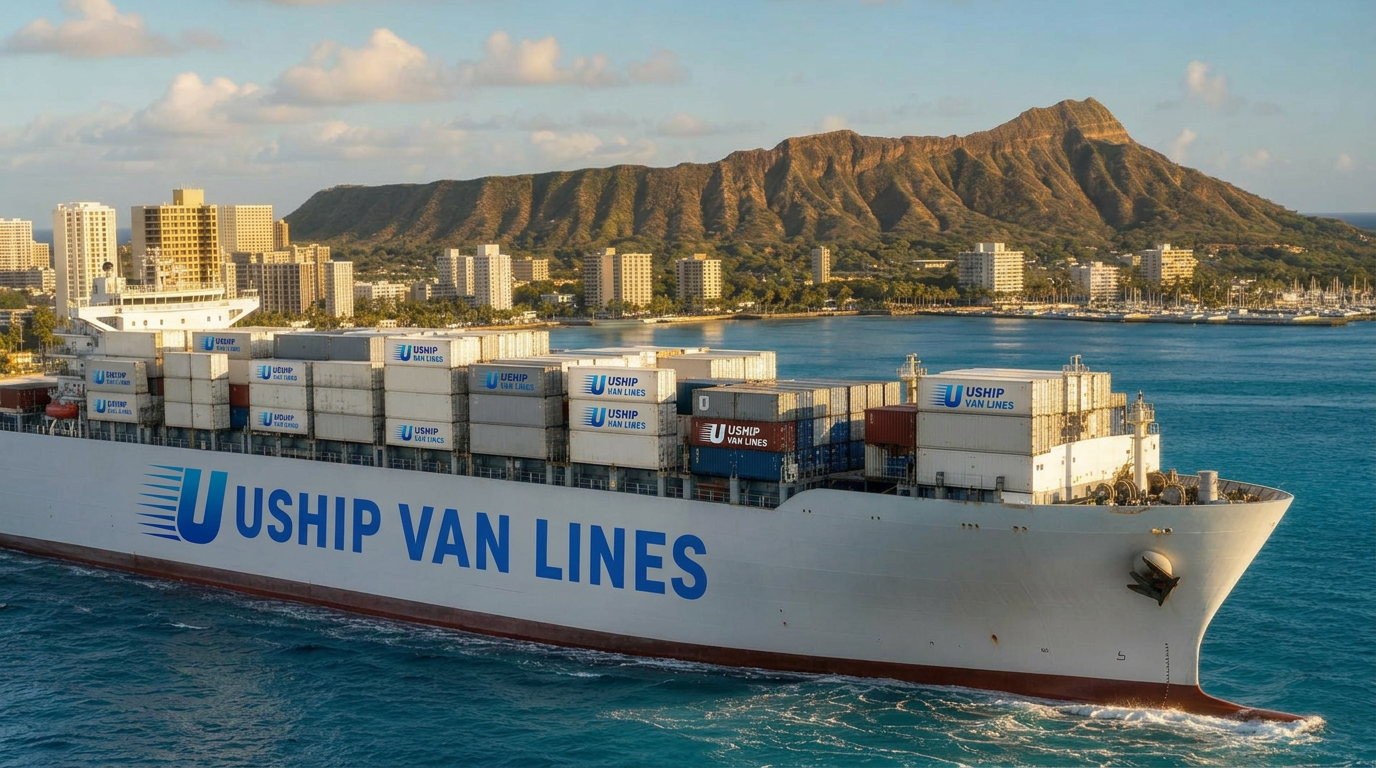
Moving from Washington to Hawaii
Moving from Washington to Hawaii means trading evergreen forests and mountain views for palm trees and Pacific sunsets. Whether you're relocating from Seattle, Spokane, or Tacoma to Honolulu, Maui, or the Big Island, your belongings will travel thousands of miles across the Pacific—first by truck to a West Coast port, then by ocean container to the islands.
Best Alaska & Hawaii Movers, powered by UShip Van Lines, specializes in this exact route. We coordinate the full journey from your Washington doorstep to your new Hawaiian home, handling port logistics, container shipping, and final delivery. Ready to start planning your island move? Request a free quote to get accurate pricing and timelines for your specific situation.
Route overview
How Your Belongings Travel from Washington to Hawaii
The Washington-to-Hawaii move follows a well-established ocean shipping corridor. Your household goods are loaded into a truck at your current residence, then transported approximately 800–1,100 miles to either the Port of Oakland or Port of Long Beach in California. There, your items are transferred into a 20-foot or 40-foot ocean container and loaded onto a Matson or Pasha vessel bound for Honolulu.
The ocean crossing takes 5–7 days to reach Oahu. If your final destination is Maui, Kauai, or the Big Island, your container then transfers to a smaller inter-island barge for an additional 2–4 days. This multi-leg journey requires careful coordination between trucking companies, port terminals, ocean carriers, and local Hawaiian delivery teams—which is why working with an experienced Hawaii moving specialist makes such a difference.
Washington residents benefit from proximity to major West Coast ports, often resulting in slightly shorter overland transit times compared to moves originating from the Midwest or East Coast. Still, the Pacific crossing and port processing mean you should plan for 2–4 weeks total door-to-door transit time, depending on your specific Washington city and Hawaiian island destination.
How the moving process works
The Step-by-Step Moving Process
-
Initial consultation and quote – Contact Best Alaska & Hawaii Movers with your move details: origin city in Washington, destination island and city in Hawaii, home size, and preferred move dates. We'll provide a detailed estimate covering all legs of the journey.
-
Pre-move survey and planning – We'll conduct a virtual or in-person inventory assessment to determine cubic footage, identify items requiring special handling (surfboards, kayaks, antiques), and finalize your shipping plan. You'll receive documentation about prohibited items and Hawaii's strict agricultural inspection requirements.
-
Packing and loading in Washington – Professional movers arrive at your Washington home to pack (if you've chosen full-service) and load your belongings into a truck. Inventory sheets are completed, and items are secured for the long journey to California.
-
Overland transport to port – Your shipment travels by truck to either Oakland or Long Beach, typically taking 1–2 days. The truck arrives at the port terminal where your goods are transferred into an ocean container—either dedicated (you're the sole shipper) or consolidated (shared space).
-
Ocean freight to Hawaii – Your container is loaded onto a Matson or Pasha vessel for the 5–7 day Pacific crossing to Honolulu. During this time, you'll receive tracking updates and estimated arrival windows.
-
Port clearance and customs/agriculture inspection – Upon arrival in Hawaii, all containers undergo USDA agricultural inspection to prevent invasive species. Certain items may be inspected or quarantined; prohibited items are confiscated. This process adds 1–3 days.
-
Final delivery to your Hawaiian home – For Oahu residents, your goods are delivered directly from the port. For neighbor island destinations, your container transfers to an inter-island barge, then to a local delivery truck. Our team schedules your delivery window and completes the final unloading at your new residence.
Estimated moving costs
What to Expect: Moving Costs from Washington to Hawaii
A typical 2–3 bedroom household move from Washington to Hawaii ranges from $6,500 to $14,000, depending on volume, services, and destination island. A studio or 1-bedroom move may cost $4,000–$7,000, while a large 4-bedroom home can exceed $18,000.
Key cost drivers include:
- Cubic footage or container size – Most movers charge by volume (cubic feet) or offer flat-rate container pricing. A 20-foot container holds roughly 1,000–1,200 cubic feet; a 40-foot container holds 2,000–2,400 cubic feet.
- Destination island – Oahu moves are typically $1,000–$2,500 less expensive than neighbor island moves due to direct shipping and no inter-island barge fees.
- Port of departure – Oakland and Long Beach are the primary ports; routing from Washington is similar in cost, though seasonal vessel schedules may vary.
- Packing services – Professional packing adds $800–$2,500 depending on home size and fragility of items.
- Vehicle shipping – Cars and trucks shipped separately via roll-on/roll-off (RoRo) vessel cost $1,200–$1,800 per vehicle Seattle/Tacoma to Honolulu.
- Time of year – Summer (May–September) sees higher demand and slightly elevated rates; winter offers better availability and occasional discounts.
- Insurance coverage – Basic carrier liability is included, but full-value replacement protection costs 1–3% of declared shipment value.
We provide itemized, transparent quotes with no hidden fees. Costs are estimates based on your provided inventory; final pricing is confirmed after a detailed survey. Always request quotes from multiple Hawaii specialists to compare value and services.
Estimated transit times
Realistic Door-to-Door Timelines
Plan for 14 to 28 days total transit time from your Washington residence to your Hawaiian home, broken down as follows:
- Loading and overland to California port: 1–3 days, depending on your Washington location (Seattle/Tacoma may be slightly faster than Spokane or eastern Washington).
- Port staging and container loading: 2–5 days. Containers are loaded based on vessel schedules, which typically run weekly but may vary seasonally.
- Ocean crossing to Honolulu: 5–7 days on Matson or Pasha vessels.
- Port clearance and agricultural inspection: 1–3 days. USDA inspections are mandatory; delays occur if items require secondary inspection.
- Inter-island barge (if applicable): 2–4 additional days for Maui, Kauai, or Big Island delivery.
- Final delivery scheduling: 1–2 days to coordinate local delivery trucks and unloading crew.
Oahu deliveries average 14–21 days door-to-door. Neighbor island deliveries average 18–28 days. Expedited service is rarely available for ocean freight, so build buffer time into your moving timeline—especially if you have lease start dates, job commitments, or school enrollment deadlines.
Peak summer season (June–August) and major holidays can add 3–7 days due to port congestion and vessel capacity. Book at least 4–6 weeks in advance to secure your preferred dates.
Regional logistics
Hawaii-Specific Logistics You Need to Know
Port operations: Your goods will route through either the Port of Oakland (Northern California) or Port of Long Beach (Southern California), then ship to Honolulu's Sand Island terminal or Kapalama Container Terminal. Neighbor island deliveries continue to Kahului (Maui), Nawiliwili (Kauai), or Hilo/Kawaihae (Big Island).
Agricultural inspections: Hawaii has the strictest agricultural import laws in the United States. All shipments undergo 100% USDA inspection upon arrival. Prohibited items include soil, potted plants, fresh fruits/vegetables, certain seeds, hay, straw, and many wooden items with bark. Pack a detailed inventory; inspectors may open boxes. Non-compliant items are confiscated without reimbursement. Best Alaska & Hawaii Movers provides a comprehensive prohibited-items list during booking.
Vehicle shipping: Cars and motorcycles ship separately on RoRo vessels (Matson, Pasha, or Horizon). Vehicles must be clean (no soil, no personal items inside), operable, and registered/insured. Shipping from Seattle or Tacoma to Honolulu takes 7–10 days and costs $1,200–$1,800. Book your vehicle shipment and household goods simultaneously to coordinate arrival.
Partial loads vs. dedicated containers: Consolidated (shared) containers cost less but may add 3–7 days while the carrier fills the container. Dedicated containers cost 20–40% more but offer faster loading and direct shipping. Discuss options based on your budget and timeline.
Delivery access in Hawaii: Many Hawaiian homes have narrow streets, steep driveways, or limited parking for large trucks. Notify your mover of access challenges (gated communities, narrow roads, apartment elevators). Additional shuttle fees ($200–$600) may apply if a smaller truck is required for final delivery.
Storage options: If your Hawaiian home isn't ready, short-term storage is available in Honolulu or on neighbor islands. Costs run $150–$400/month depending on volume. Climate-controlled units recommended for electronics, artwork, and wooden furniture due to Hawaii's humidity.
Insurance and liability: Standard carrier liability covers $0.60 per pound per item—insufficient for valuable goods. Full-value protection costs 1–3% of declared shipment value but covers replacement cost. Given the ocean journey and multiple handoffs, we strongly recommend upgrading coverage for this route.
Seasonal considerations
Best Times to Move from Washington to Hawaii
Spring (March–May): Moderate demand, good availability, and pleasant weather in both Washington and Hawaii. Hurricane season hasn't started, and port operations run smoothly. Ideal for families with school-age children planning a summer arrival.
Summer (June–August): Peak moving season due to school breaks and job relocations. Expect higher rates, tighter vessel space, and longer booking lead times. Hurricane season begins June 1, though major storms are rare. Book 6–8 weeks ahead.
Fall (September–November): Hurricane season peaks in September and tapers through November. While direct hits on Hawaii are uncommon, tropical storms can delay vessel departures or port operations by 2–5 days. Demand drops after Labor Day, offering better pricing and availability.
Winter (December–February): Off-peak season with the lowest rates and best availability. Weather in Hawaii is mild; Washington winter weather (snow, ice) can occasionally delay initial truck loading or overland transport in eastern regions. Great value if your timeline is flexible.
Hurricane season caution: The Central Pacific hurricane season runs June 1 through November 30. Matson and Pasha vessels are built to handle rough seas, but port closures or delayed departures can add 3–7 days to your timeline during active storms. Tracking and communication from your mover become essential during these months.
Port congestion: Oakland and Long Beach occasionally experience congestion during peak shipping periods (pre-holidays, post-labor negotiations). This is outside your mover's control but can add delays—another reason to book early and maintain flexibility.
Why choose Best Alaska & Hawaii Movers
Why Best Alaska & Hawaii Movers for Your Washington-to-Hawaii Move
- Hawaii shipping specialists – We focus exclusively on Alaska and Hawaii moves, with deep expertise in Pacific ocean logistics, port coordination, and island-specific regulations. This isn't a side service; it's what we do.
- End-to-end coordination – One point of contact manages your entire move from Washington loading through Hawaiian delivery, including port transfers, agricultural inspections, and inter-island barges. No handoffs, no confusion.
- Transparent, itemized pricing – You'll receive a detailed quote breaking down every cost: packing, trucking, port fees, ocean freight, delivery. No surprise charges at delivery.
- Powered by UShip Van Lines – Our partnership with UShip Van Lines gives us access to a vetted network of carriers, competitive shipping rates, and proven logistics infrastructure for complex long-distance moves.
- Proactive communication – We provide regular tracking updates, vessel schedules, and delivery windows. You'll know where your belongings are at every stage, with real humans available to answer questions.
- Flexible service levels – Choose full-service packing and unpacking, labor-only loading, or self-pack options. We tailor solutions to your budget and timeline, not a one-size-fits-all package.