
Moving from Akron, OH to Alaska
Relocating from Akron, OH to Alaska is a significant life transition that requires specialized moving expertise. This isn't a standard cross-country move—your belongings travel 3,400+ miles by truck to the Pacific Northwest, then by ocean barge to Alaska's port system, followed by final delivery to your new home in Anchorage, Fairbanks, the Mat-Su Valley, or beyond.
Best Alaska & Hawaii Movers, powered by UShip Van Lines, coordinates every leg of your Akron-to-Alaska journey with precision. From packing your Rubber City home to navigating Tacoma port logistics and delivering to your Alaska doorstep, we handle the complexity so you don't have to. Request your personalized moving quote today to start planning your Alaska adventure.
Route overview
Your Akron to Alaska Moving Route
Your household goods depart Akron and travel westbound approximately 2,300 miles via interstate highway to the Port of Tacoma or Seattle. This overland segment typically takes 4–6 days depending on scheduling and weather. At the port, your shipment transfers to containerized ocean barge service bound for Alaska—most commonly to the Port of Anchorage, though Whittier and other ports serve specific regions.
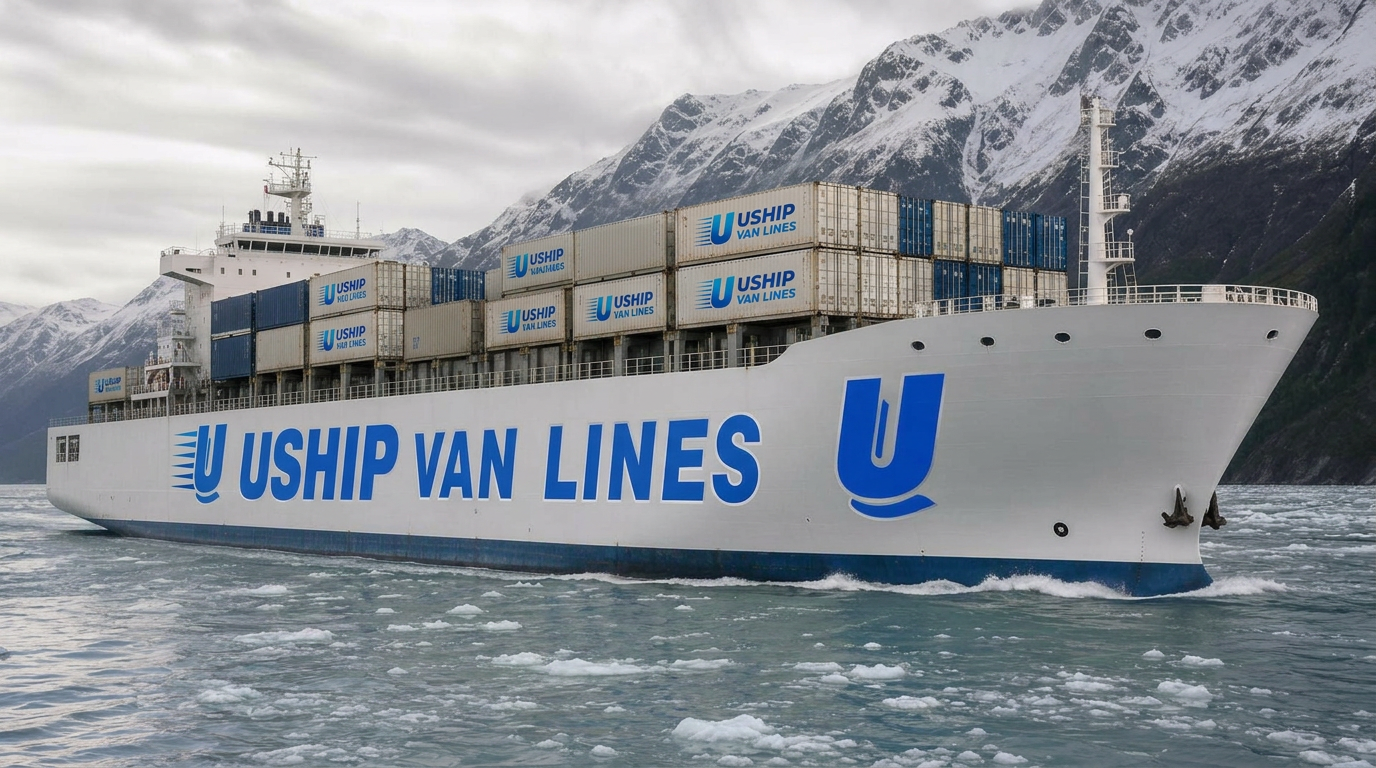
The barge crossing from Washington State to Alaska spans roughly 1,500 nautical miles and operates year-round, though frequency varies by season. Transit time on the water ranges from 5–9 days for Southcentral Alaska destinations. Once your container arrives and clears the port, local Alaska carriers complete final delivery to cities like Anchorage, Eagle River, Wasilla, Palmer, Kenai, Soldotna, or Fairbanks. Remote and bush communities may require additional coordination with regional carriers or air freight for certain items.
This three-stage journey—Ohio to Pacific port, ocean barge, Alaska last-mile—means your total door-to-door timeline typically spans 14–25 days. Summer months offer the most frequent barge sailings and optimal road conditions, while winter moves face weather-related scheduling constraints but remain entirely feasible with proper planning.
How the moving process works
How Your Akron-to-Alaska Move Works
-
Free Consultation & Quote: Contact us with your move details—home size, inventory list, preferred dates, and destination city in Alaska. We provide a detailed estimate covering all three legs: ground transport, barge shipping, and Alaska delivery.
-
Pre-Move Planning: Our coordinator schedules your packing and loading date in Akron, confirms barge sailing schedules from Tacoma/Seattle, and arranges Alaska delivery windows. We handle port documentation, customs paperwork if needed, and coordinate vehicle shipping if you're transporting cars.
-
Packing & Loading in Akron: Professional crews pack your belongings using Alaska-grade materials designed for multi-modal transport. Items are loaded into a dedicated section of the truck or a container, with full inventory documentation for port transfer.
-
Overland Transport to Pacific Port: Your shipment travels I-80 and I-90 west through Pennsylvania, Indiana, Illinois, Iowa, Nebraska, Wyoming, and either Idaho/Washington or Montana/Washington routes. The driver coordinates directly with port receivers for seamless handoff.
-
Port Transfer & Barge Loading: At Tacoma or Seattle, your goods transfer to ocean containers (typically 20' or 40' units). Our port agents complete marine shipping documentation, secure your container on the barge, and provide sailing confirmation with expected Alaska arrival.
-
Ocean Barge Transit: Your container sails through the Inside Passage or Gulf of Alaska route to your destination port. We track the vessel and provide arrival updates. Weather delays are rare but possible; we communicate any schedule changes immediately.
-
Alaska Port Clearance & Final Delivery: Once the barge docks in Alaska, local agents clear your container through port inspection and load it onto Alaska delivery trucks. Final delivery to your Anchorage home, Fairbanks apartment, or Mat-Su property completes your journey, with crews unloading and placing items according to your floor plan.
Estimated moving costs
What Your Akron-to-Alaska Move Costs
A typical 2-bedroom household (approximately 5,000–7,000 lbs) moving from Akron to Anchorage generally costs $6,500–$10,500 for full-service door-to-door moving. A 3-bedroom home (8,000–12,000 lbs) typically ranges $9,800–$15,200. These estimates include ground transport, barge shipping, Alaska delivery, and basic liability coverage.
Several factors influence your final price. Distance within Alaska matters significantly—delivery to Fairbanks adds $800–$1,500 compared to Anchorage due to the 360-mile highway haul. Summer peak season (May–August) commands premium rates due to high demand and maximum barge frequency, while winter moves (October–March) may offer 10–15% discounts despite scheduling constraints. Packing services add $800–$2,200 depending on home size and fragility of items. Vehicle shipping runs $1,800–$3,200 per car for enclosed transport on the same barge system.
Remote Alaska locations beyond the road system—like Kodiak, Juneau, or bush communities—require additional marine or air freight coordination, potentially adding $2,000–$5,000+ to base costs. Expedited barge service, when available, adds 15–25% but can shave 3–5 days off transit time. Always request a detailed written estimate that breaks down each segment of your move; legitimate Alaska movers never guarantee final prices without surveying your actual inventory and understanding your specific destination requirements.
Estimated transit times
Akron to Alaska Delivery Timeline
Door-to-door delivery from Akron, OH to Alaska typically requires 14–25 days under normal conditions. Here's how that breaks down:
Akron to Tacoma/Seattle Port: 4–6 days for the 2,300-mile overland haul. Direct routing via I-80/I-90 is most common, though winter weather through Wyoming or Montana mountain passes can add 1–2 days. Most carriers build in buffer time for weather and DOT-required driver rest periods.
Port Dwell Time: 1–4 days between truck arrival and barge departure. This depends on barge sailing schedules (which vary by season) and port processing times. Summer months have near-daily sailings; winter may have 2–3 sailings per week, requiring more precise scheduling.
Barge Transit: 5–9 days on the water for Anchorage-bound shipments. Whittier (serving Southcentral Alaska) has similar timing. Fairbanks-bound freight still goes to Anchorage first, then trucks the Richardson Highway. Southeast Alaska ports like Juneau or Ketchikan may have different routing with 7–12 day water transit.
Alaska Port to Final Destination: 1–5 days depending on location. Anchorage and Eagle River deliveries often happen within 24–48 hours of port clearance. Wasilla, Palmer, Kenai Peninsula, and Fairbanks add 1–3 days for truck scheduling and the highway run. Remote communities require additional coordination.
Summer moves (May–September) hit the faster end of these ranges due to optimal weather and frequent sailings. Winter moves (November–March) often add 3–7 days due to reduced barge frequency and potential weather delays on Alaska highways. Always plan for the upper end of the timeline and consider temporary lodging if your Alaska housing isn't immediately available.
Regional logistics
Alaska-Specific Moving Logistics
Port & Documentation: Your shipment enters Alaska through commercial ports—primarily the Port of Anchorage (serving Southcentral), but also Whittier, Kodiak, Juneau, and others depending on destination. While Alaska is a U.S. state requiring no customs clearance, maritime shipping still involves port inspection and freight documentation. Professional Alaska movers handle BOL (bill of lading), port authority paperwork, and carrier coordination automatically. You'll receive tracking information for your container number and barge vessel name.
Vehicle Shipping: Driving the Alaska Highway from the Lower 48 is a 2,500+ mile journey from the Canadian border crossing—a serious undertaking from Akron. Most families ship at least one vehicle on the same barge as their household goods. Vehicles travel in enclosed containers or on roll-on/roll-off (RoRo) vessels. Expect $1,800–$3,200 per vehicle for Akron-to-Anchorage transport, with 14–20 day delivery timelines matching household goods. Vehicles must be clean (USDA agriculture inspection requirements for Canadian transit), under 1/4 tank of fuel, and free of personal items except basic emergency gear.
Last-Mile Alaska Delivery: Alaska's road system serves Anchorage, Fairbanks, Mat-Su Valley, Kenai Peninsula, and a few other connected communities. Delivery trucks navigate the Glenn Highway, Parks Highway, Seward Highway, and Richardson Highway routinely, even in winter. However, many Alaska communities—Juneau (the capital), Kodiak, Dutch Harbor, Nome, Barrow—are off the road grid entirely. These locations require additional marine ferry, small vessel, or air freight for final delivery. Discuss your specific Alaska destination with your coordinator early; "bush" moves require specialized logistics and add significant cost and time.
Storage Options: If your Alaska housing isn't ready when your shipment arrives, most moving companies offer temporary storage in Anchorage-area warehouses. Climate-controlled storage isn't typically necessary—Alaska warehouses are cold in winter but protect from precipitation. Storage costs run $150–$400 per month for typical household volumes. Alternatively, some movers can delay final delivery by holding your container at the port (port storage fees may apply) or keeping it on the truck until your home is ready.
Insurance & Valuation: Basic liability coverage (typically $0.60 per pound) is included but provides minimal protection—a 50-lb TV damaged in transit yields only $30. Full-value protection costs 1–3% of your shipment's declared value but covers replacement cost. Given the complexity of Alaska moves (truck, barge, truck again), full-value protection is highly recommended. Review your homeowner's or renter's insurance policy; some cover goods in transit, though most exclude commercial moves.
Seasonal considerations
Best Times for Your Akron-to-Alaska Move
Summer (May–August): Peak moving season offers maximum barge frequency—sometimes daily sailings from Tacoma to Anchorage. Roads are clear, weather is predictable, and Alaska delivery crews operate at full capacity. However, this is also the most expensive period, with rates 15–30% higher than off-season. Book 6–8 weeks in advance, as barge space fills quickly. Ideal if you have school-age children (summer break) or need fast, reliable transit.
Fall (September–October): The "shoulder season" balances good weather with lower demand. Barge schedules remain frequent (3–5 sailings per week), and prices drop 10–20% from summer peaks. Early fall is especially attractive—Alaska roads are still excellent, and you'll settle before winter. Late October can bring early snow in Interior Alaska (Fairbanks region), so coordinate delivery timing carefully.
Winter (November–March): Off-peak season offers the best rates—often 15–25% below summer pricing. Barge service continues year-round but reduces to 2–3 sailings per week, adding potential dwell time at the port. Alaska winter roads are maintained but can face temporary closures during severe storms. Fairbanks-bound shipments should avoid late December and January when temperatures drop to -20°F to -40°F, though professional movers handle extreme cold routinely. Excellent choice if you're flexible on timing and want significant savings.
Spring (April–early May): Breakup season in Alaska brings unpredictable conditions. Barge schedules increase as summer approaches, and prices begin rising. Roads can be muddy or damaged from freeze-thaw cycles, though main highways remain passable. Generally less ideal than fall, but workable if your job or housing requires a spring move.
Regardless of season, Alaska's weather is dynamic. Build flexibility into your timeline, maintain communication with your moving coordinator, and arrange backup lodging or storage options if delivery faces weather delays.
Why choose Best Alaska & Hawaii Movers
Why Choose Best Alaska & Hawaii Movers for Your Akron-to-Alaska Relocation
-
Alaska Route Specialists: We coordinate Akron-to-Alaska moves regularly, with established partnerships at Pacific ports and Alaska delivery networks. We understand barge schedules, seasonal considerations, and Alaska road conditions intimately.
-
End-to-End Coordination: You get a single point of contact managing all three legs—Akron ground transport, Tacoma/Seattle port transfer, and Alaska final delivery. No juggling multiple carriers or vendors.
-
Transparent Pricing: We provide detailed written estimates breaking down every segment and fee. No hidden port charges or surprise Alaska delivery surcharges. You'll know your total investment before committing.
-
Vehicle & Specialty Item Handling: We ship cars, boats, motorcycles, and oversized equipment alongside household goods. One coordinated shipment, one timeline, one trusted team.
-
Powered by UShip Van Lines: Our backing by a nationwide moving network ensures equipment, insurance, and support resources that small operators can't match, while maintaining the personalized service Alaska moves demand.
Ready to start your Akron-to-Alaska journey? Request your free detailed quote today and speak with a moving coordinator who understands your unique route.