
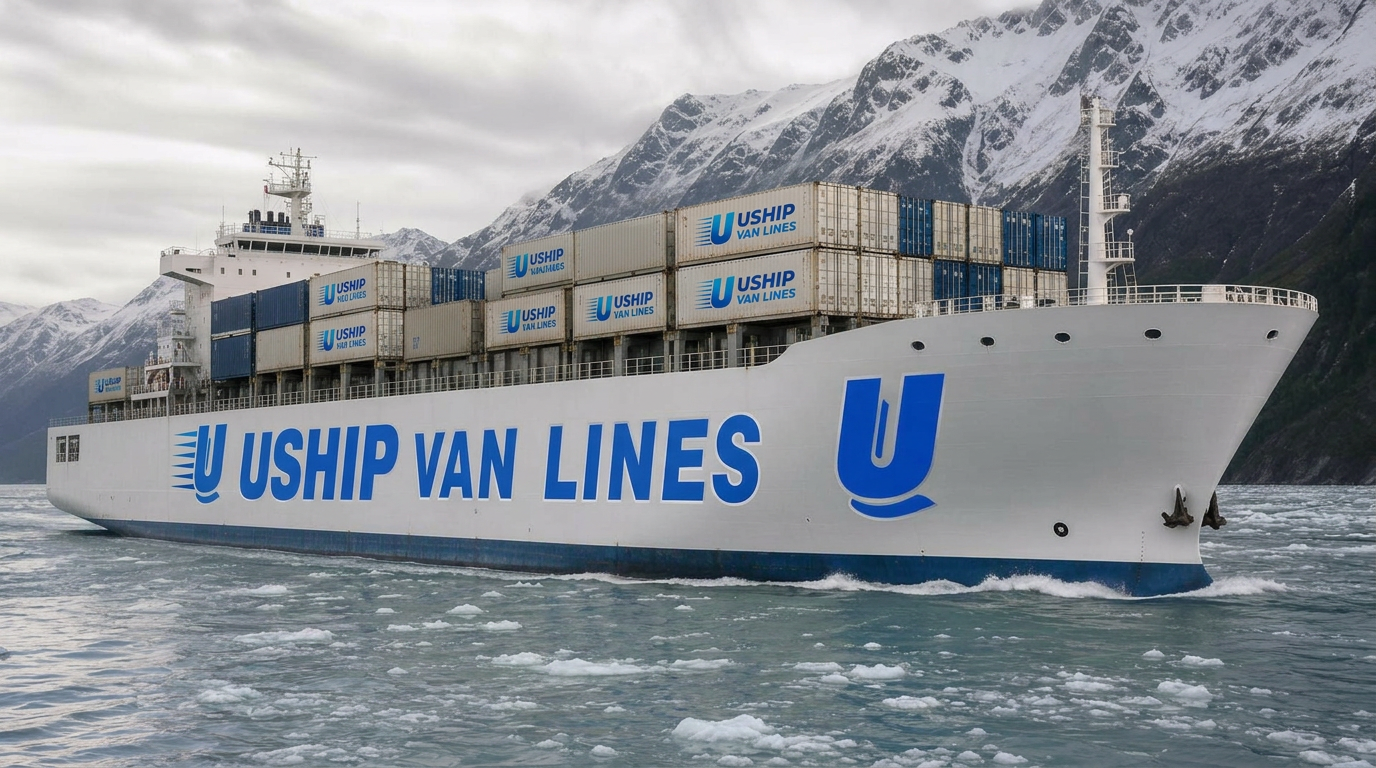
Moving from Alaska to Akron, OH
Moving from Alaska to Akron, OH requires careful coordination of barge transport, overland trucking, and weather-dependent timing. Whether you're relocating from Anchorage, Fairbanks, or the Mat-Su Valley, this 3,500+ mile journey combines maritime shipping through Pacific Northwest ports with cross-country ground transport to northeast Ohio.
Best Alaska & Hawaii Movers, powered by UShip Van Lines, specializes in Alaska-to-Lower 48 relocations with transparent pricing and dedicated coordination. Request your free quote today to start planning your move to Akron's affordable neighborhoods and four-season climate.
Route overview
Alaska to Akron: The Multi-Modal Route
Your household goods travel by truck from anywhere in Alaska to either Anchorage or Fairbanks consolidation points, then by barge from the Port of Anchorage or via the Alaska Marine Highway to Tacoma, WA. From Tacoma, your shipment transfers to a long-haul truck for the 2,400-mile journey across I-90 and I-80 through Montana, Wyoming, South Dakota, Minnesota, Wisconsin, and into Ohio via I-76 to Akron.
This route spans dramatic geography—from Alaska's subarctic terrain through Pacific maritime corridors, across the Northern Plains and Great Lakes region, to Akron's location in the western foothills of the Appalachian Plateau. The Summit County area offers a stark contrast to Alaska with its deciduous forests, humid continental climate, and proximity to Cleveland and Canton.
Akron's cost of living runs 15–25% lower than most Alaska cities, with established neighborhoods in Highland Square, Merriman Valley, and Wallhaven. The move represents both a logistical undertaking and a significant lifestyle shift from Alaska's frontier character to Ohio's Rust Belt heritage and Midwestern accessibility.
How the moving process works
Your Alaska to Akron Moving Process
-
Initial survey and inventory — A coordinator catalogs your belongings via video call or in-person visit (Anchorage/Fairbanks metro areas), noting any oversized items, vehicles, or special handling needs for the 3–4 week journey.
-
Alaska pickup and consolidation — Professional movers load your household at your Alaska residence and transport to our Anchorage or Fairbanks consolidation facility, where your shipment is prepared for barge transport and combined with other Lower 48-bound loads.
-
Barge transport to Tacoma — Your container travels via Alaska Marine Highway System or commercial barge service (typically Totem Ocean Trailer Express or similar carriers) from Whittier, Anchorage, or other Alaska ports to Tacoma, WA—the marine leg takes 5–7 days depending on routing and weather.
-
Port processing and truck transfer — At the Port of Tacoma, your shipment clears receiving, transfers to our long-haul partner network, and loads onto a 53-foot dry van for cross-country transit.
-
Cross-country transport — Your belongings travel I-90 east through Washington, Idaho, Montana, Wyoming, South Dakota, and Minnesota, then I-80/I-76 through Wisconsin and into Ohio—this leg typically takes 4–6 days with planned fuel stops and driver rest periods.
-
Akron delivery coordination — As your truck approaches Ohio, your coordinator confirms delivery window, building access (especially important for Akron's historic apartment buildings and older housing stock), and any last-minute details.
-
Unloading and inspection — Movers unload at your Akron residence, you verify inventory against the original bill of lading, note any damage for insurance purposes, and sign off on delivery completion.
Estimated moving costs
What an Alaska to Akron Move Costs
A 2-bedroom move (approximately 5,000–7,000 lbs) typically ranges $7,800–$12,500 for full-service door-to-door transport. A 3-bedroom home (8,000–12,000 lbs) generally costs $11,500–$17,800. These estimates include Alaska pickup, barge transport, cross-country trucking, and Akron delivery—but final pricing depends on exact weight, origin accessibility, and service level.
Key cost drivers include:
- Origin location — Anchorage and Fairbanks have the most frequent barge schedules and lower last-mile costs; Kenai Peninsula, Mat-Su Valley, and especially bush communities add $800–$2,500+ in positioning fees
- Shipment weight and volume — Barge costs are largely weight-based; every additional 1,000 lbs adds roughly $600–$900 to your total
- Barge schedule and seasonality — Peak summer sailings (May–September) command premium pricing; shoulder seasons offer 12–18% savings but fewer departure options
- Packing services — Professional packing adds $800–$2,200 depending on home size but dramatically reduces damage risk during the multi-leg journey
- Vehicle shipping — Adding a car to your barge container costs $1,800–$3,200 Tacoma-to-Akron; Alaska-to-Tacoma vehicle transport adds another $1,200–$1,900
- Storage needs — If timing between Alaska departure and Akron arrival doesn't align, short-term storage in Tacoma or en route costs $150–$300/month
We provide binding estimates after conducting a thorough inventory—never hidden fees or surprise charges. Request your personalized quote to see exact costs for your specific move configuration.
Estimated transit times
Realistic Alaska to Akron Timelines
Door-to-door transit typically takes 18–28 days from your Alaska residence to your Akron home, though this varies significantly by season, origin point, and barge schedule coordination.
Timeline breakdown:
- Alaska pickup to barge departure: 2–7 days (depends on consolidation needs and your distance from Anchorage/Fairbanks hubs)
- Barge transit to Tacoma: 5–7 days on the water (direct routes faster; AMHS routes with intermediate stops may take 8–10 days)
- Port processing and truck loading: 1–3 days (customs clearance is not required for domestic Alaska shipments, but port logistics and carrier coordination take time)
- Cross-country trucking: 4–6 days Tacoma to Akron (approximately 2,400 miles at regulated driving speeds with mandatory rest stops)
- Delivery window coordination: Your coordinator provides a 2–3 day delivery window once your truck enters Ohio
Scheduling considerations:
Barge sailings from Alaska to Tacoma don't run daily—most carriers operate weekly or bi-weekly schedules during peak season (May–October) and may reduce to monthly service November–April. Book 4–8 weeks ahead to secure your preferred departure date. Winter moves can extend to 35+ days due to weather delays, reduced sailing frequency, and slower road conditions through mountain passes.
Rush service is rarely available for Alaska routes due to the maritime logistics involved, though we can prioritize truck transit once your shipment reaches Tacoma.
Regional logistics
Alaska-Specific Moving Logistics
Port and consolidation infrastructure: Your shipment routes through either Anchorage (Port of Anchorage for commercial freight) or via the Alaska Marine Highway System terminals in Whittier, Homer, or other coastal communities. Most household moves consolidate in Anchorage before barge loading. If you're in Fairbanks or interior Alaska, your goods truck to Anchorage (approximately 360 miles, adding 1–2 days and $600–$1,200).
Vehicle transport options: You can ship your vehicle in a shared container with household goods or via dedicated auto transport. Roll-on/Roll-off (RoRo) barge service from Alaska to Tacoma costs $1,200–$1,900 per vehicle and takes the same 5–7 days. From Tacoma to Akron, open-carrier auto transport adds $800–$1,300; enclosed transport runs $1,400–$2,100. Most customers ship one vehicle and drive another through Canada on the Alaska Highway—a 4–5 day journey offering flexibility and sightseeing.
Restricted and prohibited items: Alaska shipments face standard interstate moving restrictions (hazardous materials, perishables, propane tanks, ammunition) plus specific considerations: opened food containers attract wildlife and pests during consolidation; plants may not survive the 3+ week journey and temperature fluctuations; liquid items must be well-sealed due to pressure changes during barge transport. Frozen goods cannot be accommodated.
Last-mile Alaska considerations: If you're outside Anchorage/Fairbanks metros—in Wasilla, Palmer, Soldotna, Kenai, Homer, or bush communities—your pickup requires specialized coordination. Mat-Su Valley adds minimal fees ($150–$400). Kenai Peninsula locations add $400–$900 depending on exact destination. True bush communities accessible only by air or seasonal road require small-plane freight coordination costing $3–$7 per pound—we help you evaluate whether shipping everything makes financial sense or if selling/storing some items is more practical.
Documentation and timing: No customs paperwork is required for Alaska-to-Lower 48 domestic moves, but you'll complete a detailed household goods inventory and bill of lading. Alaska residents should notify the DMV of your address change and ensure vehicle registration is current if shipping a car. Military members receive specialized coordination for PCS moves under different contract structures.
Seasonal considerations
When to Schedule Your Alaska to Akron Move
Spring (April–May): Shoulder season offers improving weather and increasing barge frequency as operations ramp up after winter. Expect 15–20% lower costs than peak summer but occasional weather delays. Good balance of value and reliability. Alaska highways shed winter ice; Great Lakes region experiences spring thaw conditions that rarely affect major interstates.
Summer (June–August): Peak moving season with maximum barge schedule options—often 2–3 sailings per week from major Alaska ports. Prices are highest (sometimes 20–25% above winter baseline) but transit is most predictable. Ideal if you have firm employment start dates or school enrollment deadlines in Akron. Book 6–8 weeks ahead during this busy period.
Fall (September–October): Excellent moving window with moderate pricing and reliable weather. Barge schedules remain frequent through September, tapering in October. You'll avoid peak-season premiums while still getting good schedule options. Perfect for those with flexibility—expect 12–18% savings versus summer rates.
Winter (November–March): Most economical rates (20–30% below summer peak) but significantly reduced barge schedules—sometimes monthly rather than weekly sailings. Weather can delay both maritime and overland legs. Ice fog in Fairbanks, North Pacific storms, and potential road closures through mountain passes (particularly Snoqualmie and Lookout passes) extend timelines. Only recommended if you have 6+ week flexibility and want maximum cost savings.
Barge schedule reality: Alaska Marine Highway System and commercial barge operators publish seasonal schedules months in advance. We coordinate your entire move around confirmed sailing dates—but weather always takes priority over schedules in Alaska maritime operations.
Why choose Best Alaska & Hawaii Movers
Why Choose Best Alaska & Hawaii Movers for Your Alaska to Akron Move
-
Alaska-specific expertise — We handle the complex maritime logistics, barge scheduling, and last-mile coordination that general moving companies can't support, with established relationships at Alaska ports and consolidation facilities
-
Transparent, binding estimates — Your quote includes all legs of the journey (Alaska pickup, barge transport, cross-country trucking, Akron delivery) with no hidden fees or surprise charges at delivery
-
Single-point coordination — One dedicated coordinator manages your entire multi-modal move from Alaska departure through Akron arrival, eliminating the confusion of dealing with separate barge companies, trucking lines, and local movers
-
Powered by UShip Van Lines' carrier network — We leverage vetted, licensed interstate carriers for your cross-country leg while maintaining direct oversight of the Alaska maritime components
-
Realistic timelines and proactive updates — We set honest expectations about barge schedules and weather variables, then keep you informed at every transition point with tracking updates and delivery window confirmations
-
Comprehensive insurance options — Standard liability coverage plus additional full-value protection options that cover your belongings through all transport modes, including the maritime leg where some carriers limit liability