
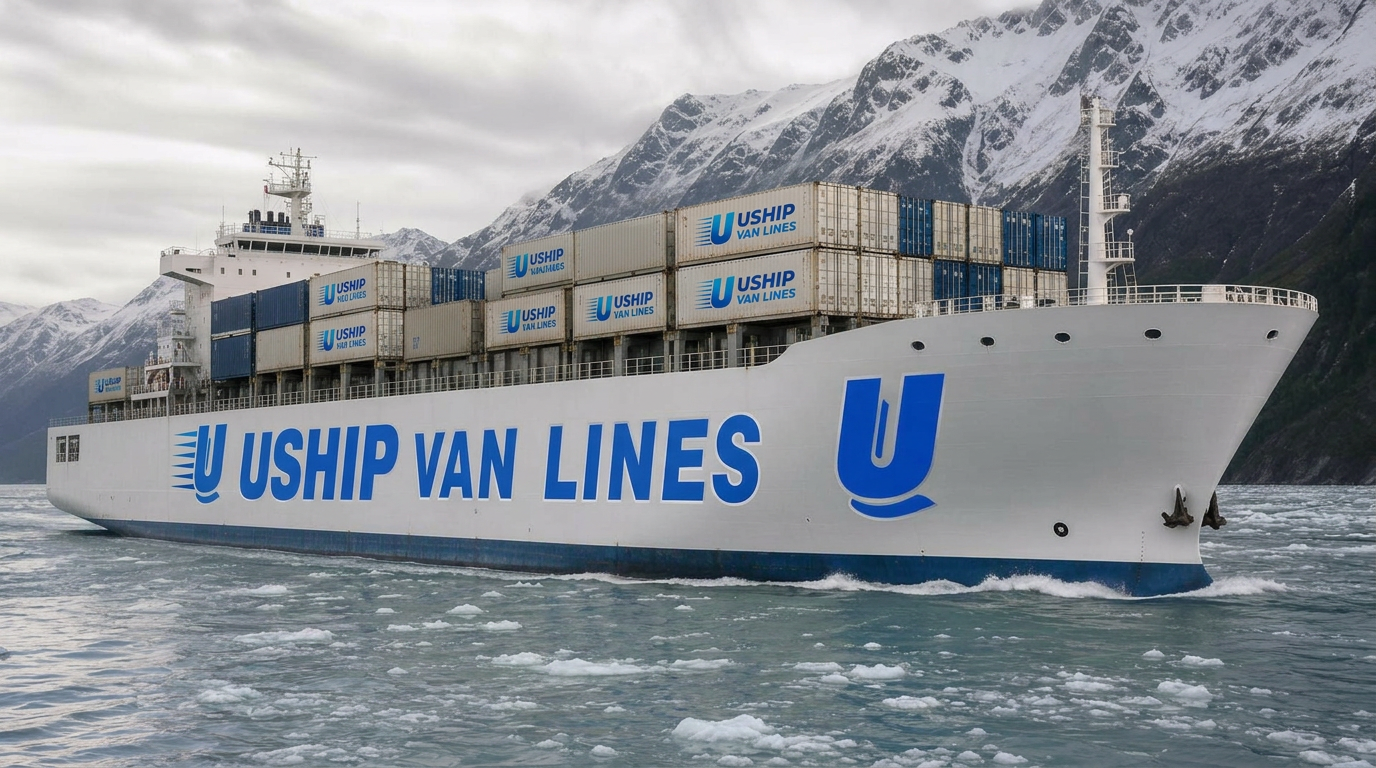
Moving from Alaska to Kenosha, WI
Relocating from Alaska to Kenosha, WI combines the complexity of barge shipping from the Last Frontier with overland transport to southeastern Wisconsin's Lake Michigan shore. Whether you're leaving Anchorage, Fairbanks, or the Mat-Su Valley for Kenosha's manufacturing economy and waterfront lifestyle, this 2,400+ mile journey requires specialized expertise in Alaska logistics.
Best Alaska & Hawaii Movers, powered by UShip Van Lines, coordinates every phase of your Alaska-to-Wisconsin move—from initial barge scheduling through final delivery to your Kenosha neighborhood. Request a detailed quote today to see how we simplify this unique cross-country relocation.
Route overview
Understanding the Alaska to Kenosha Moving Route
Your household goods travel from Alaska via the Port of Anchorage or Whittier to the Port of Tacoma, then across the northern tier states—Washington, Idaho, Montana, North Dakota, Minnesota—before entering Wisconsin and heading southeast to Kenosha. The 2,400-mile highway segment from Tacoma follows I-90 east through Spokane, crosses the Continental Divide, passes through Billings and Fargo, then transitions to I-94 eastbound through the Twin Cities and into Wisconsin. From Madison or Milwaukee, the final leg drops south on I-94 to Kenosha, situated directly on Lake Michigan between Milwaukee and the Illinois border.
This route requires careful synchronization between ocean barge schedules (typically weekly sailings from Anchorage to Tacoma with 5–7 day transit) and long-haul trucking capacity. Kenosha's position in the industrial corridor means good highway access, but winter weather across the northern plains and Upper Midwest can impact delivery schedules from November through March. The barge leg accounts for roughly one-third of total transit time, while the Tacoma-to-Kenosha overland segment adds another 4–6 days depending on season and carrier availability.
Unlike moves within the continental U.S., Alaska relocations face unique constraints: barge departure frequencies, container availability at Alaska ports, customs-style documentation for household goods, and the physical challenges of loading in locations like Fairbanks or Kenai that require trucking to the port. Once cargo reaches Tacoma and clears the terminal, the highway portion follows well-established transcontinental routes, though winter driving conditions through Montana and the Dakotas warrant extra transit buffer days.
How the moving process works
Your Step-by-Step Alaska to Kenosha Moving Process
-
Virtual or In-Home Survey (3–6 Weeks Before Departure): Our coordinator conducts a detailed inventory assessment—virtually for most Alaska locations, or in-person for Anchorage metro customers. We note cubic footage, special items (vehicles, boats, ATVs common in Alaska), and access conditions (apartment vs. house, narrow roads in Mat-Su subdivisions, gravel driveways). You receive a binding or binding-not-to-exceed quote outlining barge fees, overland transport, and any last-mile surcharges for rural Alaska pickup.
-
Barge Reservation and Documentation (2–4 Weeks Out): We reserve container space on the next available Alaska Marine Lines or Tote Maritime sailing from Anchorage/Whittier to Tacoma. You'll complete a household goods declaration (similar to customs forms) listing high-value items and restricted goods. If shipping a vehicle separately, we coordinate auto transport documentation and secure tie-downs. Lead times are critical—peak summer sailings fill weeks in advance.
-
Alaska Pickup and Port Delivery: Professional movers arrive at your Alaska residence (Anchorage, Fairbanks, Wasilla, Soldotna, or other service areas) to load your belongings into a dedicated container or shared LTL space. The truck transports goods to the Port of Anchorage or Whittier terminal, where our port agent oversees container loading onto the barge. Items are secured per maritime standards to withstand ocean transit.
-
Barge Transit to Tacoma (5–7 Days): Your shipment sails south through the Inside Passage or Gulf of Alaska route to the Port of Tacoma. Barges operate year-round but experience weather delays in fall/winter. Real-time tracking updates let you monitor vessel progress. Upon Tacoma arrival, the container is offloaded and cleared through the terminal—typically a 1–2 day process.
-
Overland Loading and Cross-Country Transport: At our Tacoma consolidation facility, your goods transfer to a long-haul semi-truck (or remain in container for intermodal rail/truck). The driver follows I-90 east across Washington, Idaho, Montana, and North Dakota, then I-94 through Minnesota and Wisconsin. This 1,800-mile leg takes 4–6 days, accounting for mandatory rest stops, weather, and routing. GPS tracking provides location updates throughout.
-
Final Delivery to Kenosha: The truck arrives in Kenosha within the pre-arranged delivery window (typically a 2–3 day span). Our crew unloads, places furniture in rooms per your floor plan, and reassembles any items disassembled for the barge leg. We complete a final inventory check and address any questions about unpacking or debris removal.
-
Post-Delivery Support: Within 48 hours, we follow up to ensure satisfaction and process any claims (damage or loss, though rare with our packing standards). You receive digital copies of all bills of lading, inventory sheets, and insurance certificates for your records.
Estimated moving costs
Cost Expectations for Alaska to Kenosha Moves
A typical 2-bedroom household (approximately 5,000–7,000 lbs or 400–600 cubic feet) moving from Alaska to Kenosha generally ranges between $6,800 and $11,500 for full-service door-to-door transport. A 3-bedroom home (8,000–11,000 lbs or 700–1,000 cubic feet) typically runs $10,200 to $16,800. These estimates assume standard packing services, barge container space, and delivery to an accessible Kenosha residence. Prices fluctuate based on exact origin (bush communities cost significantly more than Anchorage), season, and service level.
Major cost drivers include:
- Barge and port fees: Alaska Marine Highway or private barge services charge per cubic foot or by container share. A 20-foot container (partial load) costs $3,000–$5,500; a dedicated 40-foot container runs $7,000–$10,000. Port handling, lashing, and terminal fees at both Anchorage and Tacoma add $600–$1,200.
- Alaska last-mile pickup: Moving from Anchorage or Eagle River incurs standard labor rates. Fairbanks, Mat-Su Valley (Wasilla, Palmer), or Kenai Peninsula locations add 100–300 miles of Alaska trucking at $2.50–$4.50 per mile, plus difficult-access surcharges for remote subdivisions or winter road conditions.
- Overland transport (Tacoma to Kenosha): The 1,800-mile highway segment costs $2,200–$4,000 depending on carrier, season, and whether you choose dedicated vs. consolidated service. Winter moves (November–March) often carry 10–15% premiums due to weather risk.
- Packing and materials: Professional packing for fragile items, dish packs, and wardrobe boxes adds $800–$1,800 for a typical household. Alaska's rough barge transit makes quality packing essential—we use double-walled boxes, extra cushioning, and moisture barriers.
- Insurance: Basic carrier liability (60¢ per lb) is included, but full-value replacement coverage costs an additional 1–2% of declared value (e.g., $200–$500 for $25,000–$50,000 coverage).
- Vehicle shipping: If shipping a car or truck separately, Alaska-to-Kenosha auto transport runs $1,800–$3,200 for open transport, $2,800–$4,500 for enclosed.
Off-season moves (late September through April, excluding holidays) can save 12–18% compared to peak summer rates, though winter weather may extend delivery timelines. Always request a detailed line-item quote—beware of lowball estimates that omit barge fees or fuel surcharges. Best Alaska & Hawaii Movers provides transparent, binding quotes with no hidden fees.
Estimated transit times
Realistic Transit Times: Alaska to Kenosha
Door-to-door delivery from Alaska to Kenosha typically requires 14 to 24 days under normal conditions, with the wide range reflecting seasonal variables and origin location. Here's the breakdown by leg:
Alaska pickup to Port of Anchorage/Whittier (1–3 days): Anchorage and Eagle River pickups can load and deliver to port same-day or next-day. Fairbanks requires 6–8 hours of driving south to Anchorage ports, usually a 1–2 day process. Mat-Su Valley (Wasilla, Palmer) adds a day. Kenai Peninsula (Soldotna, Homer) or more remote areas can add 2–3 days for trucking and staging.
Barge transit to Tacoma (5–7 days): Weekly sailings from Anchorage to Tacoma average 5–6 days in summer, occasionally 7–8 days in rougher fall/winter seas. Barges do not sail daily—if you miss a Friday departure, the next may be the following Wednesday, adding up to 5 days of wait time. Always book early.
Tacoma port processing and overland loading (1–2 days): Container offload, terminal clearance, and transfer to truck or rail typically takes 24–48 hours. Tacoma's efficient port operations minimize delays, but customs-style inspections (random for Alaska goods) can add a day.
Tacoma to Kenosha highway transit (4–6 days): The 1,800-mile drive across I-90 and I-94 averages 4 days in summer with experienced teams. Winter conditions (snow in the Rockies, blizzards in North Dakota/Minnesota, ice in Wisconsin) can stretch this to 6–7 days. Drivers observe DOT hours-of-service limits (11 hours driving, 10 hours off), plus weather holds.
Delivery window scheduling: We provide a 2–3 day delivery window once the truck departs Tacoma. Real-time GPS tracking narrows this to same-day notice as the driver approaches Wisconsin.
Total example: Anchorage pickup on June 1 → port delivery June 2 → barge departs June 3, arrives Tacoma June 8 → overland departs June 9, arrives Kenosha June 13–14. Total: 13–14 days. A Fairbanks winter move might span December 1 pickup → port Dec 3 → barge Dec 5–12 (weather delay) → Tacoma processing Dec 13–14 → overland Dec 15–21 (slow for snow) → Kenosha Dec 22–24. Total: 22–24 days.
Rush service is rarely viable for Alaska moves due to fixed barge schedules, but we prioritize container space and dedicated trucking to minimize delays.
Regional logistics
Alaska-Specific Logistics and Kenosha Delivery Details
Port operations: Most Alaska household goods ship via the Port of Anchorage (primary terminal) or the Port of Whittier (60 miles south, ice-free year-round). Alaska Marine Lines and Tote Maritime dominate barge service to Tacoma. Container loading is strict—maritime lashing standards require goods be secured against 30-degree rolls. Our crews use load bars, padding, and tie-downs exceeding road-only standards. Port of Tacoma (Terminal 18 or 46) receives Alaska barges; goods clear customs-style inspections (rare but possible) before release.
Vehicle shipping: Many Alaska residents ship vehicles separately due to container space constraints. Roll-on/roll-off (RoRo) barge service runs Anchorage–Tacoma for $1,200–$1,800 per car (5–7 day transit). Alternatively, drive the Alaska Highway (1,400 miles Fairbanks–Seattle, 2,200 miles Anchorage–Seattle via Tok/Yukon) and ship household goods only. We coordinate either option. Kenosha delivery includes vehicles if shipped; Wisconsin DMV registration requires title, Alaska emissions exemption docs, and VIN inspection.
Restricted and prohibited items: Alaska moves face unique restrictions. Firearms and ammunition require special ATF documentation and cannot share containers with household goods—ship separately via licensed carriers. Hunting trophies (mounts, hides) need CITES permits if international species. Plants and soil are prohibited from entering Wisconsin without USDA inspection. Hazardous materials (propane, fuel, ammo reloading supplies common in Alaska) cannot travel on barges. We provide a detailed prohibited-items list during booking.
Last-mile Alaska challenges: Bush communities (Bethel, Nome, Kotzebue, Juneau, Ketchikan) accessible only by air or ferry add $2,000–$8,000 in extra costs and 5–14 days transit. Most customers in these areas consolidate belongings, fly essentials, and ship only core furniture/boxes. Fairbanks and Mat-Su Valley require positioning trucks from Anchorage; winter road conditions (ice, moose hazards, limited daylight) necessitate experienced Alaska drivers. Rural properties with long driveways or no turnaround space may need shuttle trucks—disclose access details upfront.
Kenosha delivery specifics: Kenosha's street grid and lakefront neighborhoods are generally accessible for large moving trucks, but historic downtown areas (near HarborPark) and some older residential blocks have narrow streets or low-clearance trees. Notify us if you're moving into a high-rise condo (elevator reservations required) or gated community (access codes/HOA coordination). Wisconsin has no unusual delivery restrictions, and Kenosha's proximity to I-94 simplifies final-mile routing. Winter deliveries may require shoveling pathways or salting steps—our crews come prepared, but homeowner assistance speeds unloading.
Storage options: If your Kenosha residence isn't ready, we offer short-term storage in climate-controlled Tacoma or Wisconsin facilities. Alaska goods often spend 1–3 days in Tacoma anyway during port processing; extended storage runs $150–$350/month for a typical 2-bedroom load. Kenosha has local storage if you need 30+ days, which we can arrange.
Paperwork and documentation: Alaska moves require a detailed household goods inventory (similar to international moves) for barge manifests. We generate this during the survey. You'll sign bills of lading at pickup and delivery, plus a barge release form in Tacoma. Keep copies of insurance certificates, vehicle titles (if shipping), and any high-value item appraisals. Wisconsin doesn't require special destination paperwork, but having Alaska moving docs helps with homeowner's insurance claims if needed.
Seasonal considerations
Seasonal Factors for Alaska to Kenosha Relocations
Summer (May–August): Peak moving season for Alaska departures. Barge space fills quickly—book 4–6 weeks ahead. Weather is optimal for both ocean and highway legs, yielding the fastest, most predictable transit times (14–17 days typical). Rates are highest due to demand, especially late June through early August when school schedules and PCS military moves spike. Kenosha delivery conditions are excellent, though Wisconsin summer heat can stress temperature-sensitive items left in trucks; we monitor this closely.
Fall (September–October): Shoulder season offers moderate pricing (10–15% below summer) and good availability. Barge schedules remain frequent, though Gulf of Alaska storms increase slightly. Highway weather is generally stable until late October. Kenosha sees pleasant fall conditions, making unloading comfortable. This is an ideal window for cost-conscious moves with flexible timing.
Winter (November–March): Alaska's off-season brings the lowest rates (15–20% discounts) but the most logistical challenges. Barge frequency may drop to every 10 days instead of weekly. Severe weather—North Pacific storms, ice in Alaska ports, blizzards across Montana/Dakotas, Wisconsin lake-effect snow—can delay transit by 3–7 days. Anchorage and Fairbanks experience extreme cold (subzero temps), requiring extra care for electronics and liquids. Wisconsin winters are harsh; Kenosha delivery may face driveway ice or narrow snow-cleared streets. We add weather buffer days to quotes and monitor forecasts actively. If you have deadline flexibility, winter moves save money.
Spring (April–May): Transition period with increasing barge frequency and moderate rates. Alaska spring breakup (late April–May) can create muddy access issues in rural areas but is generally manageable. Highway conditions improve rapidly as snowpack melts across the Rockies and northern plains. Kenosha's spring is mild, making delivery straightforward. Booking 3–4 weeks out is usually sufficient.
Alaska-specific notes: Barges operate year-round but reduce frequency November–March. Ice conditions in Cook Inlet (Anchorage port access) rarely halt operations but can delay sailings by 1–2 days. Daylight extremes (midnight sun in summer, limited daylight in winter) affect Alaska loading schedules—summer allows extended work hours; winter shortens them. Always confirm your target moving dates with our team to align barge schedules and weather windows.
Why choose Best Alaska & Hawaii Movers
Why Best Alaska & Hawaii Movers for Your Alaska to Kenosha Relocation
-
Alaska Logistics Expertise: We specialize exclusively in Alaska and Hawaii moves, managing barge schedules, port coordination, and last-mile Alaska pickup (Anchorage to Fairbanks to Mat-Su) that general moving companies avoid or subcontract poorly. Our team understands Cook Inlet tides, Whittier tunnel restrictions, and Alaska Marine Lines container specs.
-
Transparent, All-Inclusive Pricing: Your quote includes barge fees, port handling, overland transport, and delivery—no surprise charges. We break down costs by leg (Alaska pickup, barge, Tacoma-Kenosha highway) so you see exactly where your money goes. Binding estimates protect you from rate hikes.
-
End-to-End Coordination Powered by UShip Van Lines: From your first call through final delivery in Kenosha, a dedicated move coordinator tracks every milestone—barge booking, pickup scheduling, transit updates, delivery confirmation. You're never handed off to multiple subcontractors wondering who's responsible.
-
Proven Wisconsin Delivery Network: Our Midwest partners know I-94 corridors, Wisconsin DOT regulations, and Kenosha's neighborhoods. We've delivered to lakefront condos, suburban subdivisions, and rural Kenosha County properties—experience that ensures smooth final delivery even in winter.
-
Comprehensive Insurance and Accountability: We carry full cargo insurance and offer valuation options up to full replacement cost. Every item is inventoried with bar-coded labels; digital records prevent loss. Our claims process is straightforward and responsive, backed by UShip Van Lines' national resources.
-
Real-Time Tracking and Communication: Monitor your barge's progress via vessel tracking, then switch to GPS truck tracking once goods leave Tacoma. Text/email alerts keep you informed. Our customer service team is reachable 6 days a week, understanding that Alaska time zone differences (AKST is 4 hours behind Central) require flexible availability.