
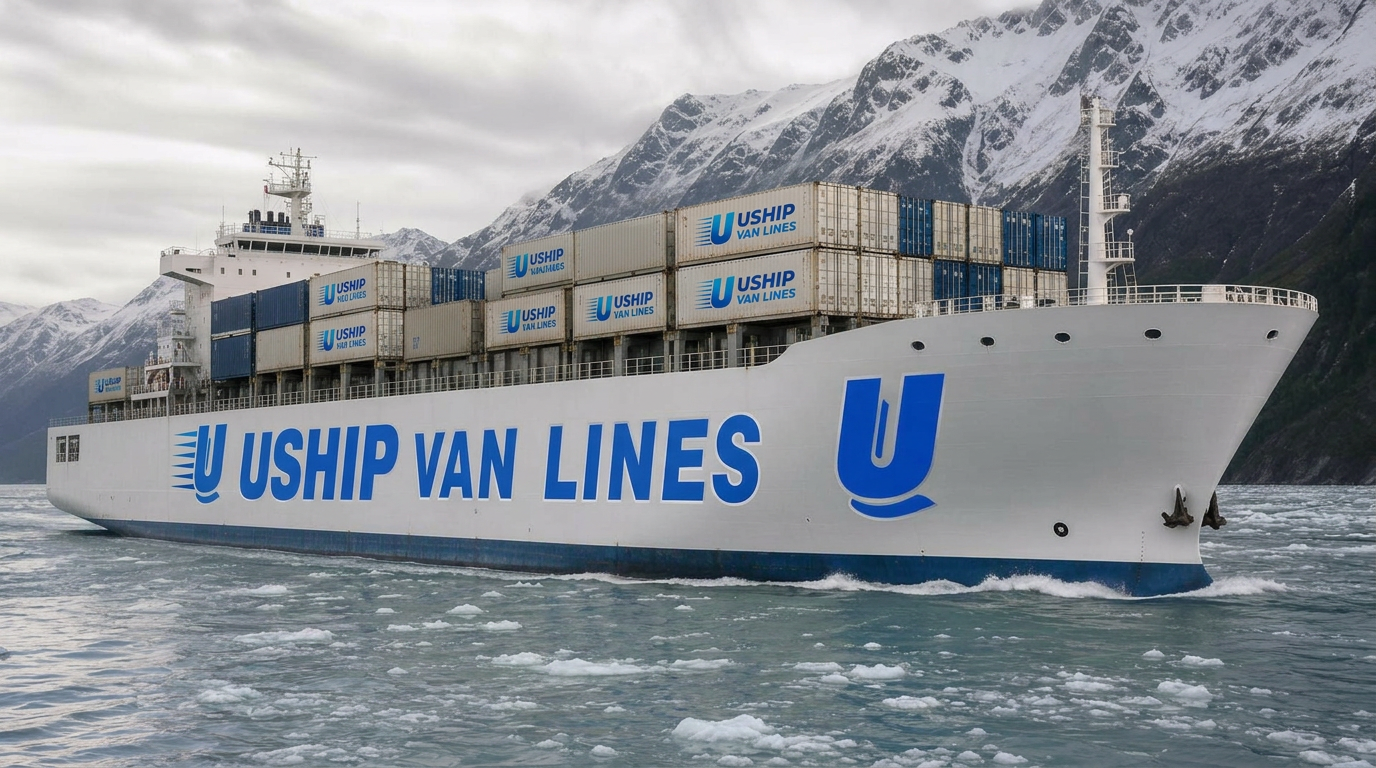
Moving from Alaska to Missouri
Relocating from Alaska to Missouri means coordinating a complex multi-modal move: barge transport from Alaska to the Port of Tacoma, cross-country trucking through the Lower 48, and final delivery to your Missouri destination. Whether you're headed to Kansas City, St. Louis, Springfield, or rural communities in the Show-Me State, this route requires careful planning around Alaska's unique shipping constraints and weather windows.
Best Alaska & Hawaii Movers, powered by UShip Van Lines, specializes in these long-distance Alaska moves. We handle every leg—from pickup in Anchorage, Fairbanks, or the Mat-Su Valley, through barge coordination, to final delivery anywhere in Missouri. Ready to start planning? Request a free quote today and let our team map out your customized move timeline.
Route overview
The Alaska–Missouri Moving Lane
Moving from Alaska to Missouri covers approximately 3,200–3,800 road miles (depending on your origin and destination cities), but the real complexity lies in the initial barge leg. Most Alaska household moves begin with ground transport to the Port of Anchorage or Whittier, where your belongings are loaded onto containers bound for Tacoma, Washington. Once stateside, your shipment transfers to long-haul trucks for the journey across Idaho, Montana or Wyoming, South Dakota or Nebraska, and into Missouri.
Missouri's central location makes it accessible via multiple interstate corridors—I-70 runs east–west through Kansas City, Columbia, and St. Louis, while I-44 serves Springfield and the southwestern corner of the state. Your moving company will select the most efficient route based on your specific origin (Anchorage metro, Fairbanks, Kenai Peninsula, or more remote Alaska locations) and destination (urban centers like Kansas City and St. Louis, or smaller towns across Missouri's diverse landscape).
This route demands expertise in Alaska barge scheduling, container logistics, cross-country trucking coordination, and understanding both Alaska's extreme weather constraints and Missouri's seasonal conditions. Working with a carrier experienced in Alaska moves ensures smooth handoffs between barge lines, trucking partners, and final delivery crews.
How the moving process works
How Your Alaska to Missouri Move Works: Step by Step
-
Free Quote & Planning Consultation – Contact Best Alaska & Hawaii Movers for a detailed estimate. We'll assess your inventory, discuss packing needs, confirm pickup/delivery addresses (including any remote Alaska access challenges), and explain the barge schedule that aligns with your timeline.
-
Pre-Move Survey & Documentation – For larger moves or complex logistics, we conduct a virtual or in-home survey. We'll also review required paperwork for interstate moving and provide guidance on items restricted by barge carriers (hazardous materials, propane tanks, certain chemicals).
-
Packing & Alaska Pickup – Our crew arrives at your Alaska location—whether Anchorage, Fairbanks, Mat-Su, Kenai, or another community—to load your household goods. Items are packed into containers or loaded onto dedicated trucks for transport to the Port of Anchorage or Whittier.
-
Barge Transit to Tacoma – Your container boards an Alaska Marine Lines, TOTE Maritime, or similar barge for the 3–5 day ocean voyage to the Port of Tacoma. Weather, sailing schedules, and port processing add 1–3 days on each end of this leg.
-
Stateside Transfer & Cross-Country Trucking – In Tacoma, your shipment transfers to a long-haul truck. The driver navigates I-90 or I-80 eastward, then south into Missouri via I-29, I-35, or I-70, depending on your destination. This leg typically takes 4–7 days of active driving, plus any necessary rest stops or weather delays.
-
Final Delivery in Missouri – Your belongings arrive at your Missouri home. The crew unloads, places furniture in rooms as directed, and removes packing debris. You'll complete a final walkthrough and sign delivery paperwork.
-
Post-Move Support – If any items require claims or follow-up, Best Alaska & Hawaii Movers coordinates with our insurance partners and handles documentation on your behalf.
Estimated moving costs
What Does It Cost to Move from Alaska to Missouri?
For a typical 2–3 bedroom household (approximately 7,000–10,000 pounds), expect to invest $6,500–$14,000 for a full-service move from Alaska to Missouri. Studio and one-bedroom moves may start around $4,500–$6,500, while large homes (4+ bedrooms, 12,000+ pounds) can exceed $16,000–$20,000.
Key cost drivers include:
- Weight and volume – Movers charge by the pound or cubic foot; heavier, bulkier shipments cost more
- Distance within Alaska – Pickup from Fairbanks, Kenai, or rural areas adds trucking time and fuel surcharges compared to Anchorage metro
- Barge fees – Container space, port handling, and scheduling premiums (especially during summer peak season) significantly impact the total
- Packing services – Full-service packing (materials, labor, specialty crating for fragile items) adds $800–$2,500
- Access challenges – Narrow roads, ferry-dependent communities, or winter ice conditions may require shuttle trucks or additional labor
- Insurance coverage – Basic carrier liability (60 cents/pound) is included; full-value protection costs extra but is highly recommended for long, multi-modal moves
- Storage – If your barge schedule and Missouri delivery window don't align, short-term storage in Tacoma or Missouri costs $150–$400/month
- Seasonality – Summer moves (May–September) command premium rates due to high demand and limited barge capacity; winter moves may qualify for discounts but face weather delays
We never guarantee prices without a detailed inventory and route assessment. Request your free, no-obligation quote from Best Alaska & Hawaii Movers to receive a customized estimate based on your exact needs, timeline, and origin/destination pair.
Estimated transit times
How Long Does an Alaska to Missouri Move Take?
Door-to-door transit from Alaska to Missouri typically requires 14–21 days, though this can stretch to 25+ days during winter or if you're moving to/from remote Alaska locations.
Breakdown by leg:
- Alaska pickup to Port of Anchorage/Whittier: 1–2 days (longer for Fairbanks, Kenai Peninsula, or off-road-system communities)
- Port staging and container loading: 1–3 days (depends on barge line schedules and port congestion)
- Barge sailing to Tacoma: 3–5 days on the water (Alaska Marine Lines and TOTE operate regular but not daily sailings)
- Port of Tacoma offload and transfer: 1–2 days (customs clearance is minimal for domestic Alaska moves, but container handling takes time)
- Cross-country trucking (Tacoma to Missouri): 4–7 days of driving (approximately 2,000–2,200 miles via I-90 and I-70 or I-80 and I-29)
- Final delivery window in Missouri: 1–2 days (scheduling with your crew, unloading, and setup)
Variables that affect timing:
- Barge schedules: Sailings from Alaska are less frequent in winter (roughly weekly vs. multiple times per week in summer)
- Weather delays: Winter storms in Alaska can delay port access; blizzards on the northern plains can slow trucking
- Peak season congestion: Summer moves face longer booking lead times and occasional barge space shortages
- Remote origins/destinations: Bush Alaska communities or rural Missouri locations add days for ground transport
For the most predictable timeline, book your move at least 4–6 weeks in advance and remain flexible with delivery dates. Best Alaska & Hawaii Movers provides tracking updates at each leg so you're never left guessing where your belongings are.
Regional logistics
Alaska-Specific Moving Logistics You Need to Know
Barge Ports & Container Handling: Most Alaska household moves depart via the Port of Anchorage or the Port of Whittier (for Kenai Peninsula and Prince William Sound access). Your moving company consolidates your belongings into 20-foot or 40-foot containers, which are loaded onto Alaska Marine Lines or TOTE Maritime barges. These vessels sail regularly to Tacoma, where your container is offloaded and transferred to a truck chassis for the overland journey to Missouri. You won't handle container logistics directly—your mover coordinates all port paperwork, container seals, and customs documentation.
Vehicle Shipping: If you're driving your car to Missouri via the Alaska Highway, factor in 4–6 days and approximately 2,500 miles from Anchorage to the Lower 48 border, plus another 2,000+ miles to Missouri. Alternatively, ship your vehicle on the same barge as your household goods (typical cost: $1,200–$2,500 per car). Vehicle barge transit mirrors household goods timelines. Ensure your gas tank is below ¼ full, remove all personal items, and provide clear title documentation.
Restricted & Prohibited Items: Barge carriers and federal law prohibit hazardous materials (propane tanks, gasoline, aerosols, paint, cleaning chemicals, ammunition, firearms without proper permits). Perishable foods, plants subject to agricultural inspection, and certain liquids may also be restricted. Your moving company will provide a detailed checklist. Missouri has no additional agricultural inspection beyond standard USDA rules, but if you're transporting plants or soil, declare them upfront.
Remote Alaska & Last-Mile Access: If you're moving from a location not on the road system (e.g., communities accessible only by plane or ferry), your mover will coordinate barge or air freight to Anchorage or another hub, then consolidate your goods into the main container. This adds time and cost but is routine for experienced Alaska movers. Similarly, rural Missouri destinations with narrow roads, long driveways, or limited truck access may require shuttle services—discuss this during your planning call.
Paperwork & Insurance: Interstate moves require a Bill of Lading (your shipment contract), inventory list, and proof of insurance. Alaska moves also involve port documentation (container manifests, barge bills of lading). Your mover handles all regulatory filings. We strongly recommend full-value protection insurance for Alaska moves—the multi-modal journey and extreme weather increase risk compared to straightforward Lower 48 moves. Typical cost: 1–2% of declared shipment value.
Seasonal considerations
Best Time of Year to Move from Alaska to Missouri
Spring (April–May): Shoulder season offers moderate pricing and improving Alaska weather. Snow is melting in Southcentral Alaska, though Fairbanks and Interior locations may still face frost heave and muddy conditions. Barge schedules ramp up as ice clears. Missouri weather is pleasant—mild temperatures, blooming landscapes—but spring storms can bring tornadoes and heavy rain, occasionally delaying final delivery.
Summer (June–August): Peak moving season for Alaska. Barge capacity is at its highest, but so is demand—expect premium pricing and longer booking lead times. Roads in Alaska are fully accessible, daylight is near 24 hours in the Interior, and weather is generally cooperative. Missouri is hot and humid, with temperatures often in the 90s°F; ensure your mover provides climate-controlled trucking if you're shipping temperature-sensitive items. Thunderstorms are common but rarely cause multi-day delays.
Fall (September–October): Excellent shoulder season. Alaska's tourist rush ends, moving rates drop slightly, and weather remains manageable through mid-October (though early snow is possible in Fairbanks and higher elevations). Barge schedules begin to thin out by late October. Missouri enjoys beautiful fall foliage and comfortable temperatures, making delivery straightforward. Book early-fall moves by late August to secure barge space before winter schedules take effect.
Winter (November–March): Off-peak season with the lowest rates, but expect logistical challenges. Alaska experiences extreme cold, limited daylight, and icy roads—Fairbanks and bush communities may be difficult to access. Barge sailings are less frequent (some weeks may have no southbound container service). Once stateside, cross-country trucking faces potential blizzards across the northern tier. Missouri winters are milder than Alaska but can see ice storms and occasional heavy snow. Winter moves require flexibility: build in extra days for weather delays and consider temporary storage if your timeline is tight. Best for cost-conscious movers with flexible schedules.
Why choose Best Alaska & Hawaii Movers
Why Choose Best Alaska & Hawaii Movers for Your Alaska to Missouri Move
-
Alaska Barge Expertise – We coordinate directly with Alaska Marine Lines, TOTE Maritime, and Tacoma port operators, ensuring seamless container loading, sailing schedules, and stateside transfers. No guesswork, no missed connections.
-
Single-Source Accountability – From your Alaska doorstep to your Missouri driveway, one team manages your entire move. You won't be handed off between multiple carriers or left to coordinate barge and trucking separately.
-
Realistic Timelines & Transparent Pricing – We provide honest transit estimates that account for barge schedules, weather windows, and cross-country driving. Our quotes include all major cost components—no surprise fees at delivery.
-
Powered by UShip Van Lines – Backed by a nationwide network of professional drivers, modern equipment, and comprehensive insurance options. We combine local Alaska knowledge with Lower 48 logistics muscle.
-
Customer Support at Every Leg – Track your shipment via phone, email, or online portal. Our team provides updates when your container loads in Alaska, sails to Tacoma, transfers to truck, and departs for Missouri. You're never in the dark.