
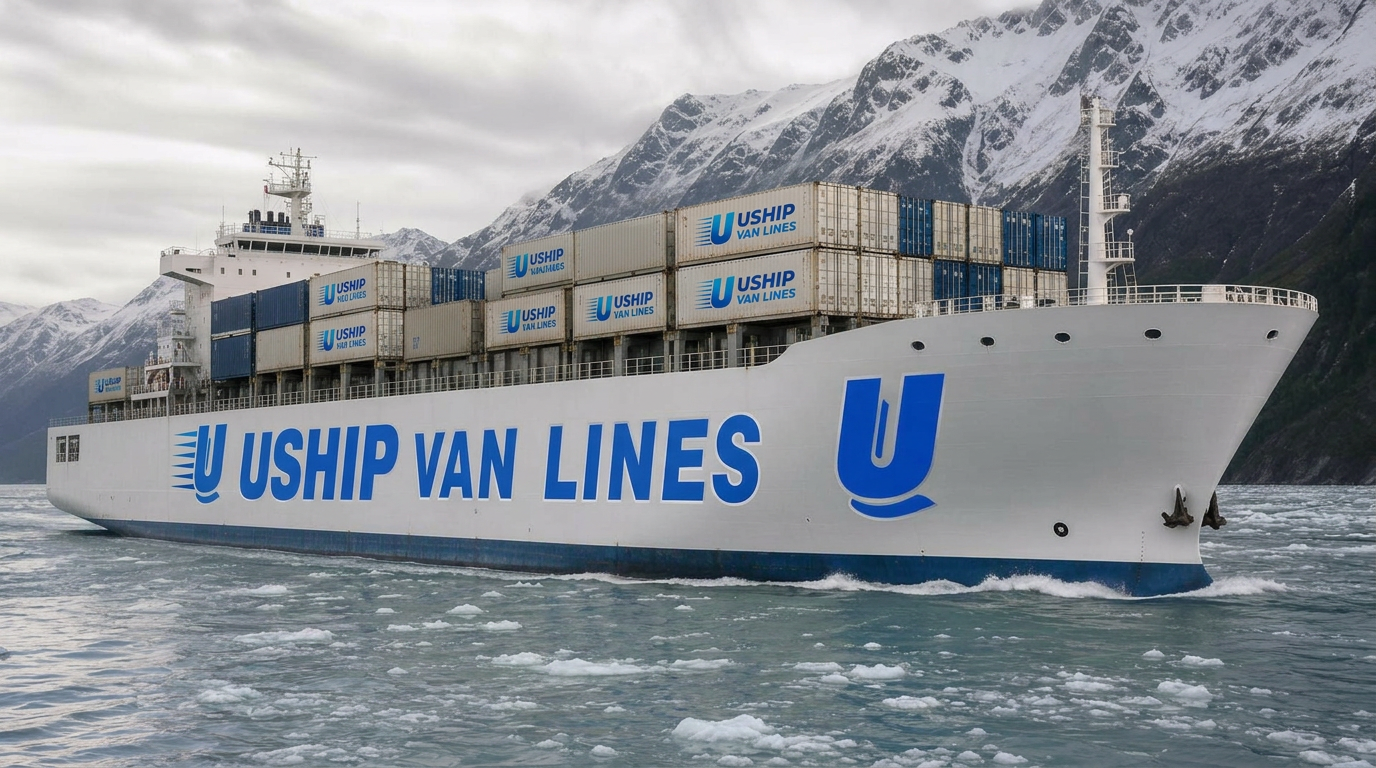
Moving from Alaska to Mississippi
Moving from Alaska to Mississippi represents one of the longest domestic relocations you can make—spanning over 3,500 miles from the Last Frontier to the Magnolia State. This route combines maritime shipping through the Port of Anchorage or Tacoma with overland trucking through the western states and down into the Deep South, requiring careful coordination and experienced logistics management.
Best Alaska & Hawaii Movers, powered by UShip Van Lines, specializes in these complex Alaska-to-Lower 48 moves. Whether you're relocating from Anchorage to Jackson, Fairbanks to Gulfport, or the Mat-Su Valley to Biloxi, we handle the entire multimodal journey—from Alaska pickup through barge transport and final delivery to your Mississippi destination. Ready to start planning your move south? Request a free quote today.
Route overview
Understanding the Alaska to Mississippi Moving Route
The Alaska-to-Mississippi corridor is a low-volume but logistically intricate route that requires specialized moving expertise. Most household goods travel by truck from your Alaska location to either the Port of Anchorage or are consolidated and transported to the Port of Tacoma, where they're loaded onto southbound barges. After ocean transit to Seattle or Tacoma, your belongings transfer to long-haul trucks for the 2,400+ mile overland journey through Idaho, Utah or Wyoming, across the Great Plains, and into Mississippi.
Mississippi's major receiving cities—Jackson, Gulfport, Biloxi, Southaven, and Hattiesburg—are all accessible via Interstate 55, Interstate 20, and Interstate 10 corridors. The state's humid subtropical climate, flatter terrain, and excellent highway infrastructure make final delivery straightforward once your shipment reaches the Lower 48. However, the Alaska departure logistics—particularly seasonal barge schedules, weather delays, and last-mile pickup from remote communities—require careful planning and realistic timeline expectations.
How the moving process works
How Your Alaska to Mississippi Move Works: Step by Step
-
Initial survey and quote: We assess your inventory size, pickup location in Alaska (urban Anchorage/Fairbanks or remote bush community), preferred moving dates, and any special items (vehicles, boats, heavy equipment). You receive a detailed quote reflecting barge freight, overland trucking, and all handling fees.
-
Pre-move preparation and scheduling: Once booked, we coordinate your pickup window around Alaska barge sailing schedules (typically weekly from Anchorage, biweekly from smaller ports). You'll receive packing guidance, inventory checklists, and timelines for each stage of the journey.
-
Alaska pickup and port delivery: Our Alaska-based team picks up your household goods and transports them to the departure port (Anchorage, Whittier, or consolidation in Tacoma). Items are containerized or palletized for barge transport, with full inventory documentation.
-
Barge transit to Seattle/Tacoma: Your shipment sails south, typically taking 5–7 days depending on the specific service and weather conditions. Marine cargo insurance covers this leg of the journey.
-
Port offloading and truck transfer: In the Pacific Northwest, your container is offloaded, cleared through port logistics, and loaded onto a long-haul semi-truck for the cross-country portion.
-
Overland transport to Mississippi: The truck travels I-90 or I-84 eastward, then southward through Mountain West and Plains states, reaching Mississippi via I-55 or I-20. This leg takes 4–6 days of drive time, plus any necessary rest stops.
-
Final delivery and placement: Our delivery team contacts you 24–48 hours before arrival, then unloads and places items in your Mississippi home according to your floor plan. You inspect and sign off on the inventory, noting any damage or discrepancies for insurance purposes.
Estimated moving costs
What Does Moving from Alaska to Mississippi Cost?
For a typical 2–3 bedroom household (8,000–12,000 pounds), expect to invest $8,500–$16,000 for a full-service Alaska-to-Mississippi move. Smaller studio or 1-bedroom loads (3,000–5,000 pounds) may range from $4,500–$7,500, while larger 4+ bedroom homes can exceed $18,000–$25,000.
Key cost drivers include:
- Distance and fuel surcharges: Over 3,500 miles of combined barge and road transport, with current diesel prices significantly impacting overland costs
- Barge freight rates: Alaska maritime shipping is priced per cubic foot or per container, with rates varying seasonally (peak summer rates are 15–25% higher)
- Pickup/delivery accessibility: Remote Alaska locations requiring small-plane or winter-road access add $500–$2,000+; Mississippi's excellent highway network keeps delivery costs moderate
- Shipment weight and volume: Heavier, denser loads cost more for both barge freight and trucking; bulky, low-density items increase cube costs
- Packing services: Professional packing adds $800–$2,500 depending on home size and fragile item quantity
- Vehicle shipping: Adding a car or truck to your barge shipment typically costs $1,200–$2,200 Alaska to Seattle, plus $800–$1,400 for the Seattle-to-Mississippi leg
- Storage: If barge schedules and your Mississippi move-in date don't align, short-term storage in Tacoma or Mississippi runs $150–$400/month
- Insurance valuation: Full-replacement-value coverage adds 1–2% of declared shipment value; basic released-value coverage (60¢/lb/article) is included
We provide written estimates with transparent breakdowns—no hidden fees. Prices are never guaranteed until a formal binding quote is issued after inventory confirmation.
Estimated transit times
How Long Does an Alaska to Mississippi Move Take?
Door-to-door transit typically requires 14–28 days, broken down as follows:
- Alaska pickup to port: 1–3 days (same-day in Anchorage; up to a week for remote bush pickups requiring seasonal road or air access)
- Barge sailing time: 5–7 days from Anchorage to Tacoma/Seattle (direct sailings); add 3–5 days if consolidating freight or using less frequent routes
- Port processing and truck loading: 2–4 days for container offloading, customs clearance (if applicable), and transfer to long-haul carrier
- Overland trucking: 5–7 days of road time from Pacific Northwest to Mississippi, accounting for weather, traffic, and federally mandated driver rest periods
- Final delivery window: 1–2 days for local delivery appointment and unloading
Several factors can extend timelines:
- Seasonal barge schedules: Winter sailings from Alaska are less frequent; some smaller ports suspend service November–March
- Weather delays: Late-season Alaska snowstorms, spring breakup, or Gulf Coast hurricanes can add 2–7 days
- Partial/consolidated loads: If your shipment shares container space, you may wait for sufficient volume before sailing
- Customs or inspection holds: Rare, but agricultural inspections or paperwork issues can delay port release by 1–3 days
We provide tracking updates at each milestone—barge departure, port arrival, truck dispatch, and delivery window—so you're never left wondering where your belongings are.
Regional logistics
Alaska-Specific Moving Logistics You Need to Know
Port and barge logistics: Most Alaska household goods ship through the Port of Anchorage (served by weekly sailings) or are trucked to Tacoma for consolidation. Whittier and smaller ports like Kodiak, Homer, and Seward offer less frequent service. Your belongings are loaded into 20-foot or 40-foot shipping containers or onto pallets wrapped in protective shrink-wrap. Barge lines require detailed inventory manifests and restrict hazardous materials (propane, ammunition, gasoline, certain cleaning chemicals).
Last-mile Alaska pickup: If you're located outside Anchorage/Fairbanks metro areas—Mat-Su Valley, Kenai Peninsula, Southeast Alaska communities, or bush villages—last-mile logistics add time and cost. Accessible road-system communities add modest fees ($200–$600); fly-in-only locations require small aircraft or seasonal ice-road/barge service, significantly increasing costs and limiting timing.
Vehicle shipping: Many Alaska movers drive one vehicle down the Alaska Highway and ship another. Barge shipping a vehicle from Alaska to Seattle costs $1,200–$2,200, then $800–$1,400 Seattle to Mississippi by auto carrier. Driving the AlCan (Alaska-Canada Highway) to Mississippi is 4,000+ miles and takes 7–10 days—factor in fuel ($800–$1,200), lodging, and vehicle wear.
Documentation and regulations: Interstate moves require a detailed inventory, Bill of Lading, and proof of insurance. If shipping vehicles, you'll need title, registration, and potentially emissions documentation for Mississippi registration. Alaska has no state sales tax, but Mississippi charges 5% state sales tax (plus local) on vehicle purchases—pre-owned personal vehicles moved for relocation are exempt.
Mississippi delivery considerations: Mississippi's infrastructure is excellent along major corridors (I-55, I-20, I-10), and most communities are easily accessible. Narrow historic-district streets in cities like Natchez or Oxford may require smaller shuttle trucks for final delivery. Hurricane season (June–November) rarely disrupts deliveries but is worth monitoring if your delivery window falls in August–October.
Seasonal considerations
Best Times to Move from Alaska to Mississippi
Spring (April–May): Barge schedules ramp up after winter, and Alaska roads become fully passable as snow melts and breakup completes. Weather in Mississippi is mild and pleasant for moving. However, spring breakup can temporarily close some rural Alaska roads, and early-season barge demand drives rates upward. This is a moderate-cost, moderate-availability window.
Summer (June–August): Peak Alaska moving season. Barge sailings are most frequent, weather is most predictable, and all roads/ports are fully operational. Mississippi temperatures soar into the 90s with high humidity, making unloading physically demanding—schedule early-morning deliveries if possible. Expect the highest rates of the year (15–30% premium) and book 6–8 weeks ahead to secure preferred dates.
Fall (September–October): Excellent option for cost-conscious movers. Barge rates drop as peak season ends, Alaska weather is still cooperative (though snow arrives by late October in Fairbanks), and Mississippi's fall climate is ideal for moving. Book by mid-August for September moves, as barge frequency decreases in November.
Winter (November–March): Lowest rates and highest availability, but significant logistical challenges. Many Alaska ports reduce sailings or shut down entirely; remote pickups may be impossible until spring. Severe winter weather can delay both Alaska pickup and overland trucking through northern states. Mississippi delivery is straightforward, though occasional ice storms impact I-20 and northern routes. Only recommended if you have flexible timelines and are prioritizing cost savings ($1,500–$3,000 less than summer).
Why choose Best Alaska & Hawaii Movers
Why Choose Best Alaska & Hawaii Movers for Your Alaska to Mississippi Relocation
-
Proven Alaska expertise: We specialize in the unique challenges of Alaska moves—barge coordination, remote pickups, seasonal weather planning, and multimodal logistics that general moving companies simply don't understand.
-
Single-source accountability: Unlike brokers who hand off your shipment to multiple carriers, we manage your entire move from Alaska pickup through Mississippi delivery, with one point of contact and transparent tracking.
-
Transparent, detailed pricing: You'll receive a written estimate breaking down barge freight, overland trucking, fuel surcharges, and any accessorial fees—no surprise charges at delivery.
-
Comprehensive cargo protection: We offer multiple insurance tiers, from basic released-value coverage to full-replacement-value policies, ensuring your belongings are protected throughout the long journey.
-
Powered by UShip Van Lines' network: Our partnership with UShip Van Lines gives us access to vetted carriers, competitive freight rates, and nationwide delivery capabilities, ensuring reliable service even on low-volume routes like Alaska to Mississippi.