
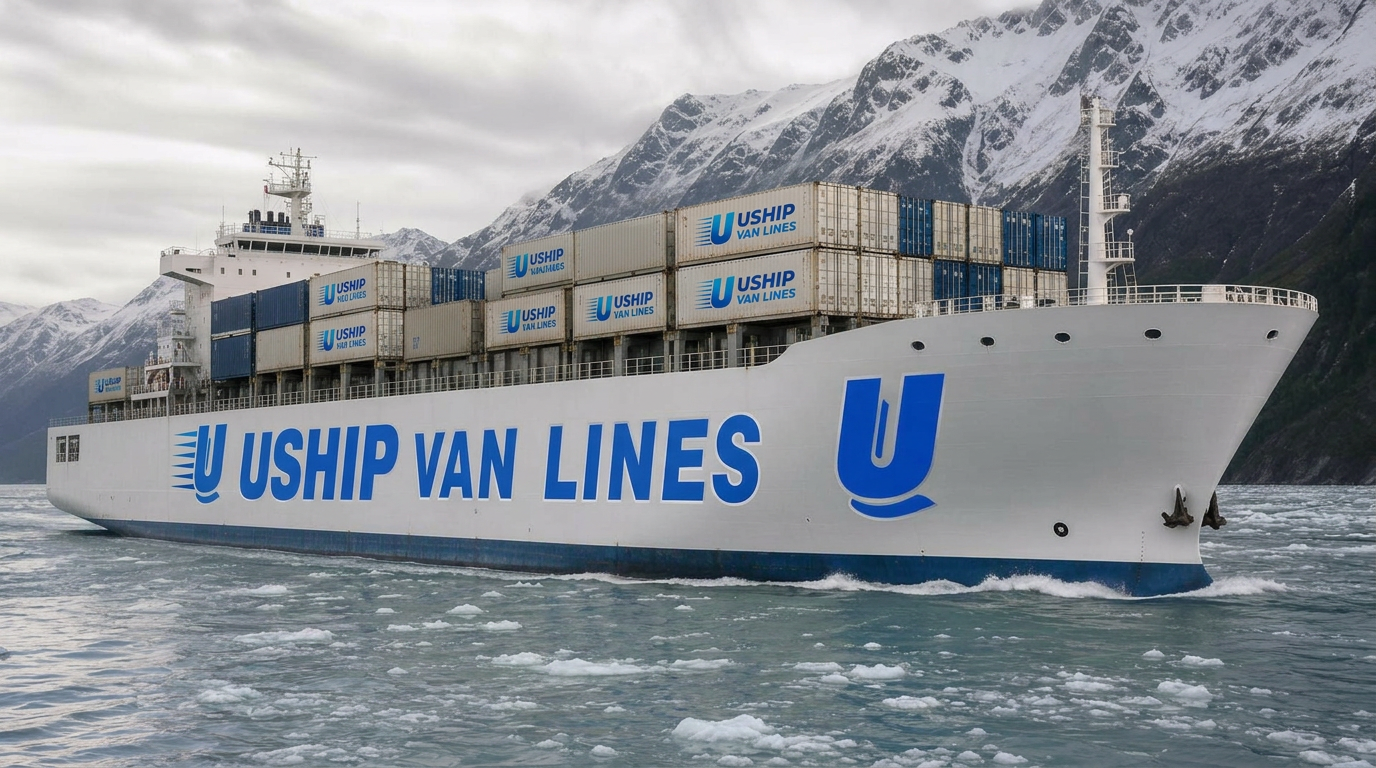
Moving from Arizona to Alaska
Relocating from Arizona's Sonoran Desert to Alaska's rugged wilderness is a dramatic life change—and a complex logistical challenge. Your household goods will travel over 2,500 miles, crossing multiple climate zones and requiring specialized barge transport through the Port of Tacoma to Anchorage, Fairbanks, or other Alaska destinations.
Best Alaska & Hawaii Movers, powered by UShip Van Lines, specializes in this exact route. We coordinate truck pickups across Phoenix, Tucson, Flagstaff, and Mesa, handle all Tacoma barge logistics, and manage last-mile delivery to your new Alaska home—whether that's in downtown Anchorage, the Mat-Su Valley, or beyond the road system. Request your free, customized moving quote today to start planning your journey north.
Route overview
Arizona to Alaska: A Multi-Modal Moving Journey
Moving from Arizona to Alaska requires a carefully coordinated multi-stage process. Your belongings are first loaded onto a moving truck at your Arizona residence—whether you're departing from Phoenix's sprawling metro area, Tucson's desert communities, or smaller towns like Prescott or Yuma. The truck then travels northward through the Western corridor, typically via Interstate 17, I-40, and I-5 to reach the Port of Tacoma in Washington state.
From Tacoma, your household goods are loaded into secure ocean freight containers and placed aboard Alaska Marine Lines (AML) or TOTE Maritime barges bound for Alaska. This maritime leg typically takes 5–7 days to reach the Port of Anchorage. Upon arrival, containers are offloaded, cleared through customs if necessary, and then transferred to local Alaska moving trucks for final delivery to destinations throughout Southcentral Alaska, the Interior (Fairbanks), Kenai Peninsula, or even remote bush communities via specialized carriers.
This route represents a complete climate transition—from Arizona's arid heat (often 100°F+ in summer) to Alaska's subarctic conditions (which can reach -40°F in winter). Proper packing, climate-controlled options for sensitive items, and understanding seasonal shipping windows are critical to a successful Arizona-to-Alaska relocation.
How the moving process works
How Your Arizona to Alaska Move Works: Step-by-Step
-
Free In-Home or Virtual Survey: We assess your household inventory via video walkthrough or in-person visit across Arizona. We identify special-handling items (electronics, artwork, musical instruments), discuss Alaska-specific restrictions (firearms regulations, hazardous materials, propane tanks), and provide a detailed written estimate.
-
Arizona Pickup & Packing: Professional movers arrive at your Arizona home on your scheduled date. We pack fragile items using industry-grade materials, disassemble furniture, and load your belongings into our truck. Phoenix-area moves typically schedule early morning to avoid peak heat; rural Arizona pickups may require additional travel coordination.
-
Overland Transport to Tacoma: Your shipment travels approximately 1,400 miles north to the Port of Tacoma, Washington. Transit typically takes 3–5 days depending on routing and consolidation schedules. Shipments are held in our secure Tacoma warehouse while awaiting the next available barge sailing.
-
Containerization & Barge Loading: Your household goods are loaded into 20-foot or 40-foot ocean freight containers (depending on shipment size), properly secured with strapping and bracing, and delivered to the barge terminal. AML barges depart Tacoma 2–3 times weekly year-round, though schedules vary seasonally.
-
Ocean Transit to Alaska: The barge voyage from Tacoma to Anchorage takes 5–7 days through the Inside Passage and Gulf of Alaska. Containers remain sealed throughout the journey, protecting your belongings from salt air and weather.
-
Port of Anchorage Arrival & Clearance: Upon docking, containers are offloaded and processed through port operations. If you're shipping vehicles, firearms, or other regulated items, additional customs/regulatory clearance may be required (typically 1–2 business days).
-
Alaska Last-Mile Delivery: Your container is transferred to a local Alaska moving truck for final delivery. Anchorage-area deliveries often occur within 1–3 days of port arrival. Fairbanks (358 miles north) adds 1–2 days. Remote Kenai Peninsula, Mat-Su Valley, or off-road-system destinations may require specialized equipment, bush planes, or winter ice-road access depending on location and season.
-
Unpacking & Setup: Our delivery team unloads, places furniture in designated rooms, reassembles items, and removes packing debris. We conduct a final walkthrough to ensure everything arrived in good condition and address any concerns immediately.
Estimated moving costs
What Does It Cost to Move from Arizona to Alaska?
A typical 2–3 bedroom household moving from Arizona to Alaska generally costs $6,500–$14,000 for full-service door-to-door transport. Studio or 1-bedroom moves may range $4,000–$7,000, while larger 4+ bedroom homes can exceed $15,000–$22,000.
Key cost drivers for this route include:
- Shipment volume: Charged by cubic feet or container space (20-ft containers hold roughly 1,000–1,200 cubic feet; 40-ft containers accommodate 2,200–2,400 cubic feet). Arizona homes with extensive garage storage, outdoor equipment, or large furniture inventories increase costs.
- Packing services: Full professional packing adds $800–$2,500 depending on home size. Fragile-only or partial packing reduces this cost. DIY packing saves money but requires Arizona-appropriate materials (rigid boxes that won't collapse in humidity during transit).
- Barge schedule & seasonality: Peak summer season (May–August) sees higher demand and pricing. Winter moves (November–March) may offer lower rates but face weather delays and reduced barge frequency.
- Alaska destination: Anchorage delivery is standard. Fairbanks adds $800–$1,800. Kenai Peninsula, Mat-Su Valley, or remote locations add $1,200–$4,000+ depending on accessibility. Bush communities requiring air freight can add $3–$8 per pound.
- Vehicle shipping: Cars/trucks shipped via the same barge route typically cost $1,200–$2,200 per vehicle (Tacoma to Anchorage). Oversized vehicles, RVs, or boats incur higher fees.
- Storage: If your Alaska home isn't ready, Anchorage-area storage costs $150–$400/month for typical household volumes. Tacoma-side storage (while awaiting barge sailing) is usually included for 7–14 days.
- Insurance: Basic carrier liability (60 cents/pound) is included; full-value replacement coverage adds 1–3% of declared shipment value.
We never guarantee prices without a detailed inventory review. Arizona homes vary dramatically—a 2-bedroom Phoenix condo differs vastly from a Tucson house with workshop and desert landscaping equipment. Request a free quote for an accurate, obligation-free estimate tailored to your specific move.
Estimated transit times
How Long Does Moving from Arizona to Alaska Take?
Door-to-door transit from Arizona to Alaska typically requires 14–28 days, though timelines vary by season, barge schedules, and final Alaska destination.
Typical timeline breakdown:
- Arizona pickup to Tacoma warehouse: 3–5 days overland truck transit
- Tacoma staging: 2–7 days waiting for next available barge departure (longer during off-peak winter months when sailings are less frequent)
- Tacoma to Anchorage barge voyage: 5–7 days ocean transit
- Anchorage port processing: 1–3 days for container offload, clearance, and transfer to local delivery truck
- Final Alaska delivery: Same-day to 5 days depending on destination (Anchorage metro: 1–2 days; Fairbanks: 2–3 days; Kenai/Homer: 2–4 days; remote locations: 3–7+ days)
Seasonal factors:
- Summer (May–August): Peak moving season. Barge schedules are most frequent (2–3 departures weekly), but demand is highest. Book 4–6 weeks ahead. Expect timelines at the shorter end (14–21 days).
- Spring/Fall (April, September–October): Moderate schedules and pricing. Good balance of availability and transit speed (18–25 days typical).
- Winter (November–March): Reduced barge frequency (sometimes 1–2 departures weekly). Weather delays in the Gulf of Alaska can add 2–5 days. Budget 21–28+ days. However, pricing is often 10–20% lower than summer.
Off-road-system Alaska destinations (accessible only by plane, boat, or winter ice roads) may add significant time. Villages in the Bush, Aleutian Chain, or Southeast Alaska require coordination with bush carriers and can extend total transit to 4–8 weeks depending on weather and logistics.
For firm delivery date commitments (starting a job, closing on a home), we recommend building in a 7–10 day buffer beyond the estimated delivery window, especially for winter moves or remote destinations.
Regional logistics
Alaska-Specific Moving Logistics: What Arizona Movers Need to Know
Port Operations & Barge Scheduling
All Arizona-to-Alaska household moves route through the Port of Tacoma, Washington. Alaska Marine Lines (AML) and TOTE Maritime operate regular barge service to Anchorage, with AML also serving Kodiak, Dutch Harbor, and Southeast Alaska ports. Sailings are scheduled 2–3 times weekly in summer, less frequently in winter. Your shipment is containerized in Tacoma (20-ft or 40-ft containers) and sealed for the ocean voyage. Barge booking cutoffs are typically 48–72 hours before sailing—missing a cutoff means waiting for the next departure.
Vehicle Shipping
Most Arizona-to-Alaska movers ship at least one vehicle via the same barge route. Cars, trucks, SUVs, and motorcycles are driven onto the barge (roll-on/roll-off service) or placed in containers. Cost: $1,200–$2,200 Tacoma to Anchorage. Vehicles must be clean (Alaska agriculture inspection), have less than 1/4 tank of fuel (safety regulations), and cannot contain personal belongings (customs rules). Arizona vehicles do not need modifications, but Alaska's dark winters mean headlight aim/quality matters, and remote areas require winter tires/studs. You can drive your vehicle to Tacoma yourself and drop at the port, or arrange for us to transport it from Arizona.
Restricted & Prohibited Items
Alaska and federal maritime law prohibit certain items on barges:
- Hazardous materials: Propane tanks (must be purged/certified or discarded), gasoline, paint, aerosols, cleaning chemicals, ammunition
- Perishable food: Refrigerated/frozen items won't survive 2+ week transit
- Plants: Alaska has strict invasive species laws; many houseplants are prohibited or require USDA inspection
- Firearms: Allowed but require declared inventory and comply with Alaska/federal transport regulations
Arizona-specific items like evaporative coolers, outdoor misters, and desert landscaping equipment are fine to ship but may be irrelevant in Alaska's climate. Many movers sell/donate these before departure.
Last-Mile Alaska Delivery Challenges
Anchorage, Wasilla/Palmer (Mat-Su Valley), Eagle River, and Kenai Peninsula communities (Soldotna, Kenai, Homer) are accessible year-round via paved roads—delivery is straightforward. Fairbanks (358 miles north via the Parks Highway) adds 1–2 days and $800–$1,800 to delivery costs. Remote locations present challenges:
- Bush communities (Bethel, Kotzebue, Nome, Barrow): No road access. Requires air freight ($3–$8/lb) or seasonal barge service (summer only for most villages).
- Southeast Alaska (Juneau, Ketchikan, Sitka): Accessible only by ferry or plane. Requires separate barge routing via Seattle/Prince Rupert.
- Winter ice roads: Some remote areas (North Slope, Interior villages) are accessible only in winter via frozen-river ice roads (December–March).
We coordinate all last-mile logistics and provide realistic delivery windows based on your specific Alaska destination.
Customs & Documentation
Alaska is a U.S. state—no international customs. However, vehicles and certain items (firearms, large cash amounts, commercial goods) require documentation. Our team handles all barge paperwork: bills of lading, port delivery orders, and container manifests. You'll receive tracking updates at each stage (Tacoma arrival, barge sailing, Anchorage port arrival, out-for-delivery).
Climate Transition Packing
Arizona's bone-dry climate (10–20% humidity) contrasts sharply with Alaska's moderate humidity (50–70% in coastal areas). Electronics, leather furniture, and wood items that have acclimated to Arizona dryness may expand slightly in Alaska's moisture. Proper packing with moisture barriers and climate-neutral storage (avoiding direct heat/cold exposure in Tacoma warehouse) minimizes issues. We use breathable packing materials and avoid plastic wrap that traps condensation.
Seasonal considerations
Best Time to Move from Arizona to Alaska: Season-by-Season Guide
Summer (May–August): Peak Season
Summer is the busiest—and most expensive—time to move to Alaska. Arizona families often time relocations with school breaks, and Alaska's construction/tourism industries drive peak demand. Barge schedules are most frequent and reliable (2–3 weekly sailings), and Alaska road conditions are optimal for deliveries anywhere in the state. However, expect premium pricing (15–25% above winter rates) and book 6–8 weeks in advance. Phoenix summer heat (110°F+) requires careful scheduling of pickup days to protect heat-sensitive items and moving crews. Anchorage enjoys 18+ hours of daylight and mild temps (55–70°F), making unpacking pleasant.
Spring (April–early May): Shoulder Season
Spring offers a sweet spot: Arizona weather is comfortable (70–85°F), barge schedules are ramping up to summer frequency, and pricing is 10–15% below peak. Alaska is transitioning from winter—Anchorage is usually snow-free by late April, but Interior Alaska (Fairbanks) and remote areas may still have lingering snow/mud. Mat-Su Valley and Kenai Peninsula back roads can be soft/muddy (
Why choose Best Alaska & Hawaii Movers
Why Choose Best Alaska & Hawaii Movers for Your Arizona to Alaska Move
-
Alaska Specialists, Not Generalists: We focus exclusively on moves to/from Alaska and Hawaii. We know the Port of Tacoma barge schedules, Alaska Marine Lines container requirements, Anchorage port procedures, and last-mile Alaska delivery challenges intimately—because that's all we do. Mainland-only movers treat Alaska as an afterthought; we treat it as our core expertise.
-
Single-Source Coordination, Zero Runaround: You get one point of contact from Phoenix pickup through Anchorage delivery. We coordinate the truck, the barge booking, the port logistics, and the Alaska last-mile carrier. No finger-pointing between multiple vendors when questions arise—we own the entire process and keep you informed with proactive updates at every stage.
-
Realistic Timelines & Transparent Pricing: We never overpromise. Our quotes include detailed line-item breakdowns (truck, barge, delivery, fuel, Alaska-specific fees) with realistic transit windows based on current barge schedules. No surprise charges for