
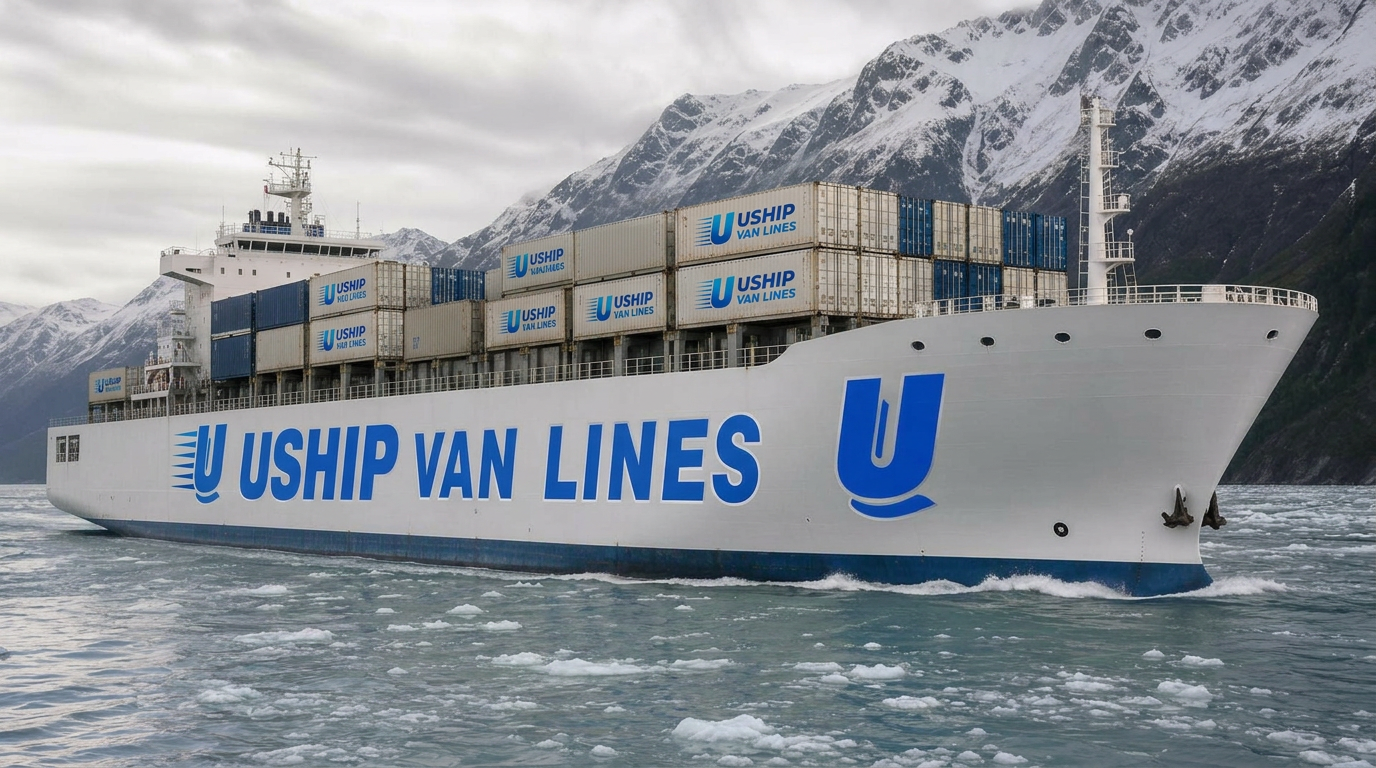
Moving from Alaska to Minnesota
Relocating from Alaska to Minnesota means coordinating a complex multi-modal move: barge transport from your Alaska community to the Port of Tacoma, overland trucking through the Pacific Northwest and Northern Plains, and final delivery to your Minnesota destination. Whether you're leaving Anchorage, Fairbanks, the Mat-Su Valley, or a more remote Alaska location, this journey requires specialized logistics expertise and careful planning.
Best Alaska & Hawaii Movers, powered by UShip Van Lines, manages every leg of your Alaska-to-Minnesota move—from scheduling barge shipments and containerization to coordinating seamless overland transport across more than 2,500 miles. Request your free, no-obligation quote today to receive a detailed timeline and cost breakdown tailored to your specific route and household size.
Route overview
Understanding the Alaska to Minnesota Moving Route
Your belongings travel from Alaska via ocean barge to the Port of Tacoma, Washington, then transfer to long-haul trucks for the overland journey east through Idaho, Montana, and North Dakota into Minnesota. This multi-stage route typically spans 2,800–3,200 miles depending on your specific origin in Alaska (Anchorage, Fairbanks, Kenai Peninsula, or bush communities) and your final Minnesota destination (Minneapolis-St. Paul metro, Duluth, Rochester, or outstate locations).
The Alaska leg requires specialized knowledge of barge schedules, container loading procedures, and port logistics at both Anchorage and Tacoma. Most Alaska shipments consolidate at the Port of Anchorage or Whittier before the 60–72 hour ocean voyage. Once your container reaches Tacoma, it's unloaded, customs-cleared if necessary, and transferred to a commercial moving truck for the 5–7 day overland haul to Minnesota.
Timing, weather, and barge availability heavily influence this route. Summer months (May–September) offer the most frequent barge sailings and optimal road conditions, while winter moves face potential delays from Alaska weather, reduced sailing schedules, and challenging road conditions through mountain passes and the northern Plains states.
How the moving process works
How Your Alaska to Minnesota Move Works: Step by Step
-
Initial consultation and survey – Your move coordinator conducts a detailed inventory (virtual or in-home in major Alaska cities) to assess volume, special items (vehicles, boats, ATVs), and any shipping restrictions. You'll receive a binding or binding-not-to-exceed estimate.
-
Barge scheduling and container booking – We reserve your spot on the next available barge sailing from Alaska to Tacoma, typically 1–3 weeks out during peak season, potentially 4–6 weeks in winter. Your coordinator confirms container size (20-foot or 40-foot) and pickup timing.
-
Alaska pickup and container loading – Professional movers arrive at your Alaska home, pack and load your household goods into the container (or you can pack yourself for cost savings). The loaded, sealed container is transported to the Port of Anchorage or Whittier for barge loading.
-
Ocean barge transit – Your container sails from Alaska to the Port of Tacoma, a journey of 60–72 hours in good weather. Barge lines include TOTE Maritime and Alaska Marine Lines, with sailings 1–3 times weekly in summer, less frequently in winter.
-
Tacoma port processing and truck transfer – At Tacoma, your container is offloaded, processed through port logistics, and transferred to a long-haul moving truck. This port dwell typically takes 2–4 business days.
-
Overland transport to Minnesota – Your shipment travels by commercial truck east through Washington, Idaho, Montana, and North Dakota into Minnesota. Transit time is 5–7 days depending on weather, route, and driver hours-of-service regulations.
-
Minnesota delivery and unloading – Movers deliver to your new Minnesota address, unload all items, and remove packing materials. You inspect and sign off on the delivery inventory, noting any damage claims immediately for insurance purposes.
Estimated moving costs
What Does It Cost to Move from Alaska to Minnesota?
A typical 2–3 bedroom household move from Alaska to Minnesota ranges from $6,800 to $14,500 depending on shipment volume, origin/destination accessibility, season, and service level. Studio or 1-bedroom apartments may cost $4,200–$7,500, while larger 4+ bedroom homes can exceed $16,000–$22,000.
Key cost drivers include:
- Distance and volume – You're shipping 2,800+ miles with multi-modal logistics; cost is primarily weight/volume-based
- Barge fees – Ocean freight from Alaska ports to Tacoma adds $1,800–$4,200 depending on container size and season
- Alaska accessibility – Remote locations, bush communities, or locations requiring additional ferry/air service add $800–$3,500
- Packing services – Full professional packing adds $900–$2,400; fragile-only or partial packing reduces costs
- Season and timing – Summer peak season (June–August) commands 15–25% premiums; winter moves may offer discounts but face delay risks
- Vehicle shipping – Adding a car/truck to your barge shipment costs $1,200–$2,800 Anchorage to Seattle, plus $800–$1,400 overland to Minnesota
- Storage – If you need temporary storage in Tacoma or Minnesota, expect $150–$400/month depending on volume
- Insurance – Basic coverage is included; full-value protection adds 1–3% of declared shipment value
Best Alaska & Hawaii Movers provides transparent, itemized quotes with no hidden fees. Request your personalized estimate to understand exactly what your move will cost based on your specific inventory and timing preferences.
Estimated transit times
How Long Does an Alaska to Minnesota Move Take?
Door-to-door transit from Alaska to Minnesota typically requires 14–28 days, broken down by leg:
Alaska pickup to barge departure: 1–7 days depending on your location and the next available sailing. Anchorage/Wasilla residents may load and ship within 2–3 days during peak season; remote areas or winter scheduling can extend this to 7–14 days.
Ocean barge transit (Alaska to Tacoma): 3–4 days of sailing time in typical weather. Storms or mechanical issues can add 1–2 days, though uncommon.
Tacoma port processing: 2–4 business days for offloading, customs clearance (if applicable), and truck transfer. Peak season congestion or container backlogs can extend this to 5–7 days.
Overland trucking (Tacoma to Minnesota): 5–7 days for the 1,800-mile truck haul. Winter weather in Montana/North Dakota or holiday periods may add 1–3 days.
Delivery window: Most carriers provide a 1–3 day delivery window once your shipment is dispatched from Tacoma.
Total realistic timeline: Book your move 3–5 weeks before your desired Alaska pickup date. Plan for 3–4 weeks door-to-door transit. Always allow buffer time—Alaska logistics are inherently less predictable than Lower 48 moves due to weather, barge schedules, and multi-modal complexity.
Regional logistics
Alaska-Specific Moving Logistics You Need to Know
Port and barge considerations: The Port of Anchorage handles most Alaska shipments, with Whittier serving as an alternate for certain routes. Your mover coordinates container delivery to the port, barge line booking (TOTE Maritime and Alaska Marine Lines are primary carriers), and ensures proper documentation. Container size depends on household volume—20-foot containers suit 1–2 bedrooms; 40-foot containers accommodate 3+ bedrooms or vehicle combinations.
Vehicle shipping: Shipping your car/truck is almost always more economical than driving the Alaska Highway (ALCAN) when factoring fuel, lodging, vehicle wear, and time. Vehicles ship in the same barge container or in dedicated vehicle space. Drain fluids to 1/4 tank, remove personal items, and ensure the vehicle is operational (or declare it inoperable for special handling). Expect $2,000–$4,200 total for vehicle shipping Alaska to Minnesota.
Remote and bush location access: If you're moving from communities not connected by road (Bethel, Nome, Kotzebue, Kodiak, etc.), your shipment requires bush plane or ferry service to Anchorage before barge loading. This adds $1,200–$5,000+ and extends timelines by 7–14 days. Discuss logistics early with your coordinator.
Customs and documentation: Moving household goods from Alaska to the Lower 48 does not require customs (both are U.S. territory), but you'll complete standard inventory documentation for insurance and tracking. If you're shipping vehicles, ensure title and registration are accessible. Active military members may have additional documentation for PCS moves.
Prohibited and restricted items: Barge and interstate regulations prohibit hazardous materials (propane, ammunition, gasoline, paint, aerosols), perishable foods, and plants with soil. Firearms must be declared, unloaded, and packed per federal regulations. Coordinate any special items (safes, pianos, antiques) during your initial survey.
Insurance and claims: Standard released-value coverage (60 cents/pound/article) is included but offers minimal protection. Full-value protection costs 1–3% of declared value but covers repair/replacement. Document high-value items with photos and appraisals. File any damage claims within 9 months, preferably within days of delivery.
Seasonal considerations
Best Time to Move from Alaska to Minnesota
Summer (May–September): Peak moving season offers maximum barge frequency (3–5 sailings/week), best weather, and fastest transits. Expect premium pricing (10–25% higher) and tight capacity—book 4–6 weeks ahead. Ideal for families moving between school years. Road conditions are excellent through Canada and the northern U.S.
Fall (October–November): Shoulder season with moderate pricing and good availability. Barge schedules reduce slightly (2–3 sailings/week). Early snow in Alaska mountain passes or Montana/North Dakota can begin affecting timelines by late October. Good balance of cost and reliability.
Winter (December–March): Off-peak season offers lowest pricing (15–30% discounts possible) but highest risk. Barge sailings drop to 1–2/week or less. Severe Alaska weather can delay pickups; winter storms in Montana, North Dakota, and Minnesota can strand trucks for days. Only recommended if you have flexible timelines and can tolerate 4–6 week potential delays. Not ideal for temperature-sensitive items.
Spring (April–early May): Transition season as barge schedules ramp up. Pricing begins rising toward summer rates. Breakup season in Alaska (late April–May) brings muddy conditions and occasional road closures. Montana/Dakotas can still see late blizzards. Generally reliable with moderate pricing if you avoid peak breakup weeks.
Recommendation: Book May–June or September for the best balance of reliability, weather, and cost. Avoid December–February unless budget is your primary concern and you can absorb significant schedule uncertainty.
Why choose Best Alaska & Hawaii Movers
Why Choose Best Alaska & Hawaii Movers for Your Alaska to Minnesota Move
-
Alaska logistics expertise – We specialize exclusively in Alaska and Hawaii moves, understanding barge schedules, port logistics, seasonal challenges, and remote access requirements that general moving companies can't navigate effectively.
-
Powered by UShip Van Lines network – Access to vetted, licensed interstate carriers nationwide ensures your shipment receives professional overland transport from Tacoma to Minnesota with full accountability and tracking.
-
Transparent, binding estimates – No surprise fees or hidden costs. You receive a detailed, itemized quote covering every leg: Alaska pickup, barge freight, port handling, overland transport, and Minnesota delivery.
-
White-glove coordination – A dedicated move coordinator manages your entire move from initial quote through final delivery, proactively communicating barge sailing confirmations, truck dispatch updates, and delivery windows.
-
Flexible service options – Choose full-service packing and loading, partial packing for fragile items only, or self-pack to control costs. We accommodate storage needs, vehicle shipping, and special handling for valuable or oversized items.
-
Proven track record – Hundreds of successful Alaska-to-Lower-48 moves annually, with expertise in military PCS relocations, corporate transfers, and family moves of all sizes.