
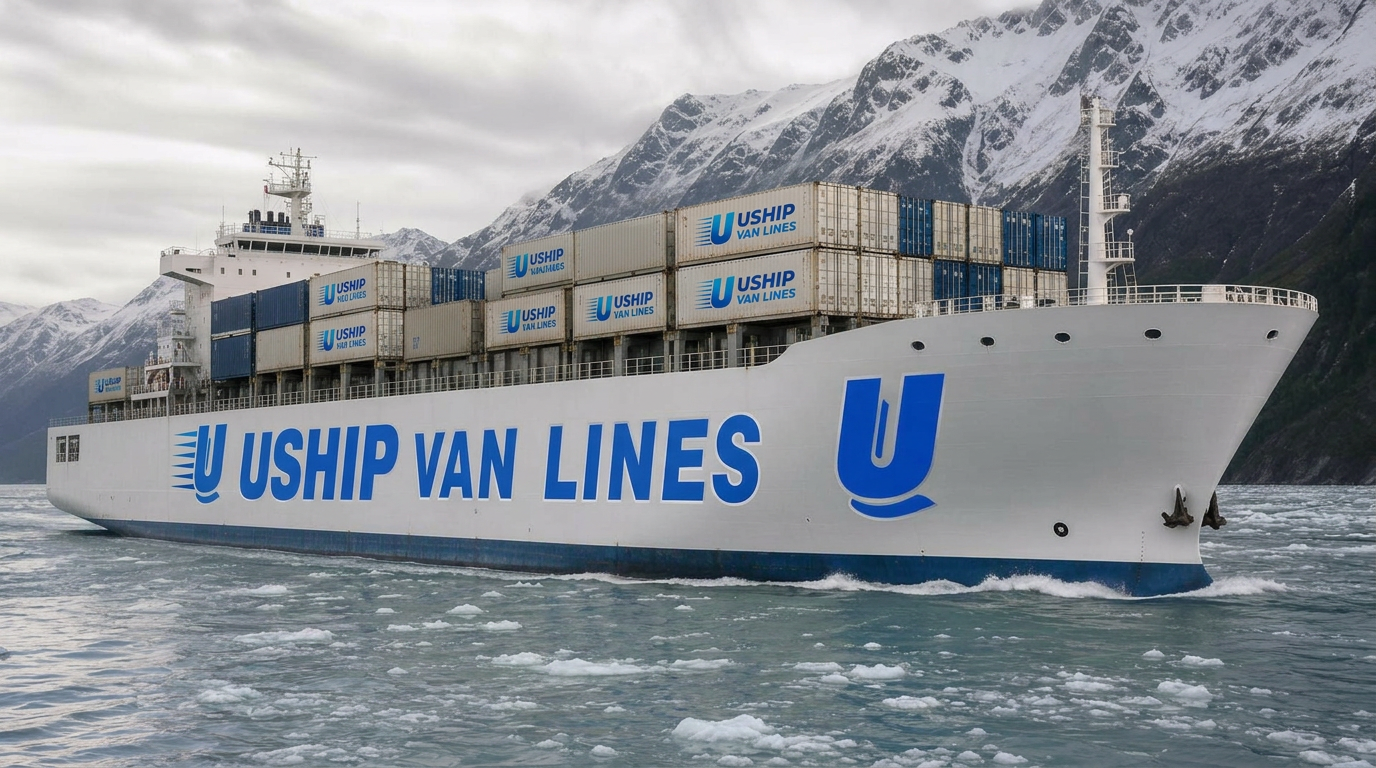
Moving from Alaska to Irving, TX
Moving from Alaska to Irving, Texas requires coordinating marine freight and over-the-road transport across 3,400+ miles. Whether you're relocating from Anchorage, Fairbanks, or the Mat-Su Valley to Irving's Las Colinas business district or the DFW suburbs, your belongings will travel by barge to the Lower 48, then continue by truck through the American West and into North Texas.
Best Alaska & Hawaii Movers, powered by UShip Van Lines, specializes in Alaska-to-Texas moves with transparent pricing, real-time shipment tracking, and end-to-end coordination. Request a free quote today to start planning your seamless transition from the Last Frontier to the Lone Star State.
Route overview
Moving from Alaska to Irving, TX: The Route
Your household goods depart Alaska via the Port of Anchorage, Whittier, or Fairbanks rail connection and travel by containerized barge south along the Alaska Marine Highway System to Tacoma or Seattle. The voyage covers approximately 1,450 nautical miles and takes 3–5 days depending on weather and the carrier's schedule.
Once offloaded in the Pacific Northwest, your container is transferred to a long-haul truck for the 2,100-mile journey through Washington, Idaho, Utah, Colorado, and into Texas via I-25 and I-35. The overland leg typically takes 4–6 days, bringing your shipment through Denver, the New Mexico high desert, and into the Dallas-Fort Worth metro area.
Irving sits just west of downtown Dallas with easy access to DFW International Airport, making last-mile delivery straightforward. Total door-to-door transit typically runs 10–18 days, depending on barge sailing schedules, peak-season demand, and Alaska weather windows.
How the moving process works
How the Alaska to Irving Move Works
-
In-home or virtual survey: Your moving coordinator assesses volume (typically 800–1,500 cubic feet for a 2–3 BR home), notes any high-value items, and confirms pickup location—Anchorage, Fairbanks, Wasilla, or other Alaska communities.
-
Packing and container loading: Professional crews pack fragile items, disassemble furniture, and load your belongings into a 20' or 40' ocean-rated container at your Alaska residence or a consolidation warehouse.
-
Alaska port delivery: The sealed container is trucked or rail-transported to the Port of Anchorage or Whittier for barge loading. You'll receive a bill of lading and tracking number.
-
Barge transit to Tacoma/Seattle: Your container sails the Inside Passage and crosses the Gulf of Alaska. Real-time GPS updates are available through the carrier portal.
-
Port offload and customs clearance: The container is unloaded, inspected if flagged, and transferred to a truck chassis at the Seattle-Tacoma marine terminal.
-
Cross-country trucking: A vetted long-haul carrier moves your shipment south through the Intermountain West and into Texas along I-25 and I-35.
-
Final delivery in Irving: The truck arrives at your new Irving address, crews unload and place items room-by-room, and you complete a final inventory check before signing off.
Estimated moving costs
What an Alaska to Irving Move Costs
A full-service move from Alaska to Irving typically costs $6,800–$12,500 for a 2–3 bedroom household, depending on volume, distance from port, packing services, and timing.
Key cost drivers include:
- Volume and weight: A studio/1-BR runs $4,500–$6,500; a 4-BR home can exceed $15,000.
- Alaska origin: Bush communities (Kodiak, Homer, Bethel) require float-plane or small-plane freight to Anchorage, adding $800–$2,000.
- Barge schedule and demand: Peak summer sailings (May–August) carry 15–25% premiums; off-season (October–March) offers lower rates but fewer departures.
- Packing services: Full-service packing adds $800–$1,800; fragile-only or DIY packing reduces costs.
- Vehicle shipping: Driving the AlCan Highway is impractical in winter; auto transport via barge adds $1,200–$2,200 per vehicle.
- Insurance and valuation: Basic carrier liability (60¢/lb) is included; full-value replacement coverage costs 1–2% of declared value.
Request a detailed quote with line-item pricing—no hidden fees, no surprise fuel surcharges after booking.
Estimated transit times
How Long the Move Takes
Door-to-door delivery from Alaska to Irving, TX takes 10–18 days under normal conditions.
Breakdown by leg:
- Local pickup to Alaska port: 1–2 days (longer for remote origins like Fairbanks or Kenai Peninsula).
- Barge sailing (Alaska to Tacoma/Seattle): 3–5 days, depending on weather and the carrier's port rotation.
- Port processing and container transfer: 1–2 days for offload, inspection, and trucking handoff.
- Cross-country trucking (Seattle to Irving): 4–6 days for the 2,100-mile journey via I-90, I-25, and I-35.
- Final delivery window: Most carriers offer 2–3 day delivery windows; expedited service narrows this to 24 hours.
Total range: 10 days (express summer sailing, no delays) to 18+ days (winter weather, equipment shortages, or bush-community pickups). Your coordinator will provide a firm estimate once barge schedules are locked.
Regional logistics
Alaska-Specific Moving Logistics
Ports and routing: Most Alaska moves funnel through the Port of Anchorage (deep-water, containerized freight) or Whittier (rail-connected, smaller volumes). Fairbanks shipments often travel by rail to Whittier. Southeast Alaska (Juneau, Ketchikan, Sitka) uses Alaska Marine Highway ferries or smaller barges with less frequent schedules.
Container types: Ocean-rated 20' steel containers (holds ~1,200 cu ft, good for 1–2 BR) and 40' containers (holds ~2,400 cu ft, good for 3–4 BR) are standard. Shared-container (LCL) options exist for smaller moves but add 2–4 days for consolidation and deconsolidation.
Vehicle shipping: Driving the Alaska-Canada Highway (AlCan) in winter is risky and time-consuming (3–5 days of hard driving). Most customers ship vehicles via the same barge as household goods. Cars must be clean (no soil/mud), operable, and have no more than ¼ tank of fuel. Enclosed auto transport is available but rare for Alaska routes.
Documentation: A detailed inventory list, proof of ownership for high-value items, and a signed bill of lading are required. No special customs clearance is needed for domestic Alaska-to-Texas moves, but USDA may inspect for plants, soil, or agricultural products.
Last-mile considerations: Irving's urban infrastructure (wide roads, suburban driveways, large apartment complexes) makes final delivery straightforward. For high-rise or restricted-access buildings, coordinate elevator reservations and loading dock times in advance.
Storage options: If your Irving home isn't ready, climate-controlled storage in the DFW area costs $150–$300/month for a 10x15 unit. Alaska-side storage (Anchorage, Wasilla) is also available if you need to vacate early.
Seasonal considerations
Best Times to Move from Alaska to Irving
Spring (April–May): Barge schedules ramp up after winter ice clears. Rates are moderate, availability is good, and Texas weather is pleasant. Book 4–6 weeks ahead.
Summer (June–August): Peak season for Alaska moves. Daily barge sailings, fastest transit times, and warmest weather—but expect 20–30% higher costs and 6–8 week lead times for guaranteed dates. Popular with families moving before the school year.
Fall (September–October): Shoulder season with declining demand. Barge schedules thin out but rates drop 10–15%. Good balance of cost and service for flexible movers. Texas heat begins to ease.
Winter (November–March): Off-peak with the lowest rates (up to 25% below summer) but limited barge departures—sometimes just 1–2 per month. Arctic storms and Gulf of Alaska weather can delay sailings by days. Alaska roads and driveways may require snow removal before pickup. Irving's mild winter makes receiving easy, but plan 8–10 weeks for booking and transit.
For remote Alaska locations (Kodiak, Dutch Harbor, Southeast Alaska islands), winter access is more restrictive. Summer and early fall are strongly preferred.
Why choose Best Alaska & Hawaii Movers
Why Choose Best Alaska & Hawaii Movers for Your Alaska to Irving Move
- Alaska specialists: We coordinate barge schedules, Alaska Marine Highway logistics, and bush-community pickups—not a service most national van lines offer.
- Transparent pricing: Line-item quotes with no hidden fuel surcharges, port fees, or surprise costs. What you're quoted is what you pay.
- Real-time tracking: GPS updates from Alaska pickup through barge transit and overland trucking to your Irving doorstep.
- Licensed, vetted carriers: Powered by UShip Van Lines, we work only with FMCSA-registered motor carriers and bonded marine freight partners.
- Flexible scheduling: We accommodate Alaska's unique seasonal windows and coordinate with your Irving move-in date, school start, or job relocation timeline.
- White-glove care: Full-service packing, furniture disassembly/reassembly, and room-by-room placement in your new Texas home.
Moving from Alaska to Irving, TX: A Complete 2026 Guide
Households leaving Alaska for Irving, TX are part of a measurable migration trend, and the moving market on this corridor has adjusted pricing, capacity, and delivery windows accordingly.
This corridor combines a roughly 2,408-mile linehaul with an ocean leg, which means you're hiring a carrier who can manage both the cross-country trucking and the barge or container handoff without dropping the ball at either end.
Below you'll find the data you actually need — pricing by shipment size, delivery timing, regional Other cost factors, route-specific challenges, and money-saving tactics that work on this exact corridor.
How Much Does Moving from Alaska to Irving, TX Cost?
Pricing on the Alaska-to-Irving, TX corridor is driven by shipment weight, timing, and the carrier you pick. The route is roughly 2,408 miles of land travel plus the ocean leg, so quotes break into linehaul + ocean container + port handling rather than a single per-mile rate.
Studios and one-bedrooms typically run $5,200–$8,300, two-bedrooms land between $9,400–$15,100, three-bedrooms are usually $14,500–$23,400, and four-bedroom homes range $20,100–$32,400. Ocean freight, port handling, and final-mile delivery in Alaska or Hawaii add a structural premium of roughly 30–45% over a comparable lower-48 long-haul. Avoiding the May–August peak alone can knock 15–25% off your final invoice.
How Long Does the Alaska to Irving, TX Move Take?
Most professional movers deliver from Alaska to Irving, TX in 18–30 business days, including the ocean leg.
On Alaska and Hawaii lanes, the timing is anchored by the weekly barge or steamship schedule. Miss the cutoff at the port of origin and your shipment waits a full week for the next sailing — which is why the carriers who run this corridor frequently are worth a small premium. Drivers cap legal hours at 11 per day, and the ocean carrier needs containers staged at the port 24–48 hours before sailing, so the published transit window already accounts for both legs plus port dwell. If you need a guaranteed delivery date, ask for "expedited" or "exclusive use" pricing — it's 30–60% more, but the truck goes straight to your destination.
Cost Factors Explained
Understanding what actually drives long-distance pricing makes it easy to spot a quote that's been padded.
Shipment weight. Carriers charge by the pound on long hauls. A 4,000-lb load vs a 6,500-lb load is the single biggest swing factor in your final bill.
Distance and routing. Linehaul mileage is fixed, but routes that detour through hub cities for consolidation can add 100–200 miles of billable distance.
Packing services. Full-pack runs $600–$2,200 on top of the move; partial-pack (kitchen + breakables only) is usually $200–$700.
Season and date. Summer and end-of-month dates carry a 15–35% premium over off-peak windows.
Specialty items. Pianos, gun safes, pool tables, and large appliances typically add $200–$700 each.
Access. Long carries (>75 ft from truck), stairs without elevator, and shuttle requirements at either end add $150–$1,200 in real-world charges.
Tips Specific to the Alaska to Irving, TX Route
Use these route-specific tactics to cut the price on your Alaska-to-Irving, TX move without cutting corners on quality.
Book 6–10 weeks ahead. Ocean carriers have fixed weekly sailings and consolidated container space fills up — last-minute bookings either pay an exclusive-use premium or wait a week. Mid-September through May offers the lowest pricing window for this corridor. Push for binding (not non-binding) estimates. Binding pricing locks the carrier in; non-binding lets them re-weigh on delivery day and bill more. Reduce shipment weight aggressively. Every 1,000 lbs you cut typically trims $400–$900 off this route's final cost. Sell, donate, or trash anything you don't truly want at the destination.
Why Mover Quotes Vary So Much on This Route
If you've gathered three quotes for this move and they look wildly different, it's because each carrier prices it through a different lens.
Carrier vs broker. Brokers post your move to a load board and the cheapest carrier accepts — you get whoever's available, not whoever's best. Asset-based carriers own their trucks and crews and price for direct accountability.
Trailer fill on this route. Carriers running regular freight on the Alaska-to-Irving, TX corridor will quote lower because they're filling trailer space they're already paying to move.
Estimate type. Non-binding quotes are intentionally low to win the booking, then re-weighed and re-priced at pickup. Binding quotes are firm.
Insurance and valuation. Released-value coverage (60¢/lb) is included free; full-value protection adds 1–2% of declared value. Quotes that don't itemize valuation are hiding the upsell.
When comparing quotes, ask each company how often they actually run trucks on this route. The answer separates carriers who price it as a normal lane from those who price it as a one-off.
How to Compare Movers for the Alaska to Irving, TX Route
Comparing movers properly is less about price and more about making the quotes apples-to-apples.
1. Send the same inventory. Use a single inventory list (room-by-room) and send it to every carrier you contact.
2. Demand a binding estimate. Ask explicitly: "Is this binding or non-binding?" Anything non-binding can be revised on pickup day after the truck weighs your shipment.
3. Verify FMCSA registration. Look up the USDOT and MC numbers on the FMCSA SAFER database. You're checking for active operating authority and a complaint history.
4. Compare line items. Linehaul, packing, valuation, fuel, and accessorials should each appear as a separate line. A flat lump-sum quote hides where the markup is.
5. Read deposit terms. A reputable carrier asks for 0–25% down and never demands cash. Anyone asking for 50%+ upfront or wire transfer only is a red flag.