
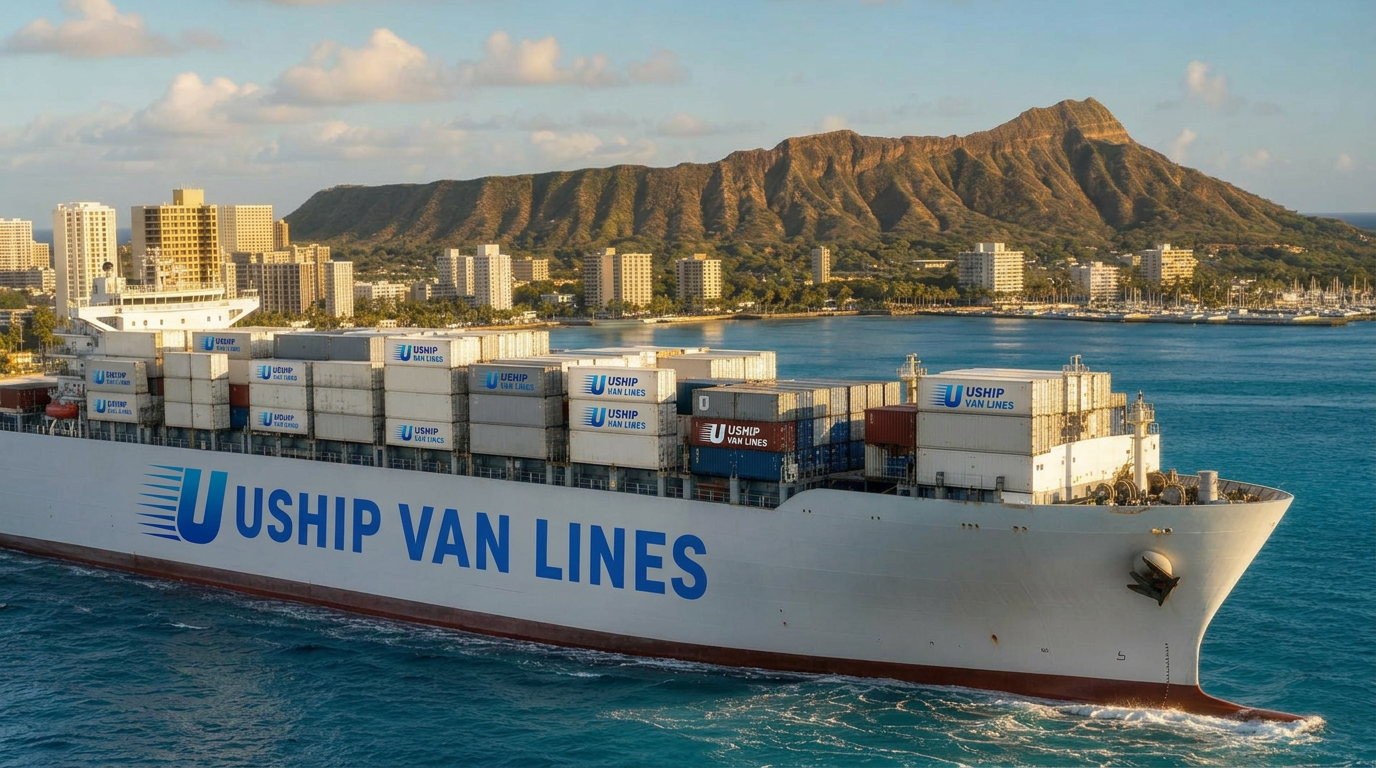
Moving from New York to Hawaii
Moving from New York to Hawaii represents one of the longest domestic relocations you can make—nearly 5,000 miles from the Empire State to the islands. This cross-country and cross-ocean journey requires careful coordination of ground transport, ocean freight, and last-mile delivery across one of the world's most remote island chains.
Best Alaska & Hawaii Movers, powered by UShip Van Lines, specializes in New York-to-Hawaii relocations. We handle the complex logistics of coordinating your household goods from pickup in New York through ocean container shipping to your final island destination. Request a free, detailed quote today to see how we streamline this multi-leg journey.
Route overview
Understanding the New York to Hawaii Moving Route
Your belongings travel approximately 4,959 miles from New York to Hawaii, making this one of the most logistically complex domestic moves. The journey begins with ground transportation from your New York home—whether in Manhattan, Brooklyn, Buffalo, or elsewhere in the state—to a West Coast consolidation port, typically Long Beach or Oakland, California. From there, your household goods are loaded into ocean containers for the Pacific crossing to Honolulu.
Matson Navigation and Pasha Hawaii operate the primary shipping lanes from the West Coast to Hawaii, with sailings departing multiple times weekly. Once your container arrives at Honolulu harbor, cargo can be distributed to Maui, Kauai, the Big Island (Hilo or Kona), or remain on Oahu for final delivery. The entire journey typically takes 3–5 weeks door-to-door, depending on consolidation schedules, sailing dates, and your final island destination.
This route requires coordination across three distinct phases: transcontinental ground transport (2,500+ miles), ocean freight (2,400+ nautical miles), and Hawaiian inter-island distribution. Each phase has specific documentation, timing, and logistical requirements that experienced Hawaii movers navigate daily.
How the moving process works
How Your New York to Hawaii Move Works: Step-by-Step
-
In-Home or Virtual Survey (3–4 Weeks Before Move): A specialist assesses your household inventory to provide an accurate cubic footage estimate. This determines container space requirements and helps identify items restricted from Hawaii (certain plants, soil-containing items, untreated wood).
-
Pickup in New York (Scheduled Move Date): Professional movers load your belongings into a long-haul truck at your New York residence. Items are inventoried, wrapped, and secured for the cross-country journey. If you're moving from a high-rise apartment in Manhattan, coordinate elevator reservations and building requirements in advance.
-
Transcontinental Ground Transport (5–8 Days): Your household goods travel by truck to the West Coast consolidation facility, typically in Southern California. This leg covers approximately 2,800 miles via I-80 or southern routes depending on origin and season.
-
Consolidation and Container Loading (3–7 Days): At the port facility, your shipment is consolidated with other Hawaii-bound cargo and loaded into ocean containers. Proper loading techniques ensure your belongings remain secure during the ocean voyage.
-
Ocean Freight to Honolulu (5–7 Days at Sea): Your container boards a Matson or Pasha vessel for the Pacific crossing. Sailings depart multiple times weekly, and transit time from California ports to Honolulu averages 5–7 days depending on weather and routing.
-
Customs Clearance and Port Processing (1–3 Days): Upon arrival in Honolulu, containers clear U.S. Customs and undergo Hawaii Department of Agriculture inspection. This agricultural inspection ensures no prohibited items enter the state's fragile ecosystem.
-
Final Delivery to Your Island Home (1–5 Days After Port Clearance): If your destination is Oahu, delivery happens directly from Honolulu. For neighbor islands (Maui, Kauai, Big Island), cargo transfers via inter-island barge (Young Brothers), adding 2–4 days. Your items are unloaded at your new home, and you verify the inventory against the original manifest.
Estimated moving costs
What Does a New York to Hawaii Move Cost?
A typical 2–3 bedroom household move from New York to Hawaii costs between $7,800 and $14,500, depending on volume, services, and final destination. This price range reflects the complete door-to-door service including ground transport, ocean freight, and island delivery.
Key cost factors include:
- Cubic footage or container space: Most moves require 400–800 cubic feet. A standard 20-foot container holds approximately 1,000 cubic feet; you may share space with other shipments (consolidation) or need a dedicated container for larger homes.
- Final island destination: Oahu delivery costs less than neighbor island delivery due to the additional inter-island barge leg (add $800–$1,500 for Maui, Kauai, or Big Island).
- Packing services: Professional packing adds $800–$2,200 but significantly reduces damage risk during the long journey. Fragile items, artwork, and electronics particularly benefit from expert packing.
- Access challenges: High-rise apartments in NYC requiring long carries or elevator fees, or difficult Hawaii access (narrow roads, stairs, limited parking) can add $300–$800 in shuttle or labor fees.
- Vehicle shipping: Shipping a car from New York to Hawaii costs an additional $1,400–$2,000 via roll-on/roll-off (RORO) auto transport to the same West Coast ports.
- Seasonal timing: Peak summer season (June–August) sees 15–25% higher rates due to increased demand from families moving before the school year.
- Storage needs: If your Hawaii home isn't ready, storage in Honolulu costs $150–$300 per month for a typical load.
We provide transparent, itemized quotes with no hidden fees. Every estimate breaks down ground transport, ocean freight, island delivery, and optional services separately so you understand exactly where your money goes. Request your free quote to receive a detailed cost projection based on your specific inventory and timing.
Estimated transit times
How Long Does a New York to Hawaii Move Take?
Expect a total transit time of 21–35 days door-to-door from your New York pickup date to delivery at your Hawaii home. This timeline includes all three phases of your move.
Timeline breakdown:
- Ground transport to West Coast: 5–8 days for your truck to travel from New York to California consolidation facilities. Weather, traffic, and routing affect this leg.
- Consolidation and container loading: 3–7 days while your shipment is combined with other Hawaii cargo and loaded into ocean containers. Timing depends on the next available sailing and how quickly the container fills.
- Ocean voyage: 5–7 days at sea from Long Beach or Oakland to Honolulu. Matson's expedited service can shave 1–2 days; slower sailings may add time.
- Port clearance and inspection: 1–3 days for customs processing and mandatory Hawaii agricultural inspection in Honolulu.
- Oahu final delivery: 1–2 days after port clearance if your destination is on Oahu.
- Neighbor island delivery: Add 3–5 additional days for inter-island barge transport and delivery to Maui, Kauai, Big Island (Hilo), or Kona.
The longest delays typically occur during consolidation (waiting for the next sailing) and inter-island transfer for neighbor island destinations. During peak summer season, consolidation can extend to 10 days as containers fill to capacity. Winter sailings often have more immediate availability, potentially shortening the timeline by 3–5 days.
For time-sensitive moves, ask about expedited ocean service and dedicated container options, which can reduce total transit time to 18–24 days but increase costs by 20–30%.
Regional logistics
Hawaii-Specific Moving Logistics You Need to Know
Ocean container shipping: Your goods travel in 20-foot or 40-foot steel containers aboard Matson or Pasha vessels. Most household moves share container space through consolidation (loaded with other shipments), which is more economical than dedicating an entire container. Container contents must be non-hazardous—no propane, paint, chemicals, ammunition, or other hazmat materials.
Mandatory agricultural inspection: All cargo entering Hawaii undergoes inspection by the Hawaii Department of Agriculture to prevent invasive species. Prohibited items include most live plants, soil-containing items, fresh produce, untreated wood furniture, and certain seeds. Your moving company provides a detailed prohibited items list during the survey. Non-compliance can result in items being confiscated, fumigated (at your expense), or your entire shipment being delayed.
Port of entry: Most shipments clear through Honolulu (Oahu), the state's primary deep-water port. From there, cargo destined for neighbor islands transfers to Young Brothers inter-island barges. Maui, Kauai, and Big Island all have secondary ports (Kahului, Nawiliwili, Hilo, Kawaihae) that receive barged containers.
Vehicle shipping: If you're shipping a car, it travels separately via RORO (roll-on/roll-off) auto transport. Vehicles must be operable, empty of personal belongings (small items in the trunk are sometimes allowed), and have less than a quarter tank of gas. Matson and Pasha both offer weekly auto sailings from the same California ports. Never pack household goods inside your vehicle—port authorities will refuse to load it.
Documentation requirements: You'll complete a detailed inventory list, a Hawaii move questionnaire (declaring restricted items), and customs paperwork. If you're relocating from outside the U.S. originally (international to NY to HI), additional customs forms may apply. Your moving coordinator provides and helps complete all required documentation.
Delivery access in Hawaii: Many Hawaii neighborhoods have narrow streets, steep driveways, or limited parking. If a full-size moving truck can't access your home, a smaller shuttle vehicle transfers your goods from the truck (adding $200–$500 in shuttle fees). For condos, coordinate elevator reservations and building move-in requirements with your property manager weeks in advance.
Storage options: If your Hawaii home isn't ready or you need temporary storage, secure climate-controlled facilities are available near Honolulu harbor. Storage is billed monthly, and your goods remain in the container or are palletized in warehouse space.
Insurance coverage: Basic carrier liability (60 cents per pound) is insufficient for Hawaii moves. Opt for full replacement value protection, which costs approximately 1–2% of your declared shipment value. This covers loss or damage during all phases—ground transport, ocean voyage, and final delivery.
Seasonal considerations
Best Times to Move from New York to Hawaii
Summer (June–August): Peak moving season for both New York and Hawaii. Families relocate before the new school year, driving up demand and prices by 15–25%. Book 6–8 weeks in advance to secure your preferred dates. New York weather is ideal for moving, and Hawaii sees peak tourism but also peak port congestion. Container consolidation may take longer during these months.
Fall (September–November): Shoulder season offers moderate pricing and good availability. September is technically peak Atlantic hurricane season for the East Coast, but rarely impacts New York moves. Hawaii enters its quieter tourism season, meaning less port congestion and faster processing. This is often the best value window for New York-to-Hawaii relocations.
Winter (December–February): Potential weather challenges in New York (snow, ice) can delay pickup, though professional movers navigate winter conditions routinely. Hawaii enjoys excellent weather, and ocean freight runs on schedule. Holiday periods (late December, early January) see reduced sailings and should be avoided if possible. Otherwise, winter offers good rates and 4–6 week booking lead times are typically sufficient.
Spring (March–May): Another excellent window with moderate demand and pricing. New York weather improves steadily, and Hawaii is spectacular. Ocean freight capacity is generally good, and port processing is efficient. Book 5–7 weeks ahead for spring moves.
Hurricane season: While Hawaii's hurricane season runs June–November, direct strikes are rare (the islands average one hurricane per 15 years). Modern weather tracking means ships route around storms. Your cargo insurance covers weather-related delays or damage.
Port congestion: Honolulu harbor occasionally experiences congestion during peak cruise ship season (September–April) and after mainland holidays. These delays are typically 1–2 days and are factored into our timeline estimates.
Why choose Best Alaska & Hawaii Movers
Why Best Alaska & Hawaii Movers for Your New York-to-Hawaii Relocation
-
Hawaii specialists, not generalists: We focus exclusively on Alaska and Hawaii moves, meaning we navigate the unique logistics—ocean containers, agricultural inspections, inter-island distribution—every single day. This isn't a once-a-year specialty move for us; it's what we do.
-
End-to-end coordination powered by UShip Van Lines: From pickup in New York through West Coast consolidation, ocean freight booking, port clearance, and final island delivery, one dedicated coordinator manages your entire move. You're never handed off between disconnected vendors wondering who's responsible.
-
Transparent, itemized pricing: Our quotes break down every cost component—ground miles, ocean freight, island delivery, packing services, insurance—so you understand exactly what you're paying for. No surprise fees at delivery.
-
Proven partnerships with Matson and Pasha: We work daily with Hawaii's primary ocean carriers, securing reliable space and competitive rates. Our volume relationships mean your shipment moves on schedule, even during peak season.
-
White-glove service for fragile and valuable items: Pianos, artwork, antiques, and family heirlooms receive custom crating and special handling throughout the journey. We've successfully moved everything from grand pianos to fine art collections to Hawaii.
-
Real-time tracking and proactive communication: You'll receive updates at every major milestone—pickup complete, truck arrived at port, container loaded, vessel departed, Honolulu arrival, delivery scheduled. Our coordinators proactively reach out if any delays occur, keeping you informed without you needing to chase updates.