
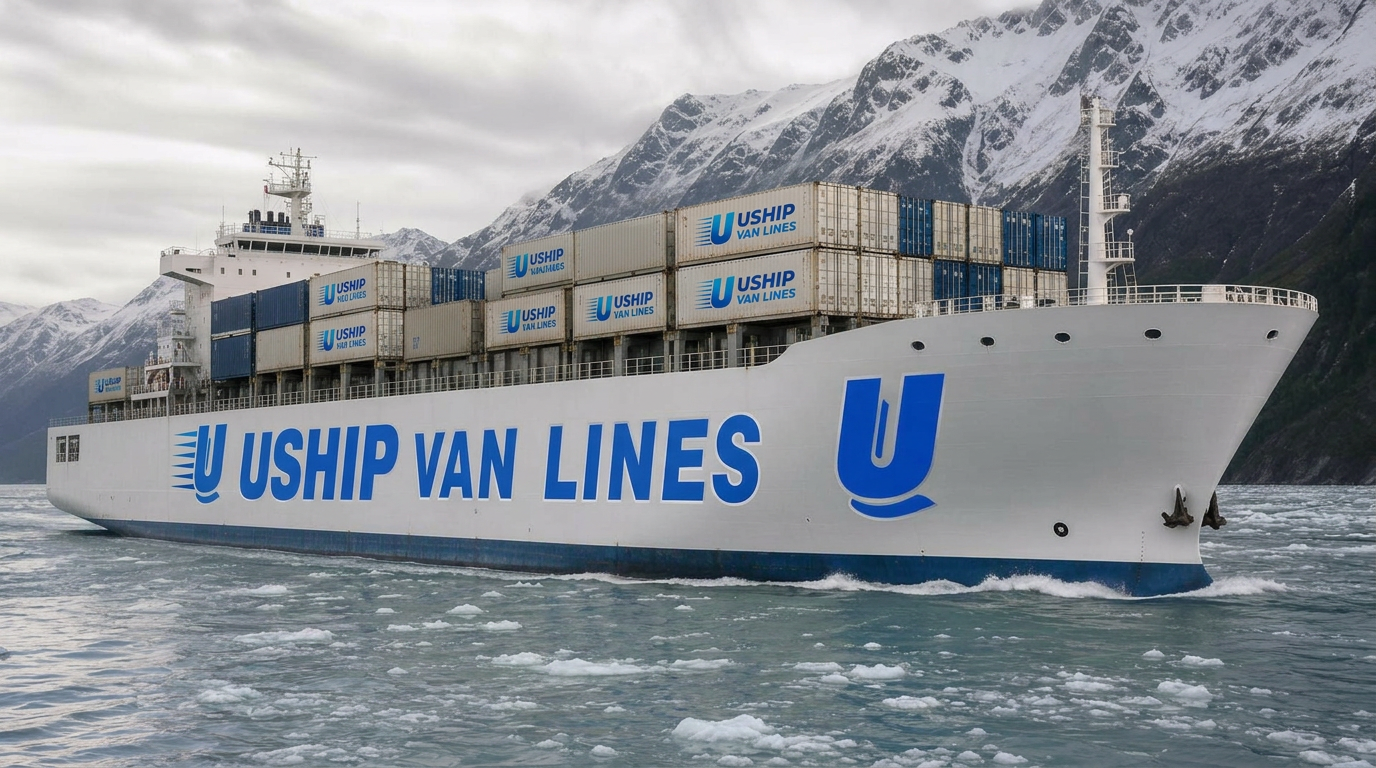
Moving from Lewisville, TX to Alaska
Relocating from Lewisville's North Texas suburbs to America's Last Frontier requires specialized logistics that most moving companies simply don't handle. Alaska moves involve barge shipping through Tacoma, strict seasonality, and last-mile delivery challenges that demand real expertise and transparent pricing.
Best Alaska & Hawaii Movers, powered by UShip Van Lines, coordinates the entire journey from your Lewisville doorstep to your new Alaska home—whether you're settling in Anchorage, Fairbanks, the Mat-Su Valley, or beyond. Our team manages over-the-road transport to Seattle/Tacoma, barge scheduling, customs documentation, and final delivery across Alaska's unique terrain. Request your free quote today to see exactly what your Lewisville-to-Alaska move will cost and when your belongings will arrive.
Route overview
How Your Lewisville to Alaska Move Works
Your household goods travel approximately 3,400 road miles from Lewisville to the Port of Tacoma, Washington, then board a northbound barge for the 1,400-nautical-mile ocean voyage to Alaska's ports. This isn't a simple point-to-point truck delivery—it's a coordinated intermodal move requiring precise timing between ground transport, marine shipping schedules, and Alaska-based final delivery teams.
Most Lewisville shipments consolidate at our Pacific Northwest transfer facility before scheduled barge departures, typically weekly from April through October and bi-weekly during winter months. Once your container arrives at Anchorage's Port (the primary receiving hub) or other Alaska ports, local carriers complete delivery to your final destination. The entire process requires 14–28 days door-to-door, with timing heavily influenced by barge schedules and your specific Alaska destination.
Texas to Alaska moves demand different expertise than standard long-distance relocations. Weight limits, container requirements, marine insurance, vehicle shipping coordination, and Alaska's restricted items list all factor into successful delivery. Understanding these requirements upfront prevents costly delays and ensures your belongings arrive intact and on schedule.
How the moving process works
Step-by-Step: Your Lewisville, TX to Alaska Moving Process
-
Initial Quote and Planning (8–12 weeks before moving date): Contact us for a detailed video survey or in-home estimate of your Lewisville residence. We'll assess your inventory, discuss Alaska destination details, explain barge schedule constraints, and provide transparent pricing. Alaska moves require longer lead times than Lower 48 relocations—booking 2–3 months ahead ensures your preferred departure window.
-
Prep and Packing (2–4 weeks before pickup): Professional packing services are strongly recommended for Alaska moves due to the ocean leg. Our crew uses marine-grade materials, moisture barriers, and reinforced cartons designed for barge transport. If you self-pack, we provide detailed guidelines for Alaska-compliant packing standards. This is also when you'll coordinate vehicle shipping if you're transporting cars separately.
-
Pickup in Lewisville (Day 1): Our ground crew loads your household goods into a 53-foot semi-trailer at your Lewisville home. Everything is inventoried, labeled, and documented. The truck departs immediately for the Pacific Northwest, typically reaching our Tacoma-area consolidation warehouse within 3–4 days via I-35, I-80/90 corridor.
-
Consolidation and Containerization (Days 4–7): Your shipment transfers into marine containers (20-foot or 40-foot units) at our Tacoma facility. Items are secured, moisture protection is added, and containers are sealed. We coordinate barge booking based on your delivery timeline and destination port requirements. You'll receive container numbers and estimated sailing dates.
-
Barge Transit to Alaska (Days 8–17): Containers board northbound barges operated by carriers like Totem Ocean Trailer Express or Alaska Marine Lines. The ocean voyage takes 7–10 days depending on routing (direct to Anchorage vs. multi-port stops). Your shipment is tracked throughout the marine leg, and we monitor weather/schedule changes in real-time.
-
Port Arrival and Customs Clearance (Days 18–21): Containers arrive at Alaska ports (most commonly Anchorage) and clear customs inspection. We handle all documentation, though you may need to provide proof of residency or answer questions about restricted items. Clearance typically takes 1–2 business days for household goods shipments.
-
Final Delivery in Alaska (Days 21–28): Alaska-based carriers unload your container and complete last-mile delivery to your new address. Anchorage and Mat-Su Valley deliveries happen quickest; Fairbanks, Kenai Peninsula, and remote locations require additional transit time. Our crew unpacks (if contracted), places furniture, and completes a final inventory check with you present.
Estimated moving costs
What a Lewisville to Alaska Move Actually Costs
A typical 2–3 bedroom household (8,000–12,000 lbs) moving from Lewisville to Anchorage ranges between $8,500–$14,500 for full-service door-to-door delivery. This estimate includes ground transport from Texas, barge shipping, basic marine insurance, and delivery in the Anchorage area. Your actual cost depends on exact weight, packing services, final Alaska destination, seasonality, and additional services.
Key cost drivers for this route:
-
Shipment weight and volume: Barge pricing is calculated by either weight (per 100 lbs) or cubic footage, whichever yields higher charges. A studio/1BR might run $5,500–$7,500; a 4–5 bedroom home easily reaches $16,000–$22,000+.
-
Packing and materials: Full professional packing adds $1,200–$2,800 depending on home size. Marine-grade packing for Alaska routes costs more than standard services due to moisture protection and reinforced materials required for ocean transport.
-
Final destination in Alaska: Anchorage delivery is baseline pricing. Fairbanks adds $800–$1,500; Kenai Peninsula communities $600–$1,200; remote bush destinations requiring additional barge/air legs can add $2,000–$5,000+ depending on accessibility.
-
Season and timing: Peak summer moves (June–August) command premium pricing due to high demand and limited barge capacity. Shoulder seasons (April–May, September–October) offer better rates. Winter moves (November–March) have reduced sailings but sometimes lower prices for flexible customers.
-
Vehicle shipping: If you're also shipping cars, expect $1,800–$2,800 per standard vehicle from Seattle/Tacoma to Anchorage via RORO (roll-on/roll-off) barge service, booked separately from household goods.
-
Storage: If barge timing doesn't align perfectly with your move-out/move-in dates, short-term storage in Tacoma ($150–$300/month) or Anchorage ($200–$400/month) may be necessary.
We provide guaranteed not-to-exceed pricing after your inventory assessment—no surprise charges at delivery. Request your detailed quote to see exactly what your specific Lewisville-to-Alaska move will cost based on your actual household and timeline.
Estimated transit times
Realistic Timeline: Lewisville to Alaska Door-to-Door
Plan for 14–28 days total transit time from pickup at your Lewisville home to delivery at your Alaska destination. This timeline breaks down into distinct legs, each with its own variables:
Ground transport to Tacoma (3–5 days): Your truck departs Lewisville and travels I-35 north through Oklahoma and Kansas, connects to I-80 across Nebraska, Wyoming, and into the Pacific Northwest. The roughly 2,200-mile journey typically takes 3–4 days of drive time, though weather in winter (Wyoming/Montana passes) can add delays.
Consolidation and barge scheduling (2–7 days): Once at our Tacoma facility, shipments are containerized and staged for the next available sailing. During peak season (May–September), barges depart weekly, minimizing wait time. Winter months see bi-weekly or less frequent sailings, potentially adding 5–10 days to your timeline. We coordinate your pickup timing to minimize warehouse dwell.
Ocean voyage to Alaska (7–10 days): The barge trip from Tacoma/Seattle to Anchorage takes 7–8 days via direct routing. Shipments to Southeast Alaska ports (Ketchikan, Juneau) may be slightly faster; those requiring stops at Kodiak, Dutch Harbor, or other points can take 9–10+ days. Weather rarely causes significant delays during the main shipping season, though severe North Pacific storms occasionally add 1–2 days.
Port clearance and final delivery (2–7 days): Customs clearance in Anchorage usually completes within 1–2 business days. Final delivery to Anchorage-area addresses can happen same-week; Fairbanks and other Interior locations add 2–4 days; Kenai Peninsula, Mat-Su outlying areas, and remote communities may need an additional week depending on road access and local carrier schedules.
Fastest possible timeline: 14 days (summer, Anchorage delivery, perfect barge connection). Most common: 18–23 days. Plan for: Up to 28 days, especially for winter moves, remote destinations, or if additional storage is required.
Regional logistics
Alaska-Specific Moving Logistics from Lewisville
Port operations and routing: Nearly all Lewisville-to-Alaska household goods shipments consolidate through the Port of Tacoma or Seattle, then sail to the Port of Anchorage (Alaska's primary receiving hub). From Anchorage, goods distribute throughout Southcentral Alaska directly or transfer to other carriers for Fairbanks, Kenai Peninsula, and beyond. If you're moving to Southeast Alaska communities (Juneau, Ketchikan, Sitka), shipments may route via different barge services with distinct schedules and pricing.
Container types and weight limits: Your belongings load into 20-foot or 40-foot marine containers. A typical 3-bedroom home fits a 40-foot container; smaller households use 20-foot units or share container space (consolidated shipping). Marine containers have weight limits—overweight containers incur surcharges or require splitting into multiple units. Our estimators calculate this precisely during your quote.
Restricted and prohibited items for Alaska: Alaska's agricultural inspection is strict. Prohibited items include soil, live plants, certain seeds, firewood, fresh produce, and untreated wooden items. Hazardous materials (paints, propane, ammunition, chemicals) cannot travel via barge. We provide a detailed checklist during planning, but expect to dispose of or personally transport some items. Firearms and alcohol have specific declaration requirements but can move with proper documentation.
Vehicle shipping coordination: Most customers shipping vehicles separately book RORO (roll-on/roll-off) barge service simultaneously with household goods. Vehicles must be delivered to the Seattle/Tacoma port 3–7 days before sailing, emptied of personal items, and have less than 1/4 tank of fuel. We coordinate timing so your car and household goods arrive in Alaska around the same timeframe, though they travel on different vessels.
Last-mile delivery challenges: Alaska's road system is limited. The main highway network serves Anchorage, Mat-Su Valley, Kenai Peninsula, and Fairbanks, but many communities are off-road. Bush destinations require additional barge legs (to Kodiak, Bethel, Nome, etc.) or air freight for small shipments, adding significant cost and time. Confirm your final address accessibility during quoting—what seems like a straightforward move to "Alaska" may involve complex multi-modal logistics.
Documentation and residency: While Alaska doesn't require customs forms for U.S. domestic moves (it's still the U.S.), you'll complete a detailed inventory and may need to show proof of new Alaska residency for certain exemptions. Military PCS moves have separate requirements and often qualify for additional services. Our team handles all paperwork, but you'll need to provide accurate information upfront.
Insurance and claims: Standard released-value coverage (60 cents/lb) is inadequate for Alaska moves given the complexity. We strongly recommend full-replacement-value insurance, which costs approximately 1–2% of declared shipment value. Marine transit adds risk (though actual damage rates are low with proper packing); comprehensive coverage provides peace of mind for your 3,400+ mile journey.
Seasonal considerations
When to Move from Lewisville to Alaska: Seasonal Planning
Summer (June–August) – Peak Season: This is Alaska's busiest moving window and the most expensive. Barge capacity is maxed out, pricing is at its highest, and you'll need to book 10–14 weeks in advance to secure your preferred dates. The upside: weekly sailings, fastest transit times, best weather for both ocean voyage and Alaska road delivery, and easiest setup at your new home (daylight, mild temperatures). If you have school-age children or a fixed job start date, summer moves make logistical sense despite premium costs.
Spring (April–May) – Shoulder Season: Excellent compromise between cost and convenience. Barge schedules ramp up from winter minimums to near-summer frequency by late May. Pricing is 10–20% lower than peak summer rates. Weather is variable—Alaska's "breakup" season means muddy conditions and occasional road challenges, but nothing prohibitive. This window works well for retirees, remote workers, or anyone with flexible timing who wants to avoid peak-season premiums.
Fall (September–October) – Best Value Window: Another shoulder season offering reduced pricing and decent barge frequency through early October. After mid-October, sailings begin tapering toward winter schedules. You'll beat the rush, pay 15–25% less than summer rates, and still enjoy reasonable transit times. Alaska weather turns colder and wetter, but moving operations continue normally. This is the sweet spot for budget-conscious movers who can avoid the June–August rush.
Winter (November–March) – Limited Service: Barge sailings drop to bi-weekly or monthly, extending your total timeline significantly. Some routes reduce service entirely. Pricing can be lower for flexible customers willing to work around sparse schedules, but the savings may be offset by longer storage costs if your move-out and barge dates don't align. North Pacific storms are more common, occasionally delaying sailings. Alaska road delivery faces snow, ice, and extreme cold, particularly for Interior and remote destinations. Only recommended if your timeline is very flexible or you're securing long-term housing and can wait for belongings.
Bottom line: Book summer moves by March/April. Shoulder seasons offer the best value-to-convenience ratio. Avoid winter unless you have compelling reasons and maximum flexibility.
Why choose Best Alaska & Hawaii Movers
Why Lewisville Families Choose Best Alaska & Hawaii Movers
-
Alaska-specific expertise, not generic long-distance: We handle Alaska and Hawaii moves exclusively, not as a side offering. Our team knows Tacoma port operations, barge carrier relationships, Alaska delivery logistics, and seasonal constraints intimately—experience that general moving companies simply don't have.
-
Transparent, all-inclusive pricing with no surprise fees: You'll receive a detailed quote breaking down every cost component: ground transport, barge fees, packing, insurance, delivery. Our guaranteed not-to-exceed pricing means the quote you accept is what you pay at delivery—no hidden fuel surcharges, container fees, or last-minute add-ons.
-
End-to-end coordination powered by UShip Van Lines network: Best Alaska & Hawaii Movers leverages UShip Van Lines' nationwide carrier network for your Texas pickup and overland leg, then transitions to our Alaska-specialist partners for marine shipping and final delivery. You get one point of contact managing the entire journey, not multiple vendors you have to coordinate yourself.
-
Flexible scheduling around barge sailings: We work backward from your Alaska delivery needs and barge schedules to determine optimal pickup timing in Lewisville. Need storage because your new place isn't ready? We offer short-term and long-term options at both ends of the route.
-
Real-time tracking and communication: You'll receive updates at every milestone—pickup complete, arrival in Tacoma, containerization complete, barge departure, Alaska port arrival, out for final delivery. Our customer portal and direct coordinator contact keep you informed throughout the 2–4 week journey.