
Moving from Cleveland, TN to Alaska
Relocating from Cleveland, Tennessee to Alaska represents one of the most ambitious moves you can make—spanning roughly 3,400 miles from the foothills of the Appalachians to the Last Frontier. Whether you're drawn by career opportunities in Anchorage, military orders to Joint Base Elmendorf-Richardson, or the allure of Alaska's rugged wilderness, this cross-continental move requires specialized logistics that few moving companies can handle.
Best Alaska & Hawaii Movers, powered by UShip Van Lines, specializes exclusively in moves to and from Alaska and Hawaii. We coordinate the entire journey—ground transport from Cleveland through the Lower 48, ocean barge shipping from Tacoma, and final delivery to your Alaska destination. Request your free, customized quote today to see how we make this complex route manageable.
Route overview
Cleveland, TN to Alaska: Understanding the Route
Your belongings will travel approximately 3,400+ miles from Cleveland, Tennessee to Alaska, combining over-the-road trucking with ocean barge transportation. The journey begins with ground transport from your Cleveland home—whether in the downtown historic district near the Ocoee River or suburban neighborhoods off APD 40—westward to Tacoma, Washington. This 2,500-mile overland leg typically takes 4–6 days.
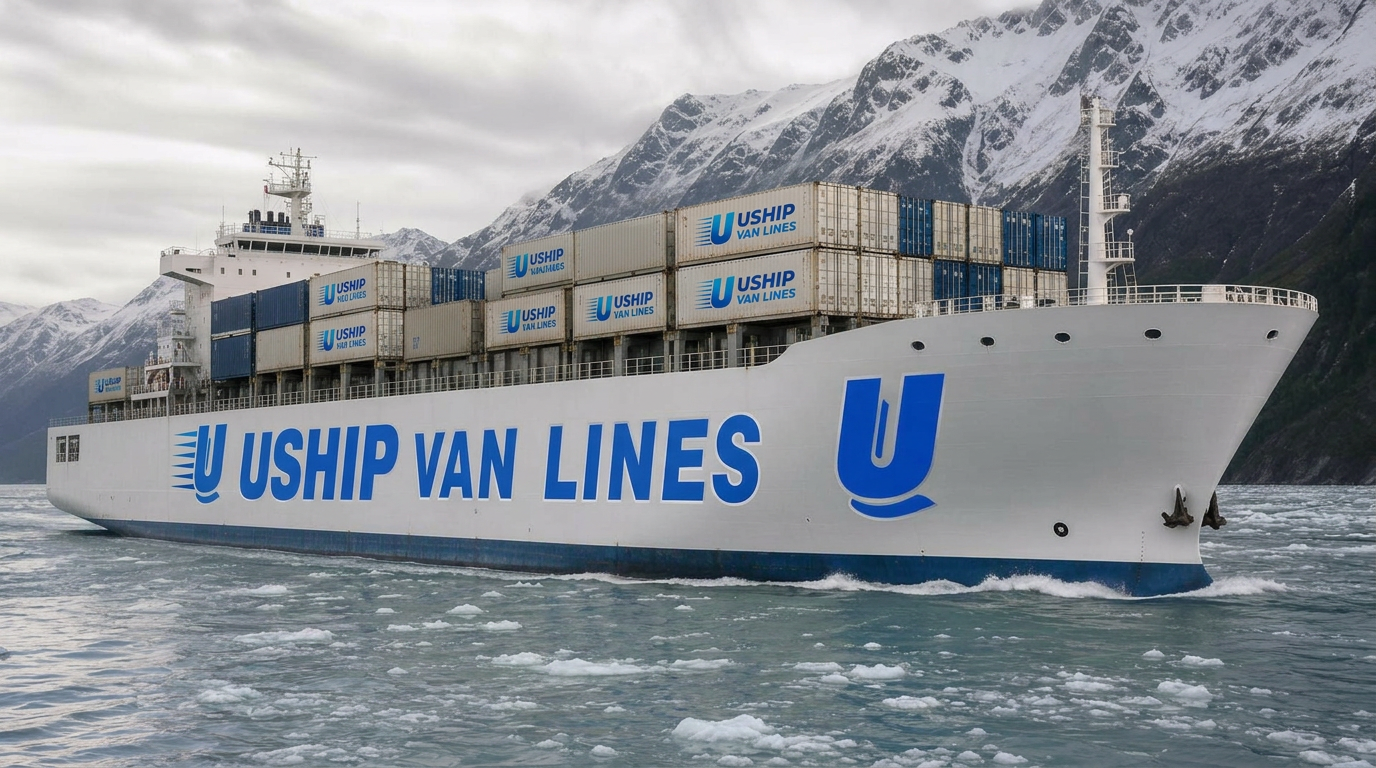
From the Port of Tacoma, your household goods are loaded onto ocean barges operated by carriers like TOTE Maritime Alaska or Alaska Marine Lines. These barges sail north through the Inside Passage, taking 7–10 days to reach the Port of Anchorage. The barge portion is the longest single leg of your move and operates on fixed weekly or bi-weekly schedules.
Final delivery depends on your Alaska destination. Anchorage and nearby communities receive direct delivery. Remote locations like Fairbanks (358 miles north), the Kenai Peninsula, or the Mat-Su Valley require additional trucking on the Alaska Highway system, adding 1–3 days. Bush communities off the road system require air freight or smaller barge transfers, significantly increasing complexity and cost.
How the moving process works
How Your Cleveland to Alaska Move Works: Step-by-Step
-
Free Consultation & Custom Quote — We assess your inventory (approximate square footage, specialty items like vehicles or boats), your Alaska destination, and your preferred timeline. Cleveland-area moves often include items like outdoor equipment, furniture from homes built in the 1950s–1980s, and vehicle shipments.
-
Pre-Move Planning & Barge Schedule Coordination — We reserve your space on the next available barge sailing from Tacoma, typically 3–6 weeks out during peak summer season. You'll receive a detailed timeline and Alaska-specific guidance on restricted items (propane, ammunition, certain chemicals).
-
Professional Packing & Loading in Cleveland — Our team arrives at your Cleveland home with materials designed for multi-modal transport. Everything is packed to withstand both highway vibration and ocean movement. We inventory and photograph high-value items.
-
Ground Transport to Tacoma — Your shipment travels via dedicated long-haul trucking across the country. The route typically follows I-40 west through Nashville and Oklahoma City, then I-84 through Idaho to Washington state—approximately 2,500 miles taking 4–6 days.
-
Containerization & Barge Loading at Port of Tacoma — Your goods are loaded into secure marine containers at the Tacoma terminal. Containers are then loaded onto the barge for the northbound sailing. This process takes 1–2 days, and you'll receive container numbers for tracking.
-
Ocean Transit to Port of Anchorage — The barge sails approximately 1,440 nautical miles through protected waters of the Inside Passage, arriving in Anchorage 7–10 days later. Sailings are weather-dependent, especially during winter months.
-
Alaska Delivery & Unpacking — After customs clearance and offloading in Anchorage (1–2 days), we coordinate final delivery to your home. Road-accessible locations receive direct truck delivery. You can opt for full unpacking services or unload yourself to save costs.
Estimated moving costs
What Does Moving from Cleveland, TN to Alaska Cost?
A typical 2–3 bedroom household move from Cleveland to Alaska costs between $6,800–$12,500 for full-service door-to-door transportation. Studio or 1-bedroom moves may range $4,200–$6,500, while larger 4+ bedroom homes can exceed $15,000–$22,000.
Key cost factors include:
- Volume and weight — Barge pricing is primarily weight-based. A typical 3-bedroom home averages 8,000–12,000 pounds.
- Alaska destination — Anchorage deliveries cost less than Fairbanks or Kenai Peninsula locations, which require additional highway trucking. Bush communities requiring air freight can double or triple costs.
- Season — Summer moves (May–September) command premium rates due to high demand and limited barge space. Winter sailings offer 15–25% discounts but face weather delays.
- Packing services — Full professional packing adds $800–$2,200. Partial packing (fragiles and kitchen only) costs $400–$900.
- Vehicle shipping — Adding a car or truck costs $1,800–$3,200 from Cleveland to Anchorage via the same barge route.
- Access challenges — Rural Cleveland properties with long driveways or homes requiring shuttle trucks increase labor costs by $300–$800.
- Storage — If your Alaska home isn't ready, Anchorage-area storage runs $150–$400/month for typical household volumes.
We never guarantee prices without a detailed inventory. Every move is quoted individually based on your specific circumstances. Request your personalized estimate to see real numbers for your situation.
Estimated transit times
How Long Does Cleveland, TN to Alaska Take?
Expect 14–21 days total from loading in Cleveland to delivery in Alaska under normal conditions. The timeline breaks down as follows:
Ground transport Cleveland to Tacoma: 4–6 days for the 2,500-mile overland haul. This leg is fairly predictable except during severe winter weather across mountain passes.
Port processing in Tacoma: 1–2 days for container loading, customs documentation, and staging for the next scheduled barge departure. Barge sailings typically run weekly during peak season (May–September) but may be bi-weekly in winter.
Ocean barge transit: 7–10 days from Tacoma to Anchorage. The voyage covers approximately 1,440 nautical miles through the protected Inside Passage, making it relatively smooth compared to open-ocean routes.
Anchorage port processing & delivery: 1–3 days for offloading, customs clearance, and final delivery to Anchorage-area homes. Fairbanks and other Interior locations add 1–2 days for the highway leg. Kenai Peninsula and Mat-Su Valley deliveries also add 1–2 days.
Seasonal variables: Winter moves (November–March) can add 3–7 days due to weather delays, reduced barge frequency, and slower highway travel on icy roads. Summer moves are faster but require booking 4–6 weeks ahead due to high demand. Spring breakup (April–May) can complicate rural Alaska deliveries as unpaved roads become impassable.
Regional logistics
Alaska-Specific Moving Logistics from Cleveland
Barge Ports & Routing: All Cleveland to Alaska moves route through the Port of Tacoma, the primary gateway for Alaska household goods. Tacoma serves as the consolidation point where shipments from across the Lower 48 converge before northbound sailings. Your goods arrive at the Port of Anchorage, Alaska's main cargo hub, then distribute throughout the state.
Vehicle Shipping: Most families ship at least one vehicle alongside household goods. Cars, trucks, and SUVs travel on the same barge in specialized vehicle containers or roll-on/roll-off (RoRo) configurations. Tennessee-registered vehicles must be registered in Alaska within 60 days of establishing residency. Alaska requires vehicle emissions testing only in certain Anchorage areas. Cost: $1,800–$3,200 per vehicle from Cleveland.
Restricted & Prohibited Items: Alaska barge shipments prohibit propane tanks (including BBQ tanks—even empty), ammunition, loaded firearms, hazardous chemicals, and certain aerosols. Perishable foods are discouraged but not banned. Plants require USDA inspection and Alaska Department of Natural Resources approval—many species are prohibited to protect Alaska's ecosystem.
Customs & Documentation: While moving within the United States, Alaska shipments require cargo manifests similar to customs documentation. You'll need proof of residency or military orders, detailed household inventory, and vehicle titles if shipping cars. We handle all documentation, but you must provide accurate personal information and inventory.
Last-Mile Alaska Delivery: Anchorage and surrounding communities (Eagle River, Girdwood, Palmer, Wasilla) are directly accessible via paved highways. Fairbanks requires trucking 358 miles north on the Parks Highway—fully paved but subject to winter closures. Kenai Peninsula destinations (Soldotna, Homer, Seward) require 100–220 miles of additional highway driving. Bush communities (Bethel, Nome, Kotzebue, Kodiak Island) are off the road system entirely and require small aircraft or secondary barge service, dramatically increasing costs.
Storage Options: If your Alaska housing isn't ready, we offer climate-controlled storage in Anchorage. Alaska's extreme temperature swings (-20°F to 80°F) make climate control important for furniture, electronics, and sensitive items. Storage costs $150–$400/month depending on volume.
Seasonal considerations
Best Time to Move from Cleveland to Alaska
Summer (May–September): Peak moving season for Alaska. Barge schedules run weekly, weather is cooperative, and Alaska roads are fully accessible. However, demand is extremely high—book 6–8 weeks in advance and expect premium pricing. This is the ideal window if you have school-age children or need predictable delivery timing. Cleveland's humid summers make packing more comfortable than winter moves.
Fall (October–November): Shoulder season offers 10–15% cost savings as demand drops after Labor Day. Barge frequency reduces to bi-weekly sailings. Early October is generally safe, but late November brings increased weather risk in the Gulf of Alaska and early snow on Alaska highways. Good compromise between cost and reliability.
Winter (December–March): Lowest rates of the year—often 20–25% below summer prices. Barge sailings are less frequent (every 10–14 days) and weather delays are common. Gulf of Alaska storms can delay sailings by 2–5 days. However, if your timeline is flexible and you're comfortable with uncertainty, winter moves offer significant savings. Cleveland's mild winters make loading easier than in northern states.
Spring (April–May): Spring breakup in Alaska creates challenges. While barge schedules increase in April, many Alaska communities experience "breakup"—when frozen ground thaws and dirt roads become muddy quagmires. May is generally better as roads dry out and summer schedules begin. Prices start climbing toward peak rates in late May.
Why choose Best Alaska & Hawaii Movers
Why Choose Best Alaska & Hawaii Movers for Your Cleveland to Alaska Move
-
Alaska & Hawaii Specialists: Unlike general long-distance movers, we focus exclusively on Alaska and Hawaii routes. We understand barge schedules, Alaska regulations, vehicle shipping requirements, and the unique challenges of Last Frontier deliveries. This isn't a rare route for us—it's our core expertise.
-
Single-Source Coordination: We manage every leg—ground transport from Cleveland, Tacoma port handling, barge booking, customs documentation, and final Alaska delivery. You work with one team throughout, not a chain of disconnected carriers. One point of contact, one shipment tracking system, one accountability.
-
Transparent Pricing: We provide detailed, itemized quotes showing exactly what you're paying for—trucking, barge freight, port fees, fuel surcharges, and delivery. No hidden charges. No bait-and-switch estimates. We explain Alaska-specific costs upfront so you can budget accurately.
-
Powered by UShip Van Lines: Our logistics backbone connects you to vetted, interstate-licensed carriers and established Alaska freight networks. We leverage technology and carrier relationships to offer competitive rates while maintaining service quality.
-
Flexible Service Levels: Choose full-service packing and unpacking, or save money with DIY packing and delivery-only service. We accommodate partial shipments, vehicle-only moves, and custom timing to fit your needs and budget.