
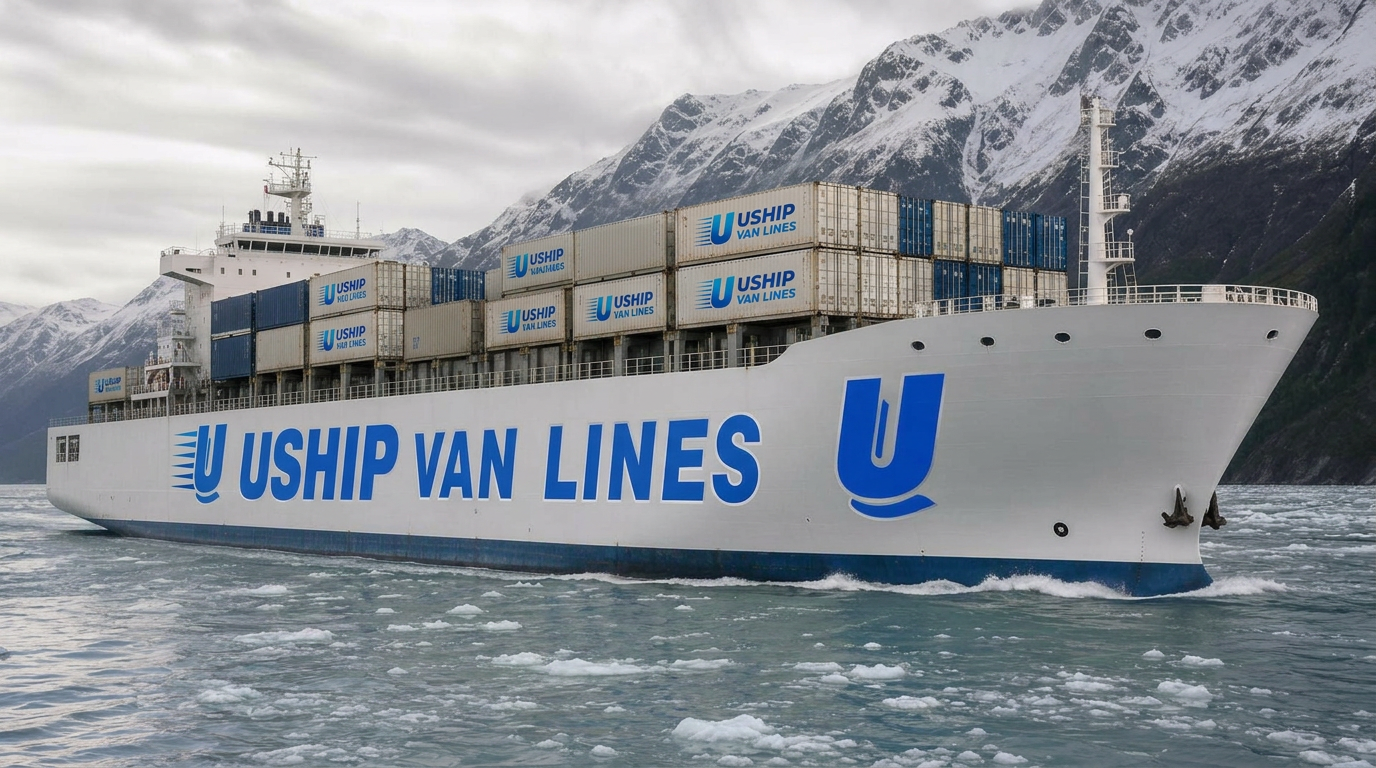
Moving from Chicago, IL to Alaska
Moving from Chicago to Alaska is one of the most logistically complex relocations in North America, but with the right planning and partner, it becomes a manageable adventure. Your household goods will travel over 2,500 miles by truck to the Pacific Northwest, transfer to ocean barge service through Tacoma, and arrive at Alaskan ports before final delivery to your new home in Anchorage, Fairbanks, the Mat-Su Valley, or beyond.
Best Alaska & Hawaii Movers, powered by UShip Van Lines, specializes in this exact corridor. We coordinate every leg—ground transport from Chicago, barge consolidation, Alaska port handling, and last-mile delivery across the Last Frontier. Request your free quote today to receive a detailed timeline and cost breakdown tailored to your inventory and destination.
Route overview
Understanding the Chicago to Alaska Moving Corridor
The Chicago to Alaska route requires multi-modal coordination that few moving companies can execute reliably. Your belongings are picked up in the Chicago metro area (including suburbs across Cook, DuPage, Lake, Kane, and Will counties) and transported via interstate highway to the Pacific Northwest—typically Seattle or Tacoma, Washington. There, your shipment is consolidated with other Alaska-bound loads and loaded onto ocean barges operated by carriers like Totem Ocean Trailer Express (TOTE) or Alaska Marine Lines.
The barge leg crosses the Gulf of Alaska to ports in Anchorage, Whittier, Kodiak, or Southeast Alaska communities. Most Chicago-to-Alaska moves arrive at the Port of Anchorage, the state's largest receiving facility. From there, final delivery is completed by truck to your specific destination—whether that's downtown Anchorage, suburban Eagle River, Wasilla in the Mat-Su Valley, Fairbanks, the Kenai Peninsula, or even bush communities accessible by seasonal road. The entire journey typically requires 2–4 weeks door-to-door, with variability based on barge schedules, weather, and your exact Alaska destination.
This route differs fundamentally from Lower 48 moves. You're not simply hiring a long-haul truck—you're coordinating ocean freight with strict containerization requirements, Alaska port logistics, customs-like agricultural inspections, and delivery into a state where distances are vast and infrastructure is limited. Working with a specialist ensures nothing is overlooked.
How the moving process works
Step-by-Step: How Your Chicago to Alaska Move Works
-
Free Quote & Planning Consultation — Contact Best Alaska & Hawaii Movers with your inventory list, Chicago pickup address, and Alaska destination. We'll provide a detailed estimate covering ground transport, barge fees, Alaska delivery, and optional services. We'll also confirm your target moving dates and discuss barge sailing schedules.
-
Pre-Move Survey & Prohibited Items Review — A moving coordinator reviews your inventory remotely or in-person. Alaska barge carriers enforce strict rules: no hazardous materials (aerosols, propane, paint, cleaning chemicals), no perishable foods, and limitations on plants. Firearms and ammunition require special documentation. We help you identify what can't travel and recommend alternatives.
-
Packing & Chicago Pickup — Professional packers arrive at your Chicago home 1–2 days before loading (if you've chosen full-service packing). On moving day, your belongings are loaded into a climate-controlled truck and begin the 2,000+ mile drive to the Pacific Northwest. Transit to Tacoma typically takes 3–5 days.
-
Consolidation & Barge Loading in Tacoma/Seattle — Your shipment arrives at the barge terminal and is transferred into a 20-foot, 40-foot, or 53-foot container (or onto a flat rack for vehicles). Containers are sealed and loaded onto the next available Alaska-bound barge. TOTE operates twice-weekly sailings; Alaska Marine Lines sails weekly. Your coordinator confirms your specific sailing date.
-
Ocean Transit to Alaska — The barge crosses the Gulf of Alaska in 3–7 days depending on the route and weather. Anchorage-bound barges typically take 4–5 days. Southeast Alaska (Juneau, Ketchikan) may be faster; Kodiak or western Alaska destinations take longer. Your shipment is tracked and you receive sailing updates.
-
Port Arrival & Customs Clearance — Upon arrival at the Port of Anchorage (or other Alaska port), your container is offloaded and processed through Alaska's agricultural inspection. Inspectors check for invasive species and prohibited items. Delays are rare but possible if issues are found.
-
Final Delivery Across Alaska — Your container is transferred to a local Alaska truck for final delivery. Anchorage deliveries often occur within 1–2 days of port arrival. Fairbanks, Mat-Su, and Kenai Peninsula deliveries add 1–3 days. Bush destinations or winter deliveries to remote areas require additional logistics and may involve temporary storage until roads are accessible.
Estimated moving costs
What Does It Cost to Move from Chicago to Alaska?
A typical 2–3 bedroom household moving from Chicago to Anchorage costs $7,500–$14,000 for a full-service move, depending on the volume of belongings, barge schedule, and services selected. A 1-bedroom apartment or small condo may range $4,500–$7,000. Larger homes (4+ bedrooms, 10,000+ pounds) can exceed $18,000, especially if moving to remote Alaska destinations.
Key cost drivers include:
- Ground transport to the Pacific Northwest — Chicago to Tacoma/Seattle is approximately 2,100 miles and represents the largest single cost component. Expect $2,500–$5,000 depending on volume and season.
- Barge freight — Ocean container costs vary by size and carrier. A shared 20-foot container typically costs $2,000–$4,000; exclusive-use 40-foot or 53-foot containers range $5,000–$9,000. Rates increase in summer peak season.
- Alaska port handling & delivery — Port fees, offloading, and final trucking to your Alaska destination add $1,500–$3,500. Remote or off-road-system locations incur surcharges.
- Packing services — Professional packing for a 3-bedroom home adds $800–$1,800. DIY packing reduces costs but increases your time investment.
- Insurance — Full-value protection costs approximately 1–2% of declared shipment value. Basic liability coverage (60 cents per pound) is included but offers minimal protection.
- Storage — If your barge arrival doesn't align with your Alaska housing availability, short-term storage in Anchorage costs $150–$400/month.
- Vehicle shipping — Adding a vehicle to your barge shipment costs $1,200–$2,500 from Seattle/Tacoma to Anchorage.
We never guarantee prices without a detailed inventory review. Costs fluctuate based on fuel surcharges, seasonal demand, and carrier availability. Request your free personalized quote to receive accurate pricing for your specific move.
Estimated transit times
How Long Does a Chicago to Alaska Move Take?
Plan for 14–28 days door-to-door from Chicago pickup to final delivery in Alaska. The range depends on your exact Alaska destination, barge sailing schedules, weather, and any storage holds.
Typical timeline breakdown:
- Chicago to Tacoma ground transport: 3–5 days (2,100 miles via I-90 and I-94)
- Tacoma terminal consolidation & barge loading: 2–7 days (depends on your arrival timing relative to the next sailing)
- Ocean barge crossing to Anchorage: 4–5 days (Gulf of Alaska route)
- Port of Anchorage offloading & inspection: 1–2 days
- Final Alaska delivery: 1–7 days depending on destination (Anchorage same-day or next-day; Fairbanks 1–3 days; remote locations 3–7 days)
Faster moves (14–18 days) are possible if your Chicago pickup aligns perfectly with an immediate barge sailing and you're delivering to Anchorage or Mat-Su Valley. Longer moves (21–28 days) occur when there's a wait for the next barge, weather delays, or delivery to Fairbanks, Kenai, or bush communities.
Winter moves can add 3–7 days due to road conditions, reduced barge frequency, and limited access to remote areas. Southeast Alaska destinations (Juneau, Sitka, Ketchikan) have different barge routes and may arrive faster or slower depending on the carrier.
Book your move at least 4–6 weeks in advance to secure your preferred timeline and barge sailing. Last-minute bookings (under 2 weeks) may require waiting for the next available barge, adding a week or more to your total transit time.
Regional logistics
Alaska-Specific Moving Logistics from Chicago
Ports & Barge Carriers
Your Chicago shipment will most likely arrive at the Port of Anchorage via TOTE (Totem Ocean Trailer Express) or Alaska Marine Lines. TOTE operates roll-on/roll-off (RoRo) barges twice weekly in summer, once weekly in winter. Alaska Marine Lines serves Anchorage, Kodiak, Dutch Harbor, and Southeast Alaska. If moving to Juneau, Sitka, Ketchikan, or other Southeast communities, your barge route and timeline differ—expect 5–9 days ocean transit and different consolidation points.
Container Types
Smaller moves (1–2 bedrooms) are typically consolidated into shared 20-foot containers. Larger households may receive exclusive use of a 40-foot or 53-foot container. Vehicle shipping uses flat racks or shared RoRo space. Your moving coordinator will recommend the right container configuration based on your inventory.
Prohibited & Restricted Items
Alaska barge carriers and state agricultural inspectors prohibit: aerosols, propane tanks, gasoline, paint, pesticides, cleaning chemicals, explosives, and perishable foods. Houseplants are heavily restricted due to invasive species concerns—many will be confiscated at port inspection. Firearms and ammunition are allowed but require advance declaration and compliance with federal and Alaska regulations. Alcohol over certain quantities may face taxation. Review the prohibited items list carefully during your consultation.
Vehicle Shipping
Many Chicago-to-Alaska movers add a vehicle to their shipment. Cars, trucks, SUVs, motorcycles, and even RVs can travel on the same barge. Vehicles must be clean (undercarriage wash required to prevent invasive species introduction), operable, and have less than 1/4 tank of fuel. Cost ranges $1,200–$2,500 from Seattle/Tacoma to Anchorage. Vehicles are driven on/off the barge—no crating required.
Alaska Delivery Geography
Alaska is massive and road-limited. Anchorage and the Mat-Su Valley (Wasilla, Palmer) are the easiest delivery destinations. Fairbanks requires a 6-hour drive north on the Parks Highway. Kenai Peninsula communities (Soldotna, Homer, Seward) are 2–4 hours south via the Seward Highway. Southeast Alaska (Juneau, Ketchikan) is not connected by road to the rest of the state—delivery is barge-only. Bush Alaska (Nome, Bethel, Kotzebue, Barrow/Utqiaġvik) requires air freight or seasonal barge service and is extremely expensive. Confirm your exact delivery address and road access early in the planning process.
Storage Options
If your Alaska housing isn't ready when your barge arrives, we can arrange short-term or long-term storage at secure Anchorage-area facilities. Storage costs $150–$400/month depending on volume. Some movers choose to store belongings in Chicago or Seattle if there's a significant timing gap—discuss options with your coordinator.
Seasonal considerations
Best Times to Move from Chicago to Alaska
Summer (May–August): Peak Season
Summer is the busiest and most expensive moving season for Alaska. Barge capacity is maximized with twice-weekly TOTE sailings and frequent Alaska Marine Lines runs, but competition for space is intense. Expect 15–25% higher costs compared to off-peak months. Weather is favorable—Chicago heat, dry Pacific Northwest conditions, and Alaska's long daylight hours make loading/unloading efficient. Book 6–8 weeks ahead minimum. Ideal if you need to move during the school break or want guaranteed access to remote Alaska locations accessible only in warm months.
Fall (September–October): Shoulder Season
Early fall offers excellent value. Barge schedules remain robust through September but demand drops after Labor Day. Costs decrease 10–15% compared to summer. Chicago weather is still mild; Alaska is entering fall but roads remain accessible. A good compromise for families moving after school starts or professionals with flexible timing. Book 4–6 weeks ahead.
Winter (November–March): Off-Peak & Challenging
Winter moves offer the lowest prices—often 20–30% below summer rates. However, barge frequency decreases (TOTE may reduce to one sailing per week) and Alaska delivery logistics become complex. Chicago winter weather can delay pickups. Alaska roads to Fairbanks, Mat-Su, and Kenai may require winter tires or chains; some bush locations become inaccessible until spring. If you're moving to Anchorage and comfortable with snow, winter can be cost-effective. Expect longer transit times (21–28 days). Book 3–4 weeks ahead.
Spring (April–May): Transition & Breakup
Spring is unpredictable in Alaska due to "breakup"—the thaw period when roads turn muddy and some routes become temporarily impassable. Chicago spring weather is pleasant for loading. Barge schedules ramp up in May as summer season begins. Costs are moderate, rising toward summer peaks by late May. Avoid early April if moving to interior Alaska or remote areas. Book 4–6 weeks ahead.
Pro tip: If you have flexibility, target late September or early October for the best balance of reasonable costs, reliable barge schedules, and manageable Alaska weather.
Why choose Best Alaska & Hawaii Movers
Why Choose Best Alaska & Hawaii Movers for Your Chicago to Alaska Move
-
Alaska Specialists — We exclusively handle Alaska and Hawaii moves. We know the barge carriers, the ports, the routes, and the challenges. We're not a general moving company experimenting with Alaska—this is what we do, every day.
-
Multi-Modal Coordination Expertise — Your move requires seamless handoffs between Chicago ground transport, Pacific Northwest consolidation, ocean barge, Alaska port handling, and final delivery. We manage every leg, every carrier, and every detail so you don't have to.
-
Transparent Pricing & No Hidden Fees — You'll receive a detailed written estimate covering all costs: ground transport, barge freight, port fees, Alaska delivery, and any optional services. We explain what's included and what's not. No surprises on delivery day.
-
Powered by UShip Van Lines' Nationwide Network — Our partnership with UShip Van Lines gives us access to vetted, licensed interstate carriers for the Chicago-to-Pacific-Northwest ground leg and established relationships with Alaska barge operators and delivery partners.
-
Dedicated Move Coordinators — From your first quote request through final delivery in Alaska, a single coordinator manages your move. You'll have a direct phone number and email. Real-time updates on your barge sailing, port arrival, and delivery window.
-
Flexible Service Levels — Choose full-service packing, partial packing, or self-pack options. Add vehicle shipping, storage, or specialty item handling (pianos, antiques, gun safes). We customize our service to your budget and timeline.