
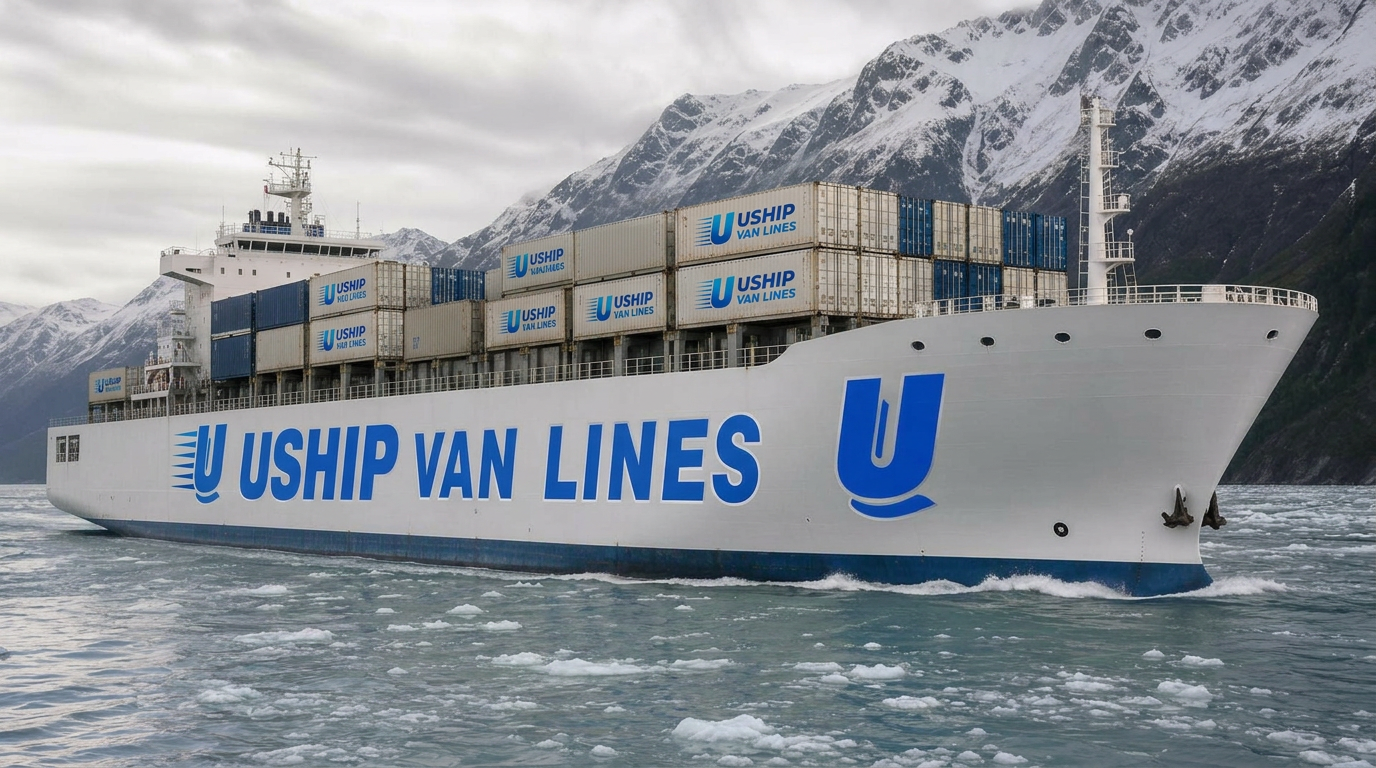
Moving from Alaska to Chicago, IL
Relocating from the Last Frontier to the Windy City involves coordinating ocean barge service, overland trucking, and Midwest delivery logistics. Whether you're leaving Anchorage, Fairbanks, or the Mat-Su Valley for Chicago's vibrant neighborhoods, this 2,300+ mile journey requires specialized expertise in Alaska shipping and continental route planning.
Best Alaska & Hawaii Movers, powered by UShip Van Lines, coordinates every leg of your Alaska-to-Chicago move—from port departure through final delivery. Request a free, no-obligation quote to see how we simplify this complex relocation.
Route overview
Understanding the Alaska to Chicago Moving Route
Your household goods travel by ocean barge from Alaska to the Port of Tacoma, Washington, then transfer to long-haul trucks for the 2,100-mile overland journey to Chicago. The entire route crosses the Pacific Northwest, Montana, North Dakota, Minnesota, and Wisconsin before reaching Illinois. Total distance from Anchorage to Chicago exceeds 2,300 miles when combining marine and ground segments.
Alaska-based moves require careful port scheduling since barge service runs on fixed weekly or bi-weekly timetables depending on season. Your possessions consolidate at the Port of Anchorage (or Whittier for some carriers), cross the Gulf of Alaska, then transfer at Tacoma for cross-country trucking through I-90 and I-94 corridors. Chicago's multiple delivery zones—from Loop high-rises to suburban Cook County—add final-mile complexity that experienced movers navigate efficiently.
This route serves military families relocating to Great Lakes Naval Station, corporate transferees joining Chicago's finance and tech sectors, retirees seeking lower costs and family proximity, and students attending University of Chicago or Northwestern. Understanding the multi-modal nature of this move helps set realistic expectations for timing and logistics.
How the moving process works
How Your Alaska to Chicago Move Works: Step by Step
-
Initial Survey and Quote – Our team conducts a virtual or in-person walkthrough of your Alaska home to assess volume (cubic feet), special items (vehicles, boats, ATVs), and access conditions. We provide a detailed cost estimate covering barge fees, trucking, insurance, and any storage needs.
-
Scheduling and Barge Booking – We reserve space on the next available barge from Anchorage or Whittier to Tacoma, coordinating with Alaska Marine Lines, Totem Ocean Trailer Express, or other carriers. Barge schedules vary by season; summer offers more frequent departures, while winter service may be limited.
-
Packing and Alaska Pickup – Professional packers arrive at your home to wrap, box, and inventory your belongings. Items load into a 20-foot or 40-foot shipping container or dedicated truck space. If you're in remote areas like Kenai, Soldotna, or Fairbanks, we arrange last-mile pickup to connect with port-bound freight.
-
Ocean Barge Transit – Your container sails from Alaska to Tacoma, typically 4–7 days depending on weather and routing. Goods remain sealed and protected during the marine leg. Upon Tacoma arrival, freight clears the port and transfers to our long-haul trucking partner.
-
Cross-Country Trucking – Your shipment travels eastward via I-90 through Washington, Idaho, Montana, South Dakota, Minnesota, and Wisconsin, entering Illinois on I-90 or I-94. This segment takes 5–8 days depending on route optimization and team driver availability.
-
Chicago-Area Delivery – Our delivery crew contacts you 24–48 hours before arrival to confirm your Chicago address, building access (elevator reservations for high-rises), parking permits, and delivery window. We unload, place items in designated rooms, and reassemble furniture as agreed.
-
Final Walkthrough and Claim Window – You inspect all items against the inventory sheet, noting any damage or missing pieces. We explain the claims process and provide contact information for post-delivery support. Your move file remains open for 90 days for any follow-up needs.
Estimated moving costs
What Does an Alaska to Chicago Move Cost?
A typical 2-bedroom apartment move from Anchorage to Chicago ranges from $6,200 to $9,800, while a 3-bedroom home averages $9,500 to $14,500. These estimates include barge shipping, long-haul trucking, basic liability coverage, and standard delivery. Actual costs depend on volume (measured in cubic feet), weight, packing services, insurance level, and timing.
Key cost drivers:
- Barge Rates – Marine shipping from Alaska to Tacoma charges by container size or cubic footage. A 20-foot container costs $2,500–$4,000; a 40-foot container runs $4,500–$7,000. Shared container space (consolidation) reduces costs for smaller loads.
- Overland Trucking – Cross-country transport from Tacoma to Chicago adds $3,000–$6,500 depending on weight, mileage, and fuel surcharges.
- Packing Services – Full-service packing (materials + labor) adds $800–$1,800 for a 2-bedroom home, $1,500–$3,000 for larger residences.
- Insurance – Basic carrier liability covers 60 cents per pound. Full-value protection (replacement cost) adds 1–3% of declared shipment value.
- Vehicle Shipping – Adding a car or truck to your barge shipment costs $1,200–$2,200 Alaska to Tacoma, plus $800–$1,400 Tacoma to Chicago.
- Storage – If your Chicago residence isn't ready, warehousing in Tacoma or Chicago runs $150–$350 per month for a typical household.
- Seasonality – Summer moves (May–September) command premium rates due to higher demand and peak barge schedules. Winter discounts of 10–20% are common November through March.
We never advertise guaranteed flat rates because every Alaska move involves unique variables—from remote pickup locations to Chicago high-rise delivery fees. Request a personalized quote for accurate pricing tailored to your inventory and timeline.
Estimated transit times
How Long Does an Alaska to Chicago Move Take?
Door-to-door transit from Alaska to Chicago typically requires 14 to 24 days, broken into distinct segments:
- Alaska Pickup to Port Departure: 1–3 days for packing, loading, and transport to Anchorage or Whittier port.
- Barge Transit (Alaska to Tacoma): 4–7 days on the water, depending on weather, sea conditions, and carrier route.
- Port Processing and Transfer: 2–4 days for customs clearance (if applicable), unloading, and transfer to trucking partner in Tacoma.
- Cross-Country Trucking (Tacoma to Chicago): 5–8 days via I-90 corridor, subject to driver hours-of-service regulations and route conditions.
- Chicago Final Delivery: 1–2 days for scheduling, elevator reservations, and actual unload.
Seasonal factors significantly impact timing. Summer barge schedules offer weekly departures, shortening port wait times. Winter sailings may be bi-weekly or monthly, adding 7–14 days to the overall timeline. Trucking delays increase during Midwest winter due to snow, ice, and road closures across Montana, the Dakotas, and Wisconsin.
For time-sensitive moves—job start dates, school enrollment, or lease expirations—we recommend booking 6–8 weeks in advance during peak season (May–September) and 4–6 weeks during off-peak months. Expedited service is sometimes available for partial loads or team-driver trucking, though costs increase 25–40%.
Regional logistics
Alaska-Specific Moving Logistics
Port and Barge Operations: Most Alaska moves consolidate at the Port of Anchorage, with secondary options at Whittier (closer to Kenai Peninsula) and occasionally Seward. Barge carriers like Alaska Marine Lines and Totem Ocean operate scheduled routes to Tacoma, the primary West Coast hub. Your goods travel in sealed containers (20-foot or 40-foot) or as break-bulk freight, protected from saltwater and weather.
Remote and Last-Mile Pickup: If you're in Fairbanks, Mat-Su Valley (Wasilla, Palmer), Kenai, Soldotna, or bush communities, we coordinate local trucking to bring your shipment to the Anchorage port. Remote pickups add 1–3 days and $400–$1,200 in staging costs. Locations accessible only by air or seasonal ice roads require specialized arrangements and advance planning.
Vehicle Shipping: Cars, trucks, SUVs, ATVs, and boats can share barge space with household goods. Vehicles must be drained of fluids to 1/4 tank or less, and personal items cannot remain inside (barge safety regulations). Shipping a standard sedan Alaska-to-Tacoma costs $1,200–$2,200; oversize vehicles (lifted trucks, RVs) cost more. Tacoma-to-Chicago auto transport adds $800–$1,400 via open or enclosed carrier.
Customs and Paperwork: Domestic Alaska-to-Lower 48 moves don't require customs clearance, but proper documentation—inventory lists, insurance forms, bill of lading—is essential for barge and trucking transfers. Military moves (PCS orders) involve additional DOD paperwork and weight allowances.
Chicago Delivery Challenges: High-rise buildings require elevator reservations and certificates of insurance (COI) submitted 3–7 days ahead. Street parking permits are mandatory in many Chicago neighborhoods; we handle permit applications or advise on no-parking zone setup. Narrow streets in older neighborhoods (Lincoln Park, Wicker Park) demand smaller delivery trucks or shuttle services, adding $200–$500.
Storage Options: If your Chicago apartment or home isn't ready, we offer short-term warehousing in Tacoma (West Coast holding) or Chicago-area facilities (final-mile staging). Climate-controlled storage protects furniture and electronics during transition periods. Monthly rates run $150–$350 depending on volume.
Prohibited and Restricted Items: Alaska moves cannot include hazardous materials (propane, ammunition, chemicals), perishable foods, or live plants. Firearms require special documentation and often ship separately. Prescription medications should travel with you, not in the moving truck.
Seasonal considerations
Best Time to Move from Alaska to Chicago
Summer (May–September): Peak moving season offers maximum barge frequency, reliable weather, and easier Chicago delivery (no snow/ice complications). Expect higher costs—10–25% premiums—and tighter scheduling. Book 8–10 weeks ahead. Ideal for families with school-age children or those avoiding winter weather risks.
Fall (October–November): Shoulder season provides moderate pricing and decent barge availability. Early October is still favorable for weather; late November introduces winter storms in the Midwest. A sweet spot for cost-conscious movers willing to accept minor weather risks.
Winter (December–March): Off-peak rates drop 15–25%, but barge schedules thin to bi-weekly or monthly. Gulf of Alaska crossings face rougher seas and occasional delays. Midwest trucking contends with blizzards, road closures, and slower transit through Montana and the Dakotas. Chicago delivery requires careful planning around snow emergencies and parking restrictions. Best for flexible timelines and budget-focused relocations.
Spring (April–early May): Barge service ramps up, pricing remains reasonable, and Midwest weather improves. An excellent compromise between cost and reliability. Breakup season in Alaska can complicate remote pickups in areas with unpaved roads.
Alaska's unique climate also affects packing: electronics and moisture-sensitive items require extra protection during the marine leg. Chicago's humidity and temperature swings demand climate-controlled storage if your delivery date shifts unexpectedly.
Why choose Best Alaska & Hawaii Movers
Why Best Alaska & Hawaii Movers for Your Alaska to Chicago Relocation
- Alaska Logistics Expertise – We coordinate barge schedules, port operations, and remote Alaska pickups daily, eliminating guesswork and missed connections that plague general moving companies.
- Single-Source Accountability – One team manages your entire move from Alaska door to Chicago door—no handoffs to unknown third parties, no coordination gaps between barge and trucking.
- Transparent Pricing – Detailed, itemized quotes break down barge fees, trucking costs, insurance, and optional services. No hidden fuel surcharges or surprise "port handling" fees at delivery.
- Powered by UShip Van Lines – Our nationwide trucking network ensures reliable cross-country transport with GPS tracking, dedicated customer support, and vetted drivers.
- Chicago Metro Fluency – We navigate high-rise COI requirements, parking permits, and neighborhood access restrictions across Cook County, DuPage, and Lake County, ensuring smooth final delivery.
- Flexible Scheduling – We work around your timeline, offering storage solutions and delivery windows that align with lease dates, job start times, and family needs.