
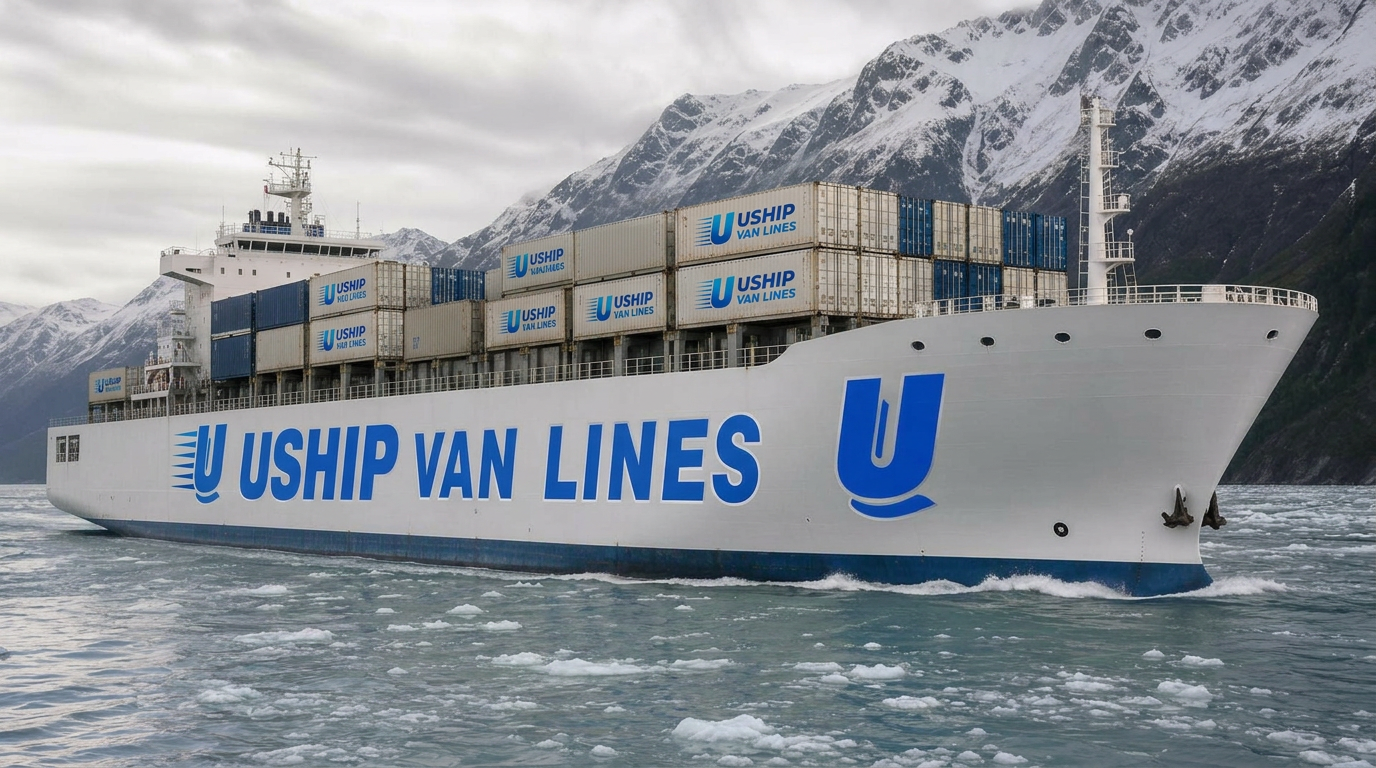
Moving from Alaska to Vermont
Moving from Alaska to Vermont means navigating one of the most complex domestic relocations in the U.S. — combining barge transport across the Pacific, cross-country trucking through Canada or the Lower 48, and final delivery to your Green Mountain State destination. Whether you're leaving Anchorage for Burlington, relocating from Fairbanks to Montpelier, or moving from the Mat-Su Valley to rural Vermont, this route demands careful coordination and deep Alaska logistics expertise.
Best Alaska & Hawaii Movers, powered by UShip Van Lines, specializes in Alaska's unique barge-to-road moves. We coordinate every leg — port scheduling in Tacoma, barge transit to Anchorage, over-the-road transport through 3,500+ miles, and white-glove delivery to your Vermont home. Request your free, customized quote today to get started.
Route overview
The Alaska-to-Vermont Moving Route
This lane covers approximately 3,800–4,200 miles door-to-door, depending on your Alaska origin and Vermont destination. Household goods travel via barge from Alaska ports (typically Anchorage or Whittier) to Tacoma, Washington, then cross-country by truck through either the ALCAN Highway corridor or Lower 48 highways to Vermont. The route crosses multiple climate zones — from sub-arctic Alaska through Canadian interior, the northern plains, and finally into New England's mountains and valleys.
Vermont destinations range from Burlington and the Lake Champlain corridor to Montpelier, Rutland, Brattleboro, and rural hill towns. Final delivery may involve narrow village roads, seasonal weight restrictions on town highways, and steep driveways in winter. Coordinating barge schedules with cross-country transit and Vermont's seasonal road conditions requires experienced logistics planning.
This is a low-volume lane with limited competition, making it essential to work with a carrier experienced in both Alaska barge logistics and New England delivery challenges.
How the moving process works
How the Alaska-to-Vermont Moving Process Works
-
Free consultation and inventory assessment — We evaluate your household size, special items (vehicles, boats, ATVs), and Alaska pickup location to design a custom move plan and provide a detailed quote.
-
Barge scheduling and port coordination — We book space on the next available barge from Anchorage or Whittier to Tacoma (or Seattle), coordinating pickup timing with sailing schedules that run weekly to bi-weekly depending on season.
-
Alaska pickup and containerization — Professional movers load your belongings into weather-sealed containers at your Alaska residence, transport to the port, and prepare for barge transit (typically 5–7 days at sea).
-
Tacoma port delivery and customs clearance — Containers are offloaded in Tacoma, cleared through any necessary inspections, and transferred to long-haul trucks for cross-country transport.
-
Cross-country trucking to Vermont — Your shipment travels 3,000+ miles via ALCAN/Canada routes or Lower 48 interstates, with routing chosen based on season, road conditions, and delivery timeline.
-
Vermont delivery and unpacking — Experienced movers navigate Vermont's village roads and deliver to your home, with full unpacking and debris removal available.
-
Post-move support — We follow up to ensure satisfaction and handle any claims or final questions about your cross-country Alaska move.
Estimated moving costs
What Does It Cost to Move from Alaska to Vermont?
A typical 2–3 bedroom household moving from Alaska to Vermont costs $8,500–$16,000 for full-service door-to-door transport. Studio and 1-bedroom moves range $5,500–$8,500, while 4+ bedroom homes can exceed $18,000–$25,000. These are estimates only; actual quotes depend on precise inventory, services, and timing.
Key cost drivers:
- Volume and weight — Alaska moves are priced primarily by container space (linear feet or full 20'/40' containers) plus weight for the cross-country leg
- Barge freight — Anchorage-to-Tacoma barge transport adds $2,000–$4,500 depending on container size and season
- Distance — 3,800+ mile over-the-road transport from Tacoma to Vermont is the largest single cost component
- Access and labor — Multi-story buildings without elevators, long carries, or difficult Vermont driveways (steep, unpaved, narrow) increase labor costs
- Season — Winter moves (November–March) may incur surcharges for Alaska winter pickup or Vermont snow-season delivery
- Vehicle shipping — Adding a car or truck to your barge container can save vs. separate auto transport ($1,800–$3,200 typically)
- Packing services — Professional packing adds $800–$2,500 depending on home size and fragile item quantity
We never guarantee prices without a formal quote. Request your free estimate to get accurate pricing for your specific move.
Estimated transit times
How Long Does an Alaska-to-Vermont Move Take?
Expect 18–28 days door-to-door for most Alaska-to-Vermont moves, though timelines vary by season, barge schedules, and weather.
Transit breakdown:
- Alaska pickup to port: 1–2 days (same-day in Anchorage, longer for Fairbanks, Mat-Su, Kenai, or bush communities requiring truck/barge feeder service)
- Barge transit to Tacoma: 5–7 days at sea (Anchorage/Whittier to Tacoma)
- Port offload and truck loading: 2–4 days (depends on port congestion and customs if routed through Canada)
- Cross-country trucking: 7–10 days (Tacoma to Vermont, weather-dependent in winter)
- Vermont delivery window: 1–3 days (delivery appointments scheduled in advance)
Seasonal variables: Winter barge schedules may be less frequent (every 10–14 days vs. weekly in summer). Snow and ice in Vermont (December–March) can delay final delivery. Spring mud season (March–April) may restrict access on unpaved town roads. Summer and early fall offer the most predictable timelines.
Expedited service is rarely available for Alaska moves due to fixed barge schedules, but we optimize every land-side connection to minimize total transit time.
Regional logistics
Alaska-to-Vermont Moving Logistics You Need to Know
Ports and barge routes: Most shipments originate at the Port of Anchorage or Whittier (60 miles south) and sail to Tacoma. Some Southeast Alaska moves (Juneau, Ketchikan, Sitka) use different barge routes. Fairbanks, Mat-Su, Kenai, and bush locations require truck transport to Anchorage ports.
Containerization and weather protection: All Alaska household goods travel in weather-sealed containers (wood vaults or steel intermodal containers) to protect against ocean spray, rain, and humidity during barge transit. Proper sealing is critical — amateur movers or self-packed containers risk water damage.
Vehicle shipping: You can ship one vehicle inside your household goods container (space permitting) or use separate auto transport. Container consolidation saves money but limits vehicle size. Separate auto transport offers more flexibility and costs $2,000–$3,500 Alaska to Vermont.
Customs and border crossings: If your truck routes through Canada (common for ALCAN corridor), no customs duties apply (U.S. household goods in transit), but proper documentation is required. Experienced carriers handle all paperwork.
Vermont delivery access: Many Vermont towns have narrow roads, low-clearance bridges, and seasonal weight restrictions (especially mud season). Large trucks may require shuttle service for final delivery. Historic village homes may have tight doorways and steep stairs.
Storage options: If your Vermont home isn't ready, we offer climate-controlled storage in Tacoma (after barge arrival) or Vermont (before final delivery). Storage costs $150–$400/month depending on volume.
Insurance: Basic carrier liability covers $0.60/lb. Full-value replacement protection is strongly recommended for Alaska moves and costs 1–3% of declared shipment value.
Seasonal considerations
Best Time of Year to Move from Alaska to Vermont
Summer (June–August): Peak moving season for both states. Weekly barge sailings, easiest Alaska access (including gravel roads in rural areas), and no snow complications in Vermont. Book 6–8 weeks ahead. Higher demand may mean premium pricing.
Fall (September–October): Excellent choice. Barge schedules still frequent, Alaska weather stable, and Vermont's fall foliage season ends before heavy snow. Slightly lower demand than summer. Watch for early winter storms in Alaska mountains and Vermont's Green Mountains by late October.
Winter (November–March): Challenging but feasible. Barge schedules reduce to every 10–14 days. Alaska winter pickup requires experienced crews for ice, snow, and extreme cold. Vermont delivery faces snow, ice, and town road weight limits. Allow extra time and budget for weather delays. Lowest pricing of the year if you have flexibility.
Spring (April–May): Unpredictable. Alaska breakup season means muddy rural roads and variable weather. Vermont mud season (late March–April) can make town road delivery difficult, and some roads have seasonal weight restrictions. Barge schedules increase in April. Good pricing, but build in weather buffers.
Pro tip: If moving to rural Vermont, avoid March–April mud season if possible. If leaving rural Alaska (bush communities, gravel road access), avoid breakup season (late April–May) when thawing makes roads impassable.
Why choose Best Alaska & Hawaii Movers
Why Choose Best Alaska & Hawaii Movers for Your Alaska-to-Vermont Move
- Alaska barge logistics expertise — We coordinate weekly with Tacoma and Anchorage ports, manage container booking, and handle all weather-protection requirements for ocean transit
- Nationwide long-haul network — Powered by UShip Van Lines, we operate cross-country routes to all 50 states, including specialized New England delivery experience
- Single-point accountability — One team manages your entire move from Alaska pickup through barge transit, cross-country trucking, and Vermont delivery — no handoffs to unknown subcontractors
- Transparent pricing — Detailed quotes with clear breakdowns of barge freight, trucking, labor, and services — no hidden fees or surprise charges
- Seasonal planning support — We help you choose optimal timing for barge schedules, Alaska access, and Vermont delivery conditions, with honest advice about weather risks
- Full-service or flexible options — Choose white-glove packing and unpacking, partial packing for fragile items only, or cost-saving self-pack with professional loading and transport