
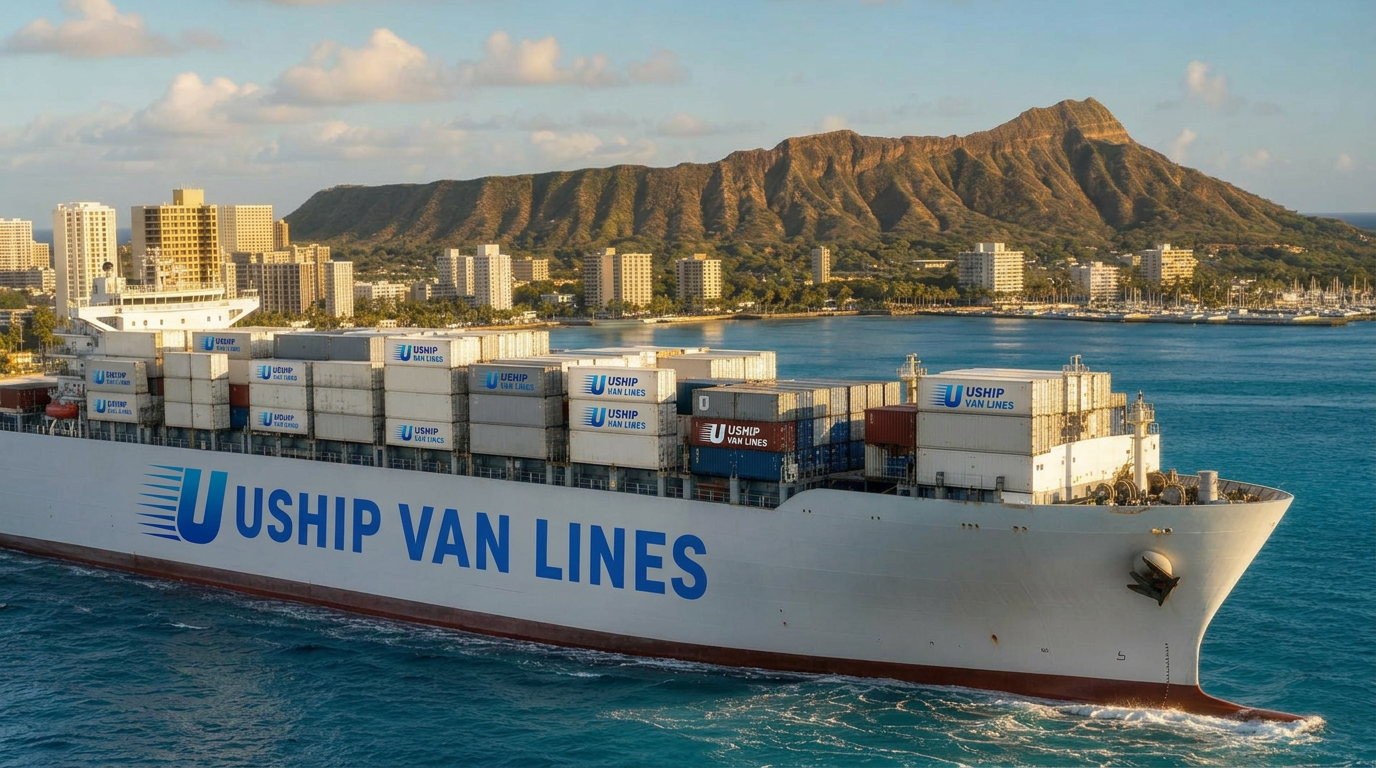
Moving from United States to Hawaii
Moving from the continental United States to Hawaii is one of the most unique relocations you'll ever make—your belongings travel by ocean container across 2,500+ miles of Pacific Ocean, arriving weeks after you do. Unlike any mainland move, Hawaii relocations require careful planning around steamship schedules, strict agricultural inspections, and island-specific delivery logistics that can add days or weeks to your timeline.
Whether you're heading to Oahu, Maui, Kauai, or the Big Island, understanding the container shipping process, realistic costs, and what items simply cannot come with you will save you thousands of dollars and considerable stress. Best Alaska & Hawaii Movers—powered by UShip Van Lines—specializes exclusively in these ocean moves, coordinating every step from your mainland door to your new island home. Ready to start planning your move to paradise? Request your free, detailed quote today.
Route overview
How Mainland-to-Hawaii Moves Actually Work
Every household move from the lower 48 states to Hawaii follows the same basic path: your belongings are picked up by a mainland moving crew, transported to the Port of Long Beach or Port of Oakland in California, loaded into a 20-foot or 40-foot ocean container, shipped via Matson Navigation or Pasha Hawaii to Honolulu, cleared through agricultural inspection, and finally delivered to your island address. If you're moving to a neighbor island (Maui, Kauai, Big Island, Molokai, Lanai), your container is transferred to a smaller inter-island barge, adding another 2–7 days.
This is not a direct-load, point-to-point truck move. Your shipment joins hundreds of other containers aboard vessels that sail on fixed weekly schedules—miss a sailing window by one day, and your belongings wait another week at the port. Timing is everything. Most customers pack and ship 4–6 weeks before their own flight to Hawaii, ensuring their household goods arrive shortly after they do.
The Port of Honolulu is the primary gateway, handling over 80% of all household moves to Hawaii. From there, containers are either delivered directly on Oahu or transferred to Matson's Young Brothers barge service for neighbor island delivery. Understanding these handoff points—and the inspections that happen at each—is critical to avoiding delays and unexpected fees.
How the moving process works
Step-by-Step: Your Mainland-to-Hawaii Move Timeline
-
Request a Quote & Schedule Your Move (6–8 Weeks Before Departure) — Contact Best Alaska & Hawaii Movers for a detailed estimate based on your inventory. We'll reserve your pickup date and book your container space on the next available sailing. Lead times of 4–6 weeks are standard during peak summer and holiday seasons.
-
Pre-Move Purge & Hawaii Preparation (4–6 Weeks Out) — Hawaii has the strictest agricultural quarantine laws in the nation. You cannot ship soil, plants (except with USDA permits), certain woods, or any items that could harbor pests. Review the Hawaii Department of Agriculture's prohibited items list and dispose of or sell anything that won't pass inspection. This is also the time to arrange vehicle shipping separately if needed.
-
Mainland Pickup & Container Loading (3–5 Weeks Before Your Flight) — Our crew arrives at your current home, packs and loads your belongings, and transports everything to the Port of Long Beach or Oakland. Your shipment is loaded into a sealed ocean container, tagged with your name and destination island, and staged for the next Matson or Pasha sailing.
-
Ocean Transit to Honolulu (7–14 Days) — Your container sails across the Pacific on a fixed schedule. Matson vessels typically take 5–7 days to reach Honolulu from the West Coast; Pasha runs a slightly longer 7–10 day route. Once the ship docks, containers are offloaded and queued for agricultural inspection.
-
Agricultural Inspection & Port Clearance (1–3 Days) — Every container entering Hawaii is inspected by HDOA officials. Inspectors may open boxes, check furniture joints, and quarantine any prohibited items. Clean, well-packed shipments clear quickly; anything flagged for pests or soil contamination can be held or refused entry.
-
Final Delivery to Your Island Address (1–10 Days After Clearance) — If you're on Oahu, delivery happens within 1–3 days of clearance. For neighbor islands, your container is transferred to a Young Brothers barge (2–3 sailings per week to each island), adding 3–7 days. Our island delivery team schedules your unload, brings your container to your new home, and places items room by room.
-
Unpack, Inspect & Settle In — Once unloaded, inspect all items immediately and note any damage on the delivery receipt. File claims within 9 months if needed. Most customers are fully unpacked within a week of delivery, ready to start their new Hawaii life.
Estimated moving costs
What You'll Actually Pay to Move from the Mainland to Hawaii
A typical 2-bedroom household (approximately 5,000–7,000 lbs) moving from the West Coast to Oahu costs $5,500–$8,500 door-to-door, including packing, container shipping, agricultural inspection, and final delivery. A 3-bedroom home (8,000–12,000 lbs) typically runs $8,500–$13,500. Moves from the Midwest or East Coast add $1,500–$3,000 for the additional overland leg to the California port.
Neighbor island delivery (Maui, Kauai, Big Island) adds $800–$1,800 for the inter-island barge and second delivery crew. Peak season moves (May–September) can see surcharges of 10–15% due to container shortages and sailing demand.
Key cost drivers specific to Hawaii moves:
- Container size and weight — You're charged by cubic footage and weight. A full 40-foot container holds a 3–4 BR home; a 20-foot container fits a small 1–2 BR apartment. Shared (consolidated) containers cost less but add 1–2 weeks to transit time.
- Origin distance from West Coast ports — Moves from California, Oregon, and Washington are cheapest; Midwest and East Coast origins require long-haul trucking to Long Beach or Oakland.
- Packing and crating services — Full-service packing (recommended for fragile items and ocean transit) adds $1,200–$2,500. DIY packing saves money but increases your risk of damage claims.
- Vehicle shipping — Cars and trucks ship separately via Roll-on/Roll-off (RoRo) vessels. Expect $1,200–$1,800 per vehicle from the West Coast to Honolulu, plus $300–$500 for neighbor island barge.
- Storage and missed sailings — If you miss your scheduled sailing or need to store your container at the port, demurrage fees of $75–$150/day apply quickly.
- Insurance and valuation — Basic carrier liability covers $0.60/lb. Full-value replacement coverage costs 1–2% of your shipment's declared value but protects high-value items.
We provide itemized, transparent quotes with no hidden fees. Prices are estimates based on your inventory list and current sailing rates—final costs are confirmed after weight and cube are measured at loading. We never guarantee fixed prices until your shipment is weighed and loaded.
Estimated transit times
Realistic Door-to-Door Timelines: Mainland to Hawaii
Plan for 3–6 weeks total from your mainland pickup to final delivery in Hawaii. The exact timeline depends on your origin city, which sailing you catch, and whether you're moving to Oahu or a neighbor island.
Typical timeline breakdown:
- Mainland pickup to West Coast port: 1–5 days (same-day if you're in Southern California; 3–5 days from the East Coast or Midwest)
- Port staging and container loading: 2–4 days (your shipment waits for the next scheduled Matson or Pasha sailing)
- Ocean transit to Honolulu: 5–10 days (Matson Express is fastest at 5–7 days; Pasha takes 7–10 days)
- Agricultural inspection and port clearance: 1–3 days (clean shipments clear in 24 hours; flagged items can delay you 3–5 days)
- Final delivery on Oahu: 1–3 days after clearance
- Inter-island barge and neighbor island delivery: Add 3–7 days if moving to Maui, Kauai, Big Island, or outer islands
Fastest possible scenario: A Los Angeles resident moving to Honolulu during off-peak season, with a clean agricultural inspection, can see delivery in 14–18 days. Longest realistic timeline: A New York family moving to Kauai during peak summer, with a missed sailing and re-inspection, might wait 6–8 weeks.
Matson sails multiple times per week; Pasha runs 1–2 sailings weekly. Missing your target sailing by even one day means waiting 4–7 days for the next vessel. We coordinate pickup dates to ensure you catch your scheduled sailing—but last-minute booking or delays at your origin can push you to the next week's ship.
Most customers fly to Hawaii 1–2 weeks after their household goods ship, giving their container time to arrive and clear inspection before they need their belongings.
Regional logistics
Hawaii-Specific Logistics: Ports, Paperwork & Last-Mile Challenges
West Coast Port Operations
Your shipment will route through the Port of Long Beach or Port of Oakland—the two primary gateways for Hawaii cargo. Long Beach handles the majority of Matson sailings; Oakland serves as a secondary hub. These ports are massive, industrial complexes where your container competes with thousands of others for space, inspection, and loading. Container terminals charge demurrage (storage fees) if your shipment sits too long—typically $75–$150/day after the first 5 days.
Agricultural Inspection: The Hawaii Wild Card
Hawaii's agricultural inspection is non-negotiable and can make or break your move timeline. Inspectors look for soil, live plants, wooden packing materials (especially pallets and crates), seeds, and any signs of insect infestation. Prohibited items are destroyed on-site at your expense. Common mistakes that trigger delays:
- Shipping potted plants or garden soil
- Packing items in used cardboard boxes from farms or outdoor storage
- Including wicker, rattan, or bamboo furniture without proper certification
- Failing to clean lawnmowers, bicycles, and outdoor gear thoroughly
We provide a pre-move checklist to help you avoid these issues. Inspections happen at the Honolulu port after your container is offloaded—you have no control over the timing, but clean shipments clear in 24–48 hours.
Vehicle Shipping: A Separate Transaction
Cars, trucks, motorcycles, and RVs do not ship in your household goods container—they travel via Roll-on/Roll-off (RoRo) car carriers operated by Matson or Pasha. You'll need separate paperwork (title, registration, insurance proof), and vehicles must be nearly empty (less than ¼ tank of gas, no personal items except floor mats). Vehicle shipping costs $1,200–$1,800 from the West Coast to Honolulu, with an additional $300–$500 for neighbor island delivery. Book vehicle shipping simultaneously with your household move to align timelines.
Neighbor Island Transfers: The Final Hurdle
If you're moving to Maui, Kauai, the Big Island, Molokai, or Lanai, your container doesn't go directly from the mainland ship to your door. It's offloaded in Honolulu, transferred to Young Brothers' inter-island barge fleet, and sails again to your destination island. Young Brothers operates 2–3 barge runs per week to each neighbor island. This leg adds 3–7 days and costs an additional $800–$1,800 depending on island and container size. Final delivery on neighbor islands can face additional challenges: narrow roads (especially on Kauai's North Shore and Big Island's rural areas), limited delivery windows, and smaller crews.
Delivery Access & Restrictions
Many Hawaii neighborhoods have steep driveways, narrow streets, and limited truck access. High-rise condos in Honolulu require building permits, elevator reservations, and strict delivery windows (often 7 AM–4 PM weekdays only). Gated communities may require advance notification and escort. Rural Big Island and Maui properties may only be accessible by smaller trucks, requiring a second transfer. We survey your delivery address in advance to plan the right equipment and crew size.
Seasonal considerations
Best (and Worst) Times to Move to Hawaii
May–September: Peak Season & Hurricane Awareness
Summer is the busiest moving season to Hawaii—families relocate before the school year, military transfers spike, and vacation travel clogs shipping schedules. Container space is tight, prices rise 10–15%, and port congestion can add 3–5 days to delivery. June through November is also the Central Pacific hurricane season. While direct hits on Hawaii are rare, tropical storms can delay sailings by 2–7 days and close ports temporarily. Book 6–8 weeks in advance if moving during summer.
October–December: Holiday Rush & Weather Unknowns
October and early November offer a brief lull with good weather and fewer crowds—this is an underrated sweet spot for moving. Late November through December sees another spike as people relocate for the holidays. Hurricane season officially ends November 30, reducing weather risk. Expect some port delays around Thanksgiving and Christmas as cargo volume surges.
January–April: Off-Peak Savings & Smooth Sailing
Winter and early spring are the easiest, cheapest times to move to Hawaii. Container availability is excellent, sailing schedules run on time, and you'll often see 10–15% lower rates than summer. Weather is mild in Hawaii but can be stormy on the mainland (especially Midwest and East Coast ice storms), which can delay your initial pickup. This is the best window for flexible movers who want predictable timelines and lower costs.
Year-Round Consideration: Port Labor & Shipping Disruptions
West Coast port labor negotiations, chassis shortages, and supply chain disruptions can impact any move, any time of year. The 2023 ILWU negotiations caused weeks of delays; similar issues can recur. We monitor port conditions daily and adjust pickup schedules to minimize your exposure to these delays. Booking early and maintaining flexibility in your delivery window protects you from these unpredictable events.
Why choose Best Alaska & Hawaii Movers
Why Best Alaska & Hawaii Movers for Your Mainland-to-Hawaii Relocation
-
We Only Do Hawaii & Alaska Moves — Unlike mainland movers who treat island shipments as an afterthought, we specialize exclusively in ocean container moves to and from Hawaii and Alaska. We know Matson and Pasha sailing schedules, agricultural inspection quirks, and neighbor island barge logistics better than any general moving company.
-
Single-Source Coordination, Port to Island — You get one point of contact who manages your entire move: mainland pickup, port delivery, container booking, customs and agricultural clearance, inter-island transfer (if needed), and final delivery to your door. No handoffs, no confusion, no "that's not our responsibility."
-
Transparent Pricing, No Sailing-Day Surprises — We provide itemized quotes that include all port fees, container costs, agricultural inspection, and delivery surcharges. You'll know exactly what you're paying before your shipment leaves the mainland—no hidden demurrage fees or last-minute "fuel surcharges."
-
Real-Time Shipment Tracking & Proactive Communication — We monitor your container from pickup through final delivery, alerting you to sailing confirmations, port arrivals, inspection clearance, and delivery appointments. You'll never wonder where your belongings are or when they'll arrive.
-
Powered by UShip Van Lines' Nationwide Network — Best Alaska & Hawaii Movers operates under the UShip Van Lines network, giving you access to vetted mainland crews, reliable port drayage, and comprehensive insurance options. You get boutique island expertise backed by a national infrastructure.