
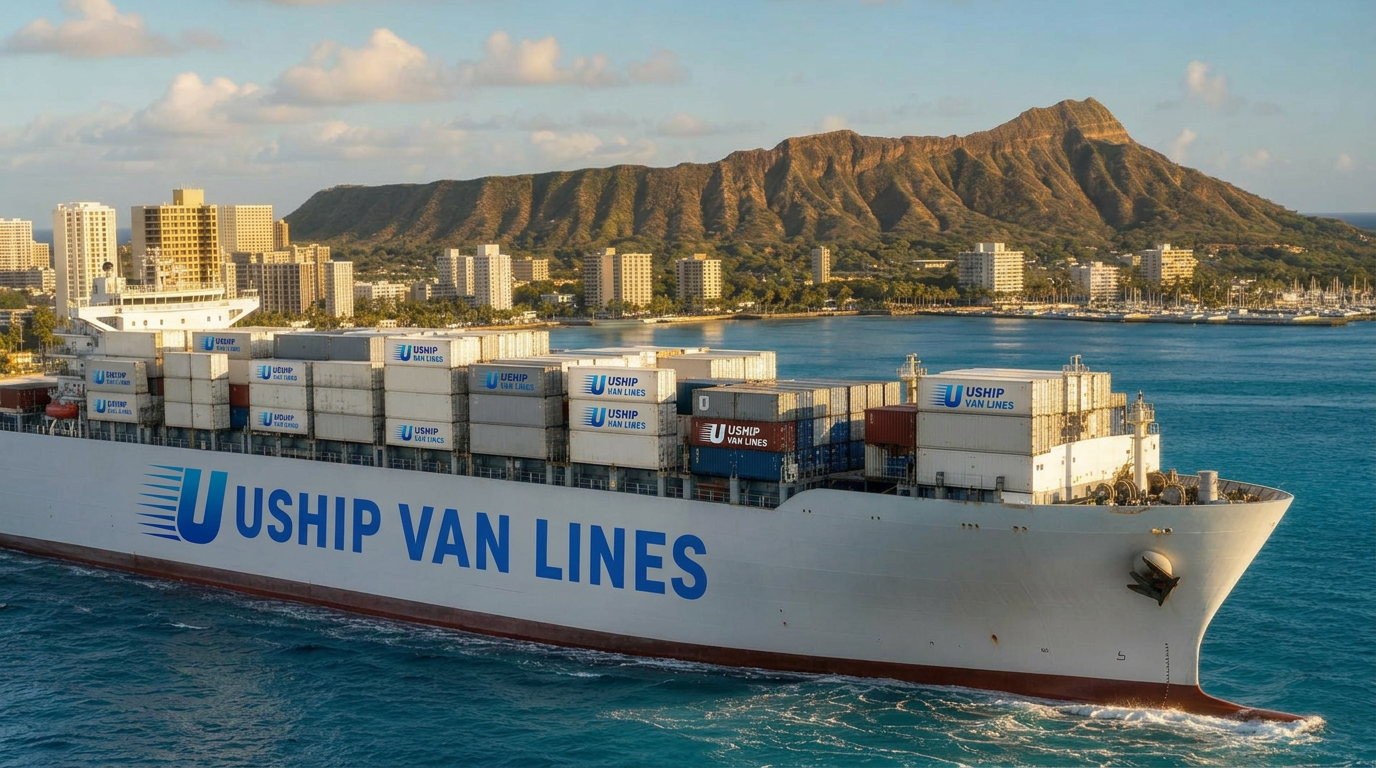
Moving from United States to Hawaii
Moving from the continental United States to Hawaii requires specialized ocean freight expertise that most traditional moving companies simply don't have. Whether you're relocating from California, Texas, New York, or anywhere in between, your household goods will travel via ocean container from West Coast ports—typically Long Beach or Oakland—to Honolulu, with additional inter-island shipping if you're settling on Maui, Kauai, or the Big Island.
Best Alaska & Hawaii Movers, powered by UShip Van Lines, coordinates every leg of your mainland-to-Hawaii move: consolidated pickup from your current home anywhere in the U.S., secure container loading at port, ocean transit with Matson or Pasha carriers, customs clearance, and final delivery to your new island address. Request your detailed moving quote today to get started with transparent pricing and realistic timelines.
Route overview
Moving from the Mainland to Paradise
Every household move to Hawaii follows the same fundamental path: your belongings are picked up from your current state, transported overland to either the Port of Long Beach or Port of Oakland in California, loaded into ocean containers, shipped across the Pacific (approximately 2,400 nautical miles to Honolulu), cleared through Hawaii's strict agricultural inspection, and delivered to your island address. If you're moving to an outer island like Maui, Kauai, or the Big Island, your shipment undergoes an additional inter-island leg via Young Brothers barge service.
This route serves every state in the continental U.S., from East Coast cities like Boston and Miami to Midwest locations like Chicago and Denver, to Southwest hubs like Phoenix and Dallas. Regardless of your origin point, the ocean crossing portion remains consistent—what varies is the overland transit time to reach California ports. West Coast origins may see door-to-door delivery in 3–4 weeks, while East Coast moves typically require 5–7 weeks total.
Hawaii's geographic isolation means there are no shortcuts or alternative routes. Understanding the multi-modal nature of this move—truck, container terminal, ocean vessel, agricultural inspection, and final delivery—helps you plan realistic timelines and avoid common pitfalls like scheduling your arrival before your household goods clear customs.
How the moving process works
How Your Mainland-to-Hawaii Move Works
-
Free quote and planning consultation – Provide your origin city, destination island and address, inventory list (bedroom count or detailed items), and preferred moving dates. We'll provide a detailed cost breakdown covering pickup, ocean freight, customs, and delivery.
-
Overland transport to California port – A partner carrier picks up your household goods from your current address anywhere in the U.S. and transports them to either Long Beach or Oakland, depending on sailing schedules and consolidation routes. This leg typically takes 3–10 days depending on distance.
-
Container loading and documentation – Your shipment is loaded into a shared ocean container (LCL) or dedicated container (FCL for large moves), and all required customs paperwork is prepared, including Hawaii Form 5-H (Declaration for Plants and Animals) and itemized inventory manifests.
-
Ocean transit to Honolulu – Matson or Pasha vessels depart California ports 2–4 times weekly, with ocean transit taking 5–7 days to reach Honolulu Harbor. Your shipment remains sealed and climate-controlled throughout the voyage.
-
Agricultural and customs inspection – All household shipments entering Hawaii undergo mandatory inspection by the Hawaii Department of Agriculture to prevent invasive species. This process adds 1–3 business days and may require unpacking specific items for visual inspection.
-
Inter-island transfer (if applicable) – Shipments destined for Maui, Kauai, or the Big Island transfer to Young Brothers barges in Honolulu, adding 2–5 days depending on barge schedules and destination port capacity.
-
Final delivery to your new home – A local Hawaii moving crew delivers your cleared shipment to your island address, unloads all items, and performs basic furniture placement. Final-mile delivery windows are typically 2–3 business days to accommodate island logistics.
Estimated moving costs
What Your Move Will Cost
A typical 2–3 bedroom household move from the mainland United States to Hawaii ranges from $4,800 to $9,500 door-to-door, depending on volume, origin distance, destination island, and service level. West Coast origins (California, Oregon, Washington) generally fall in the $4,800–$6,500 range, while East Coast and Midwest origins typically cost $6,500–$9,500 due to longer overland transit.
Key cost factors include shipment volume (measured in cubic feet), whether you choose shared container (LCL) or dedicated container (FCL) service, origin-to-port distance, destination island (Oahu is least expensive; Kauai and Big Island add $800–$1,500 for inter-island transport), packing services (professional packing adds $800–$2,000), vehicle shipping (cars ship separately via roll-on/roll-off vessels at $1,200–$1,800 per vehicle), and storage fees if your shipment arrives before you do.
Insurance is mandatory for ocean transit and typically costs 1.5–3% of your declared valuation. Optional full-value protection provides comprehensive coverage but increases total cost by approximately 8–12%. We provide detailed, itemized quotes with no hidden fees—final price depends on your specific inventory and service selections, never on market fluctuations or last-minute surcharges.
Estimated transit times
How Long Your Move Takes
Door-to-door transit from the mainland U.S. to Hawaii typically requires 3–7 weeks depending on your origin location and destination island. West Coast origins (California, Nevada, Arizona) average 3–4 weeks total, while East Coast and Midwest locations should plan for 5–7 weeks.
Here's the typical breakdown: overland transport to California port takes 1–2 days (West Coast origins) up to 7–10 days (East Coast origins), container consolidation and port processing requires 2–4 days, ocean transit from California to Honolulu takes 5–7 days, agricultural inspection and customs clearance adds 1–3 business days, inter-island barge transfer (for outer islands) requires an additional 2–5 days, and final delivery scheduling typically occurs within 2–3 business days after clearance.
Sailing schedules are frequent—Matson operates multiple weekly departures from both Long Beach and Oakland—but agricultural inspection timelines are unpredictable and depend on inspector availability and workload at Honolulu Harbor. Plan conservatively: arriving in Hawaii 1–2 weeks before your household goods is common and allows you to secure housing, open bank accounts, and prepare for delivery without living in an empty home or paying for hotel storage of essential items.
Regional logistics
Hawaii-Specific Moving Requirements
Port operations: Your shipment will process through either Long Beach or Oakland on the mainland, then arrive at Honolulu Harbor (Sand Island Container Terminal). Outer island destinations—Kahului (Maui), Nawiliwili (Kauai), Hilo and Kawaihae (Big Island)—receive shipments via Young Brothers inter-island barge from Honolulu. You cannot choose your mainland departure port; it's determined by consolidation schedules and vessel availability.
Agricultural inspection: Hawaii maintains the strictest biosecurity protocols in the United States. Every household shipment undergoes mandatory inspection for invasive species, pests, and prohibited plants. Inspectors may open boxes, examine furniture crevices, and quarantine items requiring fumigation. Common issues include potted plants (generally prohibited), soil on garden tools or sports equipment, wood furniture with bark edges, and used outdoor equipment. Clean all items thoroughly before packing, and declare anything questionable on your Form 5-H to avoid delays or fines.
Vehicle shipping: Cars and household goods ship separately. Vehicles travel via Matson or Pasha roll-on/roll-off (RoRo) vessels and require separate booking, typically costing $1,200–$1,800 per vehicle from West Coast ports. Vehicles must be nearly empty (less than ¼ tank fuel, no personal items except floor mats and car seats) and arrive at the vehicle processing terminal 3–5 days before sailing. Vehicle transit takes 7–10 days port-to-port, plus overland transport time if you're not driving to California yourself.
Documentation requirements: You'll need a detailed inventory list for customs (item-by-item for high-value electronics and appliances), Hawaii Form 5-H agricultural declaration, proof of Hawaii residency or lease agreement, valid government ID, and insurance documentation. Missing or incomplete paperwork delays customs clearance by days or weeks.
Delivery access: Many Hawaii neighborhoods have narrow streets, low-hanging trees, or restricted truck access. High-rise condos may require freight elevator reservations, building insurance certificates, and move-in deposits. Communicate delivery address specifics—including any access restrictions, parking limitations, or HOA requirements—when booking to avoid day-of-delivery complications and potential re-delivery fees ($300–$600).
Seasonal considerations
Best Times to Move to Hawaii
Winter (December–February): Peak tourist season means higher accommodation costs if you arrive early, but moving costs remain stable. Weather in Hawaii is mild year-round, though winter brings occasional heavy rain and surf on north shores. Port congestion is moderate. Book 8–10 weeks ahead for holiday-adjacent moves.
Spring (March–May): Excellent moving window with moderate weather, lower tourist traffic, and good port availability. Agricultural inspection queues are typically shorter in April and May. This is often the most cost-effective period for booking, particularly mid-March through early May.
Summer (June–August): High season for family relocations aligned with school calendars. Expect higher demand for delivery appointments and potentially longer final-mile scheduling windows. Hurricane season begins June 1, though direct Hawaii impacts are rare. Book 10–12 weeks ahead for July–August arrivals.
Fall (September–November): Hurricane season peaks in September but rarely affects shipping schedules. Port operations remain consistent. Fall offers good availability and competitive pricing, particularly September–October before holiday volume begins. Agricultural inspection processing is generally efficient during this period.
Hawaii's year-round temperate climate means weather rarely delays ocean transits. The primary seasonal variable is port congestion during summer months and around major holidays (Thanksgiving, Christmas). For maximum flexibility and best pricing, avoid scheduling your shipment arrival during the last two weeks of December or the first week of January.
Why choose Best Alaska & Hawaii Movers
Why Choose Best Alaska & Hawaii Movers
-
Specialized Hawaii expertise: We coordinate mainland-to-Hawaii moves daily, managing every leg from your current doorstep through ocean transit, agricultural inspection, and final island delivery—eliminating the coordination burden of working with multiple carriers.
-
Transparent, all-inclusive pricing: Our detailed quotes break down every cost component—pickup, port handling, ocean freight, customs, inter-island transfer, and delivery—so you know exactly what you're paying for with no surprise fees at delivery.
-
Established carrier partnerships: We work directly with Matson and Pasha for ocean transit and maintain relationships with Hawaii-based delivery teams on all major islands, ensuring reliable service and accountability throughout your move.
-
Agricultural compliance guidance: We prepare you for Hawaii's strict biosecurity requirements, provide accurate Form 5-H completion instructions, and advise which items to leave behind or ship separately to avoid inspection delays.
-
Powered by UShip Van Lines: Our technology platform provides real-time shipment tracking, digital documentation management, and 24/7 customer support throughout your move, giving you visibility and peace of mind during the multi-week transit process.