
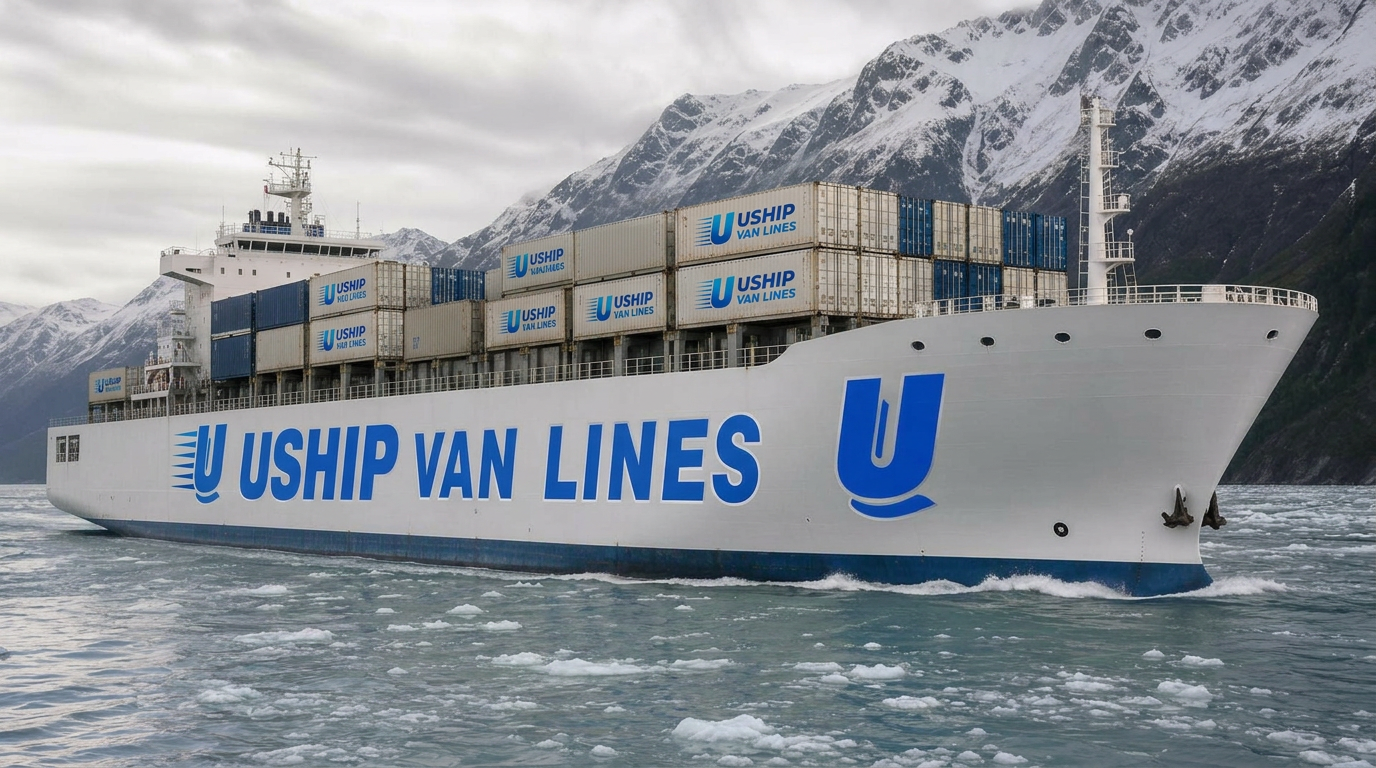
Moving from United States to Alaska
Moving to Alaska requires specialty logistics that standard long-distance movers can't handle. Your household goods travel by truck to the Port of Tacoma, ride a barge across the Gulf of Alaska, and complete the final leg to Anchorage, Fairbanks, or beyond. The process typically takes 2–4 weeks door-to-door, with costs varying widely based on volume, destination, and season.
Best Alaska & Hawaii Movers, powered by UShip Van Lines, coordinates every leg of your move—from continental pickup through barge booking and last-mile delivery across Alaska. Request your free quote today to receive a detailed estimate tailored to your exact route and timeline.
Route overview
How Your Belongings Travel to Alaska
Alaska is not connected to the continental U.S. highway system, which means every household move requires ocean freight. Your possessions travel by truck from your origin city to the Port of Tacoma in Washington State, where they're loaded into ocean-rated containers and placed aboard Alaska Marine Lines or Tote Maritime barges. These vessels sail 1,400 nautical miles through the Inside Passage or Gulf of Alaska to the Port of Anchorage, Alaska's primary cargo hub.
From Anchorage, your shipment transfers to local carriers for delivery to your final address—whether that's in Anchorage proper, the Mat-Su Valley (Wasilla, Palmer), the Kenai Peninsula, Fairbanks via the Parks Highway, or even bush communities accessible only by air or seasonal ice roads. This intermodal journey requires precise coordination between trucking companies, barge lines, and Alaska destination agents.
Barge sailings from Tacoma to Anchorage run multiple times per week year-round, though departure frequency and transit speed vary by season. Winter ice conditions and severe weather can add 2–5 days to voyage times, while summer offers faster, more frequent service with calmer seas.
How the moving process works
The Alaska Moving Process: Step by Step
-
Origin pickup and containerization – A crew loads your household goods at your continental U.S. residence and packs them into a 20-foot or 40-foot ocean container, securing items against the motion of sea transport.
-
Truck transport to Port of Tacoma – The sealed container travels by truck to Tacoma, Washington, typically taking 1–5 days depending on your origin state. Cross-country moves from the East Coast may require 7–10 days for this leg.
-
Port staging and customs documentation – At the port, your container is inspected, documented, and staged for loading. Alaska is part of the United States, so no international customs clearance is required, though cargo manifests must be filed.
-
Barge voyage to Anchorage – Your container boards an Alaska-bound barge for a 3–7 day ocean voyage (weather and routing dependent). Vessels sail through protected Inside Passage waters or open Gulf of Alaska routes.
-
Port of Anchorage offloading – Containers are unloaded at the Port of Anchorage and transferred to a secure yard for local carrier pickup, usually within 1–2 business days of arrival.
-
Last-mile delivery – An Alaska-based trucking company transports your container to your final address. Anchorage-area deliveries often complete same-day; Fairbanks, Mat-Su, and Kenai deliveries add 1–3 days; remote bush destinations require specialized arrangements.
-
Unloading and container return – Movers unload your belongings, and the empty container is returned to the port for back-haul to the Lower 48.
Estimated moving costs
What Alaska Moves Cost
A typical 2–3 bedroom household moving from the continental United States to Alaska costs $6,500–$14,000, depending on distance, volume, season, and final destination. A studio or 1-bedroom move may range $3,500–$6,000, while 4+ bedroom homes can exceed $16,000.
Key cost drivers:
- Distance to Port of Tacoma – West Coast origins (California, Oregon, Washington) pay less for the trucking leg than East Coast or Southern states, which require cross-country hauls.
- Shipment volume – Barge freight is priced by container size (20-foot vs. 40-foot) and sometimes by cubic footage. Partial containers cost more per cubic foot than full loads.
- Final Alaska destination – Anchorage deliveries are least expensive. Fairbanks, Mat-Su, and Kenai Peninsula addresses add $800–$2,000 for extended ground transport. Bush and island communities require air freight or seasonal barge service at premium rates.
- Season – Summer (May–September) is peak moving season; rates rise 15–30% due to demand. Winter offers lower costs but longer, weather-dependent transit.
- Vehicle shipping – Adding a car or truck to your move costs $1,200–$2,500 via the same barge (roll-on/roll-off service).
- Packing and crating – Full professional packing adds $800–$2,500. Fragile items, artwork, and electronics often require custom crating for ocean transport.
Best Alaska & Hawaii Movers provides binding estimates based on a detailed inventory. We never quote guaranteed flat rates without assessing your specific shipment and route.
Estimated transit times
How Long Your Alaska Move Takes
Door-to-door transit from the continental U.S. to Alaska typically requires 14–28 days, broken down as follows:
- Origin pickup to Port of Tacoma: 1–10 days, depending on your starting location. West Coast pickups reach Tacoma in 1–3 days; Midwest origins need 4–7 days; East Coast shipments take 7–10 days by truck.
- Port staging: 1–3 days for container inspection, documentation, and loading onto the next available barge.
- Barge voyage: 3–7 days from Tacoma to Anchorage. Summer sailings average 3–4 days in calm conditions; winter storms can extend voyages to 6–7 days.
- Anchorage port processing: 1–2 days for offloading, customs paperwork, and transfer to local carriers.
- Last-mile delivery: Same-day to 5 days. Anchorage metro deliveries often complete within 24 hours of port release. Fairbanks adds 1–2 days (358-mile haul). Kenai Peninsula, Mat-Su Valley, and remote areas add 2–5 days, weather permitting.
Winter moves (October–April) often stretch to the longer end of these ranges due to snowstorms, icy roads, and slower barge schedules. Summer moves (May–September) benefit from peak service frequency and shorter ocean transits but face higher demand and occasional booking delays.
Regional logistics
Alaska-Specific Moving Logistics
Port and routing: Nearly all household moves to Alaska route through the Port of Tacoma and the Port of Anchorage. Alternative routings via Seattle or direct sailings to Whittier exist but are less frequent. Some Southeast Alaska destinations (Juneau, Ketchikan, Sitka) use Alaska Marine Highway barge service with different scheduling.
Ocean containers: Your goods travel in 20-foot or 40-foot steel containers meeting International Organization for Standardization (ISO) specifications. These units withstand salt spray, ship motion, and rough handling. Proper interior bracing is critical to prevent shifting.
Vehicle shipping: Cars, trucks, and motorcycles can ride the same barge via roll-on/roll-off (RoRo) service. Vehicles must be operable, nearly empty of personal belongings (only floor mats, jack, and spare tire allowed), and cannot have roof cargo. Cost is typically $1,200–$2,500 per vehicle, added to your household shipment.
Restricted and prohibited items: Alaska moves prohibit hazardous materials (propane, gasoline, ammunition, paint, aerosols), perishable foods, and plants subject to agricultural inspection. Firearms must be declared and properly packed. Household cleaners and toiletries are allowed in small quantities but may be restricted on barges.
Last-mile challenges: Anchorage, Wasilla, Palmer, and Kenai Peninsula towns have paved road access year-round. Fairbanks is accessible via the Parks Highway (AK-3), though winter ice fog and extreme cold (-40°F) can delay trucks. Bush communities—Bethel, Nome, Kotzebue, Barrow—require air freight or seasonal barge service at significantly higher cost. Some are accessible only during summer months or via winter ice roads.
Insurance: Ocean freight increases the importance of full-value protection coverage. Barge transport, though safe, involves more handling and harsher conditions than standard trucking. Best Alaska & Hawaii Movers offers comprehensive marine cargo insurance tailored to Alaska routes.
Seasonal considerations
Best Times to Move to Alaska
Summer (May–September): Peak moving season. Barge schedules are most frequent, weather is mildest, and road conditions are optimal. However, demand drives prices up 20–30%, and booking 4–6 weeks in advance is essential. Ideal for families moving before the school year or coordinating with job start dates.
Fall (October–November): Shoulder season with moderate rates and availability. Early snowfall can affect last-mile deliveries to interior and remote areas. Barge frequency begins tapering in late November as ice season approaches.
Winter (December–March): Lowest prices and easiest booking, but most challenging conditions. Severe weather can delay barges by 3–7 days; ice on the Parks Highway may slow Fairbanks deliveries; and bush routes become inaccessible until spring breakup. Choose winter moves only if you have flexible arrival dates and understand weather risks.
Spring (April–May): Transition period as ice melts and barge service ramps up. Rates begin climbing in late April. "Breakup" season creates muddy, impassable conditions on unpaved roads, affecting some rural deliveries. Late May is often the sweet spot—improving weather, not-yet-peak pricing, and school-year transitions.
Alaska Marine Lines and Tote Maritime adjust schedules seasonally. Always confirm current sailing dates when planning your move, especially for December–February bookings.
Why choose Best Alaska & Hawaii Movers
Why Choose Best Alaska & Hawaii Movers
- Alaska specialists: We coordinate Alaska and Hawaii moves exclusively, managing barge bookings, port logistics, and last-mile delivery with carriers experienced in extreme-weather operations.
- Transparent pricing: Our estimates itemize trucking, barge freight, port fees, and Alaska delivery costs—no hidden surcharges. We provide binding quotes based on detailed inventories.
- End-to-end coordination: You work with a single point of contact who manages every leg, from continental pickup through Anchorage delivery and beyond. We track your shipment in real time and communicate delays immediately.
- Powered by UShip Van Lines: Our booking platform connects you with licensed, insured carriers and Alaska destination agents, backed by UShip's nationwide logistics network.
- Flexible scheduling: We accommodate military PCS moves, seasonal relocations, and custom timelines, with options for expedited summer service or budget-friendly winter moves.
- Vehicle and specialty freight: Add your car, boat, ATV, or oversized items to your household shipment. We arrange RoRo vehicle transport and custom crating for valuables.