
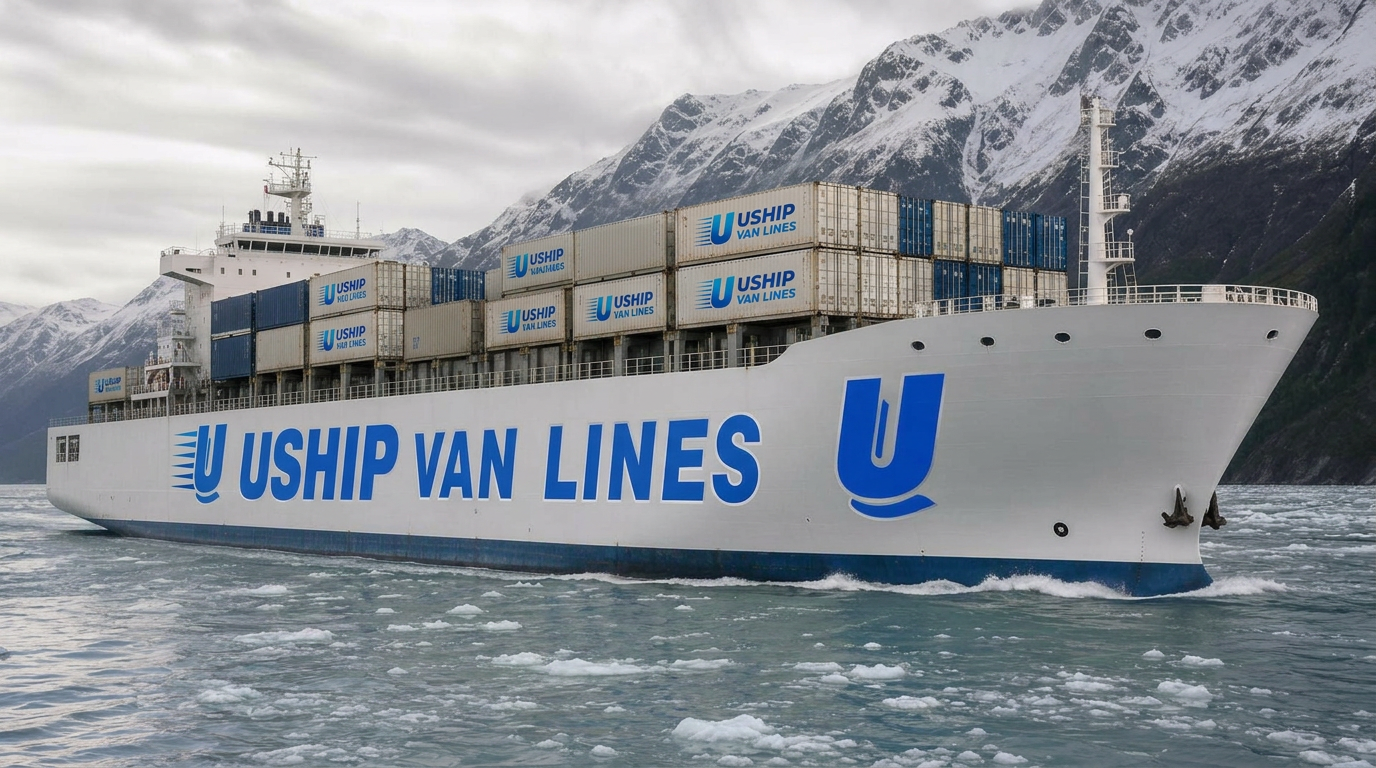
Moving from United States to Alaska
Relocating from the contiguous United States to Alaska is a unique undertaking that combines overland trucking through Canada with ocean barge freight—a move that requires specialized logistics, careful timing, and experienced coordination. Whether you're headed to Anchorage, Fairbanks, the Mat-Su Valley, or remote bush communities, your household goods and vehicles will travel thousands of miles by truck, barge, and final-mile delivery.
Best Alaska & Hawaii Movers, powered by UShip Van Lines, coordinates every leg of your Alaska move—from pickup anywhere in the Lower 48, secure barge transit through Tacoma or Seattle, Port of Anchorage customs clearance, and last-mile delivery to your new home. Ready to start planning? Request a free, no-obligation quote today and get a detailed timeline and cost breakdown tailored to your exact route and inventory.
Route overview
How Moving from the U.S. Mainland to Alaska Works
Unlike a standard long-distance move, Alaska relocations involve a multimodal journey. Your belongings are loaded into a 53-foot trailer at your current home, driven via the Alaska-Canada Highway (Alcan) or shipped as freight to a Pacific Northwest port—typically Tacoma or Seattle—then loaded onto an ocean barge bound for the Port of Anchorage. Transit times vary by season, sailing schedules, and final destination, but most household moves take 10–21 days door-to-door.
Vehicles follow a parallel path: driven onto the barge as roll-on/roll-off (RoRo) freight or shipped in enclosed containers for high-value cars. Once your shipment clears U.S. Customs in Anchorage (a formality for domestic moves but still required), a local delivery crew transports your goods to Anchorage, Eagle River, Wasilla, Palmer, Kenai, Soldotna, or Fairbanks. For off-road-system communities—such as Bethel, Kodiak, or Southeast Alaska towns—final delivery may involve smaller barges, bush planes, or seasonal ice-road access.
This route demands precision: barge sailing schedules are fixed, weather windows narrow in winter, and logistical delays compound quickly. Partnering with a carrier experienced in Alaska moves ensures your shipment stays on schedule and arrives intact, even when conditions are less than ideal.
How the moving process works
Step-by-Step: Your Alaska Move Timeline
-
Request a Quote & Book Early (6–12 Weeks Out)
Contact Best Alaska & Hawaii Movers for a detailed estimate based on your origin city, inventory volume, vehicle(s), and Alaska destination. Summer sailings (May–September) fill fast; book as early as possible to secure your preferred barge departure. -
Pre-Move Planning: Inventory, Documentation & Restrictions
Create a detailed inventory list for customs. Remove all personal items from vehicle interiors (customs requirement). Discard or consume hazardous materials—aerosols, propane, bleach, ammunition—which cannot travel by barge. Arrange for pet and plant transport separately; many airlines and ferries restrict species and seasons. -
Pickup in the Lower 48
A professional crew loads your household goods into a secure trailer at your current address. Vehicles are either driven to the port (if operable) or shipped on the same truck. Your shipment is sealed, inventoried, and dispatched to the Pacific Northwest port hub. -
Overland or Direct Port Staging (1–5 Days)
Depending on origin, your trailer may drive the Alcan Highway through Canada (requiring proper documentation) or proceed directly to Tacoma/Seattle for barge consolidation. Goods are staged in a secure warehouse until the next scheduled Alaska barge sailing. -
Barge Transit: Tacoma/Seattle → Port of Anchorage (3–5 Days at Sea)
Your household shipment and vehicle(s) board an Alaska Marine Lines or similar carrier barge. Ocean transit typically takes 3–5 days, though weather and sea conditions can add time. Sailings run year-round, with reduced frequency November–March. -
Customs Clearance & Port Offload (1–2 Days)
Upon arrival in Anchorage, your shipment clears U.S. Customs (a domestic formality) and is offloaded to a bonded warehouse or direct-to-truck for final delivery. Delays here are rare but can occur during peak summer season or if documentation is incomplete. -
Last-Mile Delivery to Your Alaska Home (1–3 Days)
A local Alaska delivery team transports your goods to Anchorage, Fairbanks, the Kenai Peninsula, or Mat-Su Valley. For remote or off-road-system locations, specialized carriers handle the final leg—sometimes involving smaller barges, ATVs, or seasonal ice roads. Unloading, assembly, and debris removal are included in full-service moves.
Estimated moving costs
What Does a Move from the U.S. to Alaska Cost?
A typical 2–3 bedroom household move from the continental United States to Anchorage or the Mat-Su Valley ranges from $6,500 to $14,000, depending on distance, volume, number of vehicles, and service level. Moves to Fairbanks or off-road-system communities add $1,500–$4,000 for additional overland or small-barge delivery.
Key cost drivers include:
- Origin distance: Moves from the West Coast (Seattle, Portland, California) cost less than East Coast or Southern routes due to shorter overland legs.
- Household volume: Charged by cubic feet or trailer space. A 1,200 sq ft home averages 800–1,200 cubic feet; a 2,000 sq ft home may fill 1,500–2,000 cubic feet.
- Vehicle shipping: RoRo barge transport for a sedan runs $1,200–$1,800; trucks, SUVs, or enclosed container service cost more.
- Season: Summer (May–September) is peak season, with higher demand and sometimes premium rates. Winter moves (October–April) offer lower costs but fewer barge sailings and weather risks.
- Final destination: Anchorage and Mat-Su deliveries are most economical. Fairbanks adds overland miles; remote villages require small-barge or air freight.
- Service level: Full-service packing and unpacking add $1,000–$2,500. Self-pack and freight-only options reduce cost but increase your labor.
- Insurance and storage: Comprehensive valuation coverage costs 1–3% of declared value. Temporary storage in Tacoma or Anchorage runs $100–$300/week.
Best Alaska & Hawaii Movers provides transparent, itemized quotes with no hidden fees. Request your free estimate to see exactly what your move will cost, broken down by service, distance, and timing.
Estimated transit times
How Long Does a U.S. to Alaska Move Take?
Door-to-door transit from the Lower 48 to Alaska typically takes 10–21 days, depending on origin, barge schedule, and final destination.
Breakdown by leg:
- Pickup to Pacific Northwest port (Tacoma/Seattle): 2–7 days, depending on your starting city. West Coast origins (California, Oregon, Washington) take 2–3 days; Midwest and East Coast moves take 5–7 days.
- Port staging and barge loading: 1–3 days. Your shipment waits for the next scheduled Alaska sailing, which may depart weekly (summer) or biweekly (winter).
- Ocean barge transit (Tacoma → Anchorage): 3–5 days at sea. Weather, tides, and port congestion can add 1–2 days.
- Customs clearance and offload in Anchorage: 1–2 days. Peak summer season or documentation issues may extend this.
- Final delivery to your Alaska address: 1–3 days. Anchorage and Mat-Su deliveries are fastest; Fairbanks adds 1–2 days; remote or off-road-system locations add 3–7 days or more, especially if seasonal access is required.
Fastest scenario (West Coast to Anchorage, summer): 10–12 days.
Typical scenario (Midwest/East Coast to Mat-Su, any season): 14–18 days.
Extended scenario (any origin to remote Alaska, winter): 21+ days.
Flexibility is essential. Barge schedules are fixed, and winter weather or mechanical delays can add time. Best Alaska & Hawaii Movers tracks your shipment in real time and keeps you updated at every milestone.
Regional logistics
Alaska-Specific Moving Logistics You Need to Know
Ports and Barge Terminals
Most Alaska-bound household goods barges depart from the Port of Tacoma or Seattle and arrive at the Port of Anchorage. Secondary ports—Whittier, Kodiak, Dutch Harbor—serve specific regions but typically require transshipment. Your mover handles all port scheduling, freight booking, and terminal coordination.
Customs and Documentation
Even though Alaska is a U.S. state, shipments pass through customs checkpoints. You'll need a detailed inventory list, government-issued ID, and vehicle titles. Canadian transit (if driving or trucking the Alcan) requires additional paperwork: vehicle registration, proof of insurance, and sometimes temporary import permits. Best Alaska & Hawaii Movers prepares and files all required documents on your behalf.
Vehicle Shipping: RoRo Barge vs. Container
Most cars, trucks, and SUVs ship roll-on/roll-off (RoRo) on the open barge deck. Vehicles must be operable, with no more than ¼ tank of fuel and completely empty interiors (customs rule). High-value or classic cars can be shipped in enclosed 20' or 40' containers for added protection. Motorcycles, ATVs, and boats also ship via barge; rates vary by size and weight.
Last-Mile Delivery: Road-System vs. Off-Road-System
Anchorage, Mat-Su Valley (Wasilla, Palmer), Eagle River, Kenai, Soldotna, and Fairbanks are on Alaska's road system and receive standard truck delivery. Off-road-system communities—Bethel, Nome, Kotzebue, Dillingham, Southeast Alaska islands—require small-barge, air freight, or seasonal ice-road transport, adding cost and time. Confirm your delivery method when booking.
Storage Options
If your Alaska home isn't ready, secure storage is available in Anchorage or at the Port of Tacoma. Rates run $100–$300/week depending on volume. Climate-controlled storage is limited in Alaska but available by request for sensitive items.
What You Can't Ship
Hazardous materials—propane, gasoline, aerosols, bleach, fireworks, ammunition—are prohibited on barges. Perishable foods, live plants, and pets require separate arrangements (many airlines restrict pet travel November–March due to temperature). Firearms are allowed if properly declared and secured; alcohol and tobacco are legal but may incur state taxes upon arrival.
Seasonal considerations
Best Time to Move to Alaska: Seasonal Insights
Spring/Summer (May–September): Peak Season
Most Alaska moves happen during the warmer months. Barge sailings run weekly, roads are clear, and daylight is abundant. Demand is highest, so book 8–12 weeks in advance. Expect premium pricing and less scheduling flexibility, but the most reliable weather and fastest deliveries. Ideal for families moving before the school year or anyone prioritizing speed and convenience.
Fall (October–November): Shoulder Season
Barge frequency drops to biweekly, and costs decrease slightly. Weather is still manageable, though snow begins in interior Alaska by mid-October. A good window for cost-conscious movers willing to accept a bit more scheduling uncertainty. Final deliveries to remote areas may face early-season road or ice conditions.
Winter (December–March): Off-Season
Lowest rates and lightest demand, but barge sailings are least frequent (sometimes every 2–3 weeks) and weather risks are highest. Heavy snow, ice fog, and extreme cold can delay final-mile delivery, especially to Fairbanks or bush communities. Ocean conditions are rougher, and port offloading may slow. Only recommended if you have flexible timelines and no hard move-in deadlines. Some remote villages are accessible only by winter ice roads, making this the only season for certain deliveries.
Year-Round Considerations
Alaska barge carriers operate 12 months a year, but service levels vary. Always confirm the next available sailing when booking. If your move deadline is firm, plan for worst-case transit times and build in buffer days. Best Alaska & Hawaii Movers monitors weather and adjusts logistics proactively to keep your move on track.
Why choose Best Alaska & Hawaii Movers
Why Best Alaska & Hawaii Movers for Your Alaska Relocation?
- Alaska Specialists, Not Generalists: We exclusively serve Alaska and Hawaii moves, coordinating barge schedules, customs, last-mile delivery, and remote-access logistics daily—not as an add-on, but as our core business.
- Transparent, All-Inclusive Pricing: You'll receive a detailed, itemized quote covering pickup, barge freight, port fees, customs, and final delivery. No surprise charges, no hidden fuel surcharges, no bait-and-switch.
- Powered by UShip Van Lines' Trusted Network: We leverage UShip's vetted carrier network for reliable overland transport, combined with our proprietary Alaska logistics partnerships for barge and last-mile delivery. You get national reach with Alaska expertise.
- Real-Time Tracking & Proactive Communication: From trailer pickup to final delivery, you'll know where your shipment is. We monitor barge sailings, weather, and port operations, updating you at every milestone and adjusting logistics before delays become problems.
- Full-Service or Flexible Options: Choose white-glove packing and unpacking, or pack yourself and save. Ship your entire household, or consolidate with a partial load. We tailor service levels to your budget and timeline, with no pressure to overbuy.