
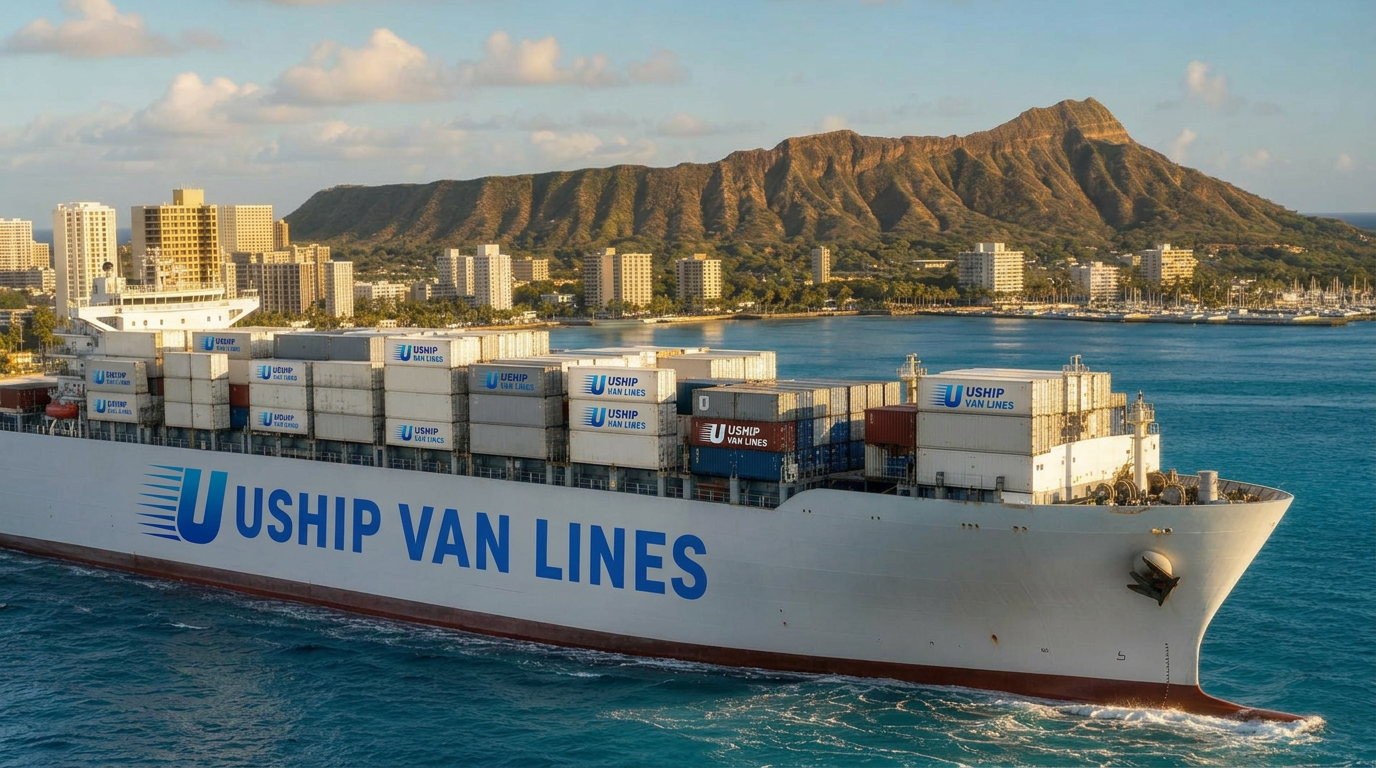
Moving from St Cloud, MN to Hawaii
Moving from St Cloud, MN to Hawaii transforms a straightforward Midwest relocation into a complex ocean shipping operation spanning more than 4,000 miles. Your belongings will travel by truck across the continental U.S. to West Coast ports—typically Long Beach or Oakland—then voyage by container ship across the Pacific to Honolulu, with potential inter-island transport to Maui, Kauai, or the Big Island.
Best Alaska & Hawaii Movers, powered by UShip Van Lines, coordinates every phase of this multi-modal journey: mainland pickup in St Cloud, overland transport to California ports, containerization, ocean freight via Matson or Pasha Lines, Hawaiian port clearance, and final delivery to your island address. Request a detailed quote today to understand your timeline, costs, and documentation requirements for this unique continental-to-Pacific move.
Route overview
St Cloud to Hawaii: Continental to Pacific Island Shipping
The St Cloud, MN to Hawaii moving corridor requires careful orchestration across four distinct phases. Your household goods depart Central Minnesota—a city of 68,000 located 65 miles northwest of Minneapolis—and travel approximately 1,800 miles west to California port facilities. This overland leg typically takes 3–5 days depending on routing and consolidation schedules.
From Long Beach or Oakland, your containerized shipment joins Matson Navigation or Pasha Hawaii vessel schedules for the 2,400-nautical-mile ocean crossing to Honolulu. These carriers operate weekly sailings with 8–12 day transit times. If your final destination is a neighbor island—Maui's Kahului, Kauai's Nawiliwili, or Hilo/Kona on the Big Island—an additional inter-island barge leg adds 3–7 days and requires separate scheduling.
Minnesota's continental climate and Hawaii's tropical environment create special considerations: moisture-sensitive items need proper packing, winter departure windows demand weather contingency planning, and Hawaii's strict agricultural inspection rules prohibit many common household plants, soils, and wooden items. Understanding these complexities upfront prevents costly delays at Honolulu's Sand Island terminal.
How the moving process works
Step-by-Step: How Your St Cloud to Hawaii Move Unfolds
-
Pre-Move Survey & Hawaii Restrictions Review – A moving specialist conducts an in-home or virtual assessment of your St Cloud residence, inventories items, and reviews Hawaii Department of Agriculture prohibited/restricted goods lists. Wooden furniture, potted plants, certain foods, and soil-containing items face strict entry rules. You'll receive a detailed timeline and documentation checklist covering the 4–6 week total transit window.
-
Mainland Packing & Loading in St Cloud – Professional crews arrive at your Minnesota home to pack, inventory, and load your belongings into a moving van. High-value items receive custom crating; tropical-bound shipments require moisture barriers for electronics and mattresses. The truck departs for California, typically taking 3–5 days with potential consolidation stops if you're sharing container space.
-
West Coast Port Delivery & Containerization – Your shipment arrives at Long Beach or Oakland port facilities where it's transferred into a 20-foot or 40-foot ocean container. Full-container loads (FCL) give you exclusive space; less-than-container loads (LCL) share space with other shippers and require precise cubic-footage calculations. The container is sealed, documented, and queued for the next available Matson or Pasha sailing.
-
Trans-Pacific Ocean Voyage – Your container boards a vessel for the 8–12 day crossing to Honolulu. Sailings depart weekly year-round, though summer and holiday periods see heavier booking volumes. Ocean freight is the calmest, most controlled leg—containers remain sealed throughout the voyage in climate-stable cargo holds.
-
Honolulu Port Clearance & Inspection – Upon arrival at Sand Island, U.S. Customs and Hawaii Agriculture officials inspect documentation and may physically inspect containers for prohibited items. Most shipments clear within 1–2 business days if paperwork is complete; agricultural violations trigger quarantine, re-inspection fees, or confiscation. Your moving coordinator monitors clearance status in real-time.
-
Inter-Island Transfer (If Applicable) – Oahu residents receive direct delivery from Honolulu. Maui, Kauai, and Big Island moves require your container to be loaded onto Young Brothers inter-island barges, adding 3–7 days and a second port-handling fee. Neighbor island ports have limited weekly schedules—Kahului receives three sailings per week, Nawiliwili two, Hilo and Kona vary.
-
Final Delivery & Unpacking – A local Hawaiian moving crew delivers your container to your new address, unloads, and places items according to your floor plan. Unpacking services are available. You'll conduct a final inventory check against the original manifest and note any damage for insurance claims. Empty containers return to port within 24–48 hours to avoid demurrage fees.
Estimated moving costs
What Does a St Cloud, MN to Hawaii Move Cost?
A typical 2–3 bedroom household moving from St Cloud to Hawaii ranges between $8,500 and $16,000, with the wide variance driven by shipment volume, container type, destination island, and service level. This estimate includes mainland pickup, overland transport to California, ocean freight, port fees, and Hawaiian delivery—but excludes optional services like full packing, vehicle shipping, or storage.
Key cost drivers:
- Shipment volume – A 1,200 cubic-foot load (small 2BR apartment) may fit in a shared 20' container (LCL) for $8,500–$10,500. A full 3BR home averaging 2,000–2,500 cubic feet typically requires an exclusive 40' container (FCL) costing $12,000–$16,000.
- Destination island – Oahu deliveries are least expensive. Maui, Kauai, and Big Island moves add $1,200–$2,500 for inter-island barge fees, second port handling, and longer last-mile delivery.
- Packing services – Professional full-pack adds $1,500–$3,000 depending on home size and specialty items (art, antiques, pianos). Partial pack-only (fragiles and kitchenware) runs $600–$1,200.
- Seasonal timing – Peak summer months (June–August) and holiday periods see 10–15% rate premiums due to high demand and limited container availability.
- Vehicle transport – Cars ship separately via roll-on/roll-off (RoRo) vessel, adding $1,400–$2,200 per vehicle from West Coast ports to Honolulu (Matson and Pasha both offer auto shipping).
Port fees, documentation charges, fuel surcharges, and Hawaii's 4% general excise tax on services are typically itemized separately. We never guarantee exact pricing without a detailed inventory—cube sheets, weight, and accessorial services all affect final costs. Request a binding estimate with transparent line items before committing.
Estimated transit times
How Long Does St Cloud to Hawaii Shipping Take?
Door-to-door transit from St Cloud, MN to Hawaii typically requires 3–6 weeks (21–42 days), with destination island and consolidation needs creating the range.
Transit breakdown:
- St Cloud pickup to California port: 3–7 days. Direct truckload moves reach Long Beach in 3–4 days; consolidated shipments waiting for other customers to fill a container may stage in a Twin Cities warehouse for 2–5 days before departing.
- Port dwell & containerization: 2–4 days. Your goods are unloaded, inventoried, loaded into the ocean container, documented, and queued for vessel loading.
- Ocean voyage to Honolulu: 8–12 days on the water. Matson's fast vessels make the crossing in 8–9 days; Pasha and slower sailings take 11–12 days. Weekly departure schedules mean a missed sailing adds 7 days.
- Honolulu port clearance: 1–3 days for Customs and Agriculture inspection, assuming proper documentation and no prohibited items flagged.
- Oahu final delivery: 1–2 days from Sand Island to your residence. Delivery windows are typically 8 AM – 5 PM, with 24-hour advance notice.
- Neighbor island inter-island barge: Add 5–10 days total—3–7 days for barge transit (Maui 36 hours, Kauai 48 hours, Big Island 2–4 days depending on port) plus 2–3 days for scheduling and port handling on both ends.
Expedited options: Exclusive full-container loads (FCL) with pre-booked vessel space and direct trucking can achieve 21–24 day door-to-door service to Oahu during off-peak periods. Shared container loads (LCL) requiring consolidation typically run 28–35 days. Neighbor island moves rarely complete faster than 32 days due to inter-island barge schedules.
Always build 5–7 days of buffer into your relocation timeline for weather delays (winter storms in the Rockies or Sierra Nevada), port congestion, or inspection holds.
Regional logistics
Hawaii-Specific Moving Logistics & Requirements
Port infrastructure: Honolulu's Sand Island terminal handles all Mainland-to-Hawaii container traffic. Matson Navigation (the dominant carrier, operating since 1882) and Pasha Hawaii both maintain weekly sailing schedules from Long Beach and Oakland. Neighbor island ports—Kahului (Maui), Nawiliwili (Kauai), Hilo and Kawaihae (Big Island)—receive inter-island barge service from Young Brothers, the state's sole inter-island cargo carrier since 1900.
Agricultural inspection: Hawaii maintains the nation's strictest biosecurity rules to protect fragile island ecosystems. The Hawaii Department of Agriculture prohibits or restricts soil, potted plants (except specific pre-approved species with certification), wooden furniture containing bark, fresh fruits and vegetables, seeds, live animals (except pets with separate permits), used gardening tools, hay/straw, and coffee/macadamia products from outside the state. Inspectors open containers at random; violations result in confiscation, fumigation fees ($350–$800), or entire-shipment quarantine. Your mover provides a comprehensive prohibited-items list during the survey phase—follow it religiously.
Vehicle shipping: Cars and trucks ship separately via roll-on/roll-off (RoRo) vessels from Richmond (San Francisco Bay Area) or San Diego to Honolulu, typically 7–10 days ocean transit plus 3–5 days each end for processing. Matson and Pasha both operate auto-carrier services. Vehicles must be clean (no soil in wheel wells or undercarriage), contain no personal items (completely empty except 1/4 tank fuel), and pass agricultural inspection. Cost runs $1,400–$2,200 per vehicle to Oahu; inter-island car barges to neighbor islands add $500–$900.
Delivery access: Hawaii's unique geography creates last-mile challenges. Oahu's urban Honolulu and suburban neighborhoods (Kailua, Kaneohe, Pearl City) offer straightforward truck access. Neighbor island rural properties—especially Big Island's Puna district, Maui's Hana coast, or Kauai's North Shore—may require smaller shuttle trucks or even barge/helicopter delivery for truly remote locations. Narrow roads, low-clearance bridges, and unpaved driveways are common. Share photos and Google Maps links of your destination property during the survey to avoid delivery-day surprises.
Paperwork: You'll need a government-issued ID, destination address proof (lease or purchase agreement), inventory manifest (provided by mover), and a Hawaii residence declaration. Military members require PCS orders. Customs clearance is straightforward for U.S. citizens moving personal household goods (no duties or tariffs), but CBP documentation must be complete and accurate to avoid clearance delays.
Storage options: If your Hawaii housing isn't ready upon arrival, Honolulu-area storage facilities can hold your container for $200–$400/month (climate-controlled units cost more). Neighbor island storage is limited and expensive—better to delay mainland pickup if possible. Some movers offer free storage for 7–14 days as part of full-service packages.
Seasonal considerations
Best & Worst Times for Minnesota-to-Hawaii Moves
Spring (March–May): Moderate demand and generally favorable weather make spring an excellent window. Mainland snowmelt and Minnesota's unpredictable late-winter storms have passed, while Hawaii's dry season (April–October) ensures calm port operations. Ocean freight capacity is good, and rates haven't hit summer peaks. Book 4–5 weeks ahead.
Summer (June–August): Peak moving season sees highest demand and premium rates—expect 10–20% surcharges. Families relocate before the school year, military PCS orders concentrate in summer, and container space tightens. Matson and Pasha prioritize commercial cargo during peak agriculture export seasons (pineapple, coffee). Early June or late August bookings find better availability than July 4th windows. Book 6–8 weeks ahead. Hurricane season begins June 1, though Central Pacific storms are less frequent than Atlantic; port operations rarely face weather closures.
Fall (September–November): September and October offer the sweet spot—post-summer demand drops, rates moderate, and Hawaii's hurricane season winds down by November. Port labor agreements typically renew September 30, occasionally creating brief slowdowns, but otherwise fall provides excellent availability and pricing. Book 3–4 weeks ahead.
Winter (December–February): Winter presents unique challenges. Mainland snowstorms in Minnesota and across the Rockies/Sierra Nevada can delay truck departures by 1–3 days. Holiday periods (Thanksgiving through New Year's) see container booking freezes December 15–January 5 as carriers prioritize commercial cargo. January–February offer rock-bottom rates and instant availability—ideal for flexible movers. Hawaii's wet season (November–March) brings rain but rarely disrupts port operations; ocean swells peak January–February, though container ships handle conditions easily. Book 3 weeks ahead, with weather contingency buffers.
Hurricane considerations: The Central Pacific hurricane season (June 1–November 30) averages four named storms annually, with most tracking well south of the islands. Matson and Pasha have never cancelled a sailing due to storms in modern history, though port operations may pause for 12–24 hours during rare direct-approach scenarios. Your shipment insurance covers weather-related delays and damage.
Why choose Best Alaska & Hawaii Movers
Why Best Alaska & Hawaii Movers for Your St Cloud to Hawaii Move
-
Pacific island moving specialists – While general movers handle the Midwest-to-California leg competently, Hawaii relocations demand deep knowledge of Matson/Pasha schedules, HDOA agricultural rules, inter-island barge logistics, and Hawaiian last-mile delivery challenges. We coordinate Alaska and Hawaii moves exclusively, with decades of combined Pacific shipping experience.
-
End-to-end coordination powered by UShip Van Lines – You get a single point of contact managing every phase: St Cloud pickup, overland transport, California port delivery, ocean freight booking, Honolulu clearance, and island delivery. No handoffs between disconnected vendors; no finger-pointing if issues arise.
-
Transparent pricing with itemized estimates – We provide line-by-line cost breakdowns covering truck, ocean freight, port fees, barge charges, fuel surcharges, and taxes. You'll understand exactly what you're paying for before signing. No hidden demurrage fees or surprise accessorial charges.
-
Agricultural compliance expertise – Our intake questionnaire flags prohibited items before your truck leaves Minnesota. We provide detailed packing guidance for moisture-sensitive goods crossing climates and handle all HDOA documentation, minimizing inspection delays that plague inexperienced shippers.
-
Flexible scheduling & storage solutions – We work around your St Cloud closing dates, Hawaiian lease start dates, and military PCS timelines. Short-term storage in Minneapolis or Honolulu areas bridges timing gaps without forcing rushed decisions or double moves.