
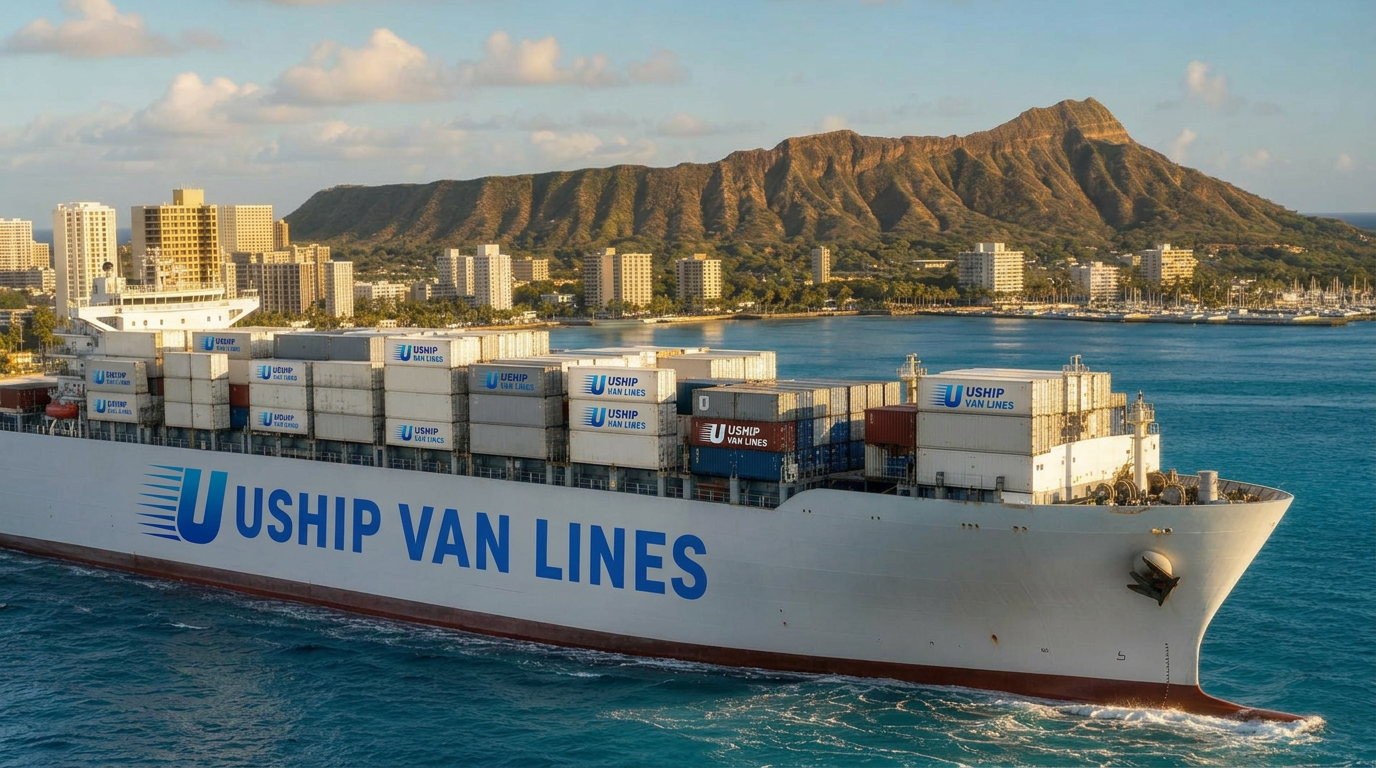
Moving from Oklahoma City, OK to Hawaii
Moving from Oklahoma City to Hawaii transforms a continental lifestyle into island living—but the 3,900-mile journey across the Pacific requires specialized ocean freight coordination that most mainland movers never handle. Your household goods will travel by truck to a West Coast port, load into a Matson or Pasha container, then ship 5–7 days to Honolulu before final delivery to your island destination.
Best Alaska & Hawaii Movers, powered by UShip Van Lines, coordinates every leg of this complex route—from your Oklahoma City doorstep through Long Beach or Oakland ports to your new Hawaii home. Whether you're relocating for military orders, a tech job in Honolulu, or retirement on Maui, we handle the logistics so you can focus on your tropical transition. Request a free quote today to see exactly what your cross-Pacific move will cost and how our container-shipping expertise saves you time and stress.
Route overview
Oklahoma City to Hawaii: A Cross-Continental, Trans-Pacific Route
The Oklahoma City to Hawaii moving corridor serves military families (Schofield Barracks, Joint Base Pearl Harbor-Hickam), remote workers embracing island life, and retirees trading Tornado Alley for trade winds. Unlike a typical long-distance move, this route requires hybrid logistics: ground transport across 1,300–1,500 miles of the continental U.S., then ocean container shipping across 2,400+ nautical miles of the Pacific.
Your shipment departs Oklahoma City by truck, traveling west through Texas and the Southwest to reach Long Beach or Oakland—the two primary embarkation ports for Hawaii-bound freight. There it's loaded into a 20-foot or 40-foot ocean container (shared or exclusive, depending on your move size) and placed aboard a Matson or Pasha vessel for the 5–7 day sail to Honolulu. If your final destination is Maui, Kauai, or the Big Island, your container transfers to an inter-island barge for an additional 2–4 days, then delivers via local cartage to your address.
Total door-to-door transit averages 14–21 days in summer, 18–28 days during winter weather or holiday port congestion. This timeline makes advance planning essential—book 4–6 weeks ahead for peak summer moves, 3–4 weeks for off-peak winter relocations.
How the moving process works
How Your Oklahoma City to Hawaii Move Works: Step by Step
-
Free In-Home or Virtual Survey – Our estimator reviews your inventory (furniture, appliances, boxes, vehicles) and explains container options: shared (cost-effective for 1–2 BR homes) or exclusive (faster, more secure for 3+ BR homes). You'll receive a binding estimate with no hidden port fees.
-
Pre-Move Preparation & Hawaii Compliance – We provide a checklist for Hawaii's agricultural restrictions (no potted plants, certain woods, or soil), vehicle import requirements (safety inspection within 30 days of arrival), and pet quarantine paperwork if you're bringing animals. You'll also decide whether to ship your car in the same container (space permitting) or arrange separate auto transport.
-
Oklahoma City Pickup & Professional Packing – Our crew arrives on your scheduled date, packs fragile items in Hawaii-grade materials (reinforced boxes, moisture barriers for the ocean crossing), loads your container or shares space in a consolidated shipment, and secures everything for the 1,300-mile overland leg.
-
Overland Transit to Long Beach or Oakland – Your shipment travels I-40 west through Amarillo and Albuquerque, or I-44/I-40 through Tulsa and Flagstaff, reaching the West Coast port in 3–5 days. The driver coordinates with the port terminal for container staging.
-
Ocean Container Loading & Customs Clearance – At the port, your goods are loaded into the ocean container (or your exclusive container is sealed), and we file the required Hawaii Agricultural Declaration and U.S. Customs documentation. Matson and Pasha vessels depart Long Beach 2–3 times per week, Oakland 1–2 times weekly.
-
Trans-Pacific Voyage to Honolulu – The container sails 2,400 nautical miles in 5–7 days, arriving at Honolulu's Sand Island terminal. Hawaii agriculture inspectors examine containers for prohibited items; non-compliance can delay release by 1–3 days.
-
Inter-Island Transfer (If Needed) & Final Delivery – If you're moving to a neighbor island, your container transfers to a Young Brothers or Aloha Marine barge (2–4 additional days). Once cleared, our local delivery team unloads at your Hawaii residence, unpacks if requested, and removes all packing materials. You inspect and sign off—your Oklahoma City to Hawaii move is complete.
Estimated moving costs
What Does an Oklahoma City to Hawaii Move Cost?
Typical range for a 2–3 bedroom home: $6,800–$12,500 door-to-door, depending on volume, container type, and final island. Smaller 1-bedroom or studio moves in shared containers start around $4,200–$5,800; larger 4-bedroom homes in exclusive 40-foot containers can reach $14,000–$18,000.
Key cost drivers:
- Container type – Shared 20-foot containers (cost-effective, longer transit) vs. exclusive 40-foot containers (faster, more secure, higher cost).
- Final destination island – Oahu delivery is least expensive; Maui, Kauai, and Big Island add $800–$1,800 for inter-island barge and cartage.
- Vehicle shipping – Adding a car to your household-goods container saves money vs. separate auto transport but reduces space for furniture; expect $1,200–$2,000 for a sedan in a shared auto container.
- Packing services – Full-service packing (recommended for the ocean crossing) adds $800–$1,800; partial packing (kitchen, fragile items) runs $400–$900.
- Seasonal demand – June–August and December holiday moves cost 10–20% more due to peak port congestion and limited container availability.
- Storage – If your Hawaii residence isn't ready, Honolulu warehouse storage costs $150–$300/month for a typical household.
We never quote prices over the phone without reviewing your inventory. Request a free virtual survey for a binding estimate that covers every leg—Oklahoma City pickup, overland transport, ocean freight, and Hawaii delivery—with no surprise port fees or fuel surcharges.
Estimated transit times
How Long Does Oklahoma City to Hawaii Moving Take?
Typical door-to-door timeline: 14–21 days in summer, 18–28 days in winter. Breaking it down by leg:
- Oklahoma City to West Coast port (Long Beach or Oakland): 3–5 days by truck, depending on weather and driver hours-of-service. Winter ice storms in the Texas Panhandle or New Mexico can add 1–2 days.
- Port staging & container loading: 1–3 days. Containers must be loaded, inspected, and cleared by customs before the vessel sails.
- Ocean voyage to Honolulu: 5–7 days. Matson's faster vessels make the crossing in 5 days; Pasha's typically take 6–7 days.
- Honolulu port clearance & agriculture inspection: 1–2 days. Hawaii's strict biosecurity inspections can delay release if documentation is incomplete.
- Inter-island barge (Maui, Kauai, Big Island only): 2–4 additional days, plus 1 day for neighbor-island port clearance.
- Final delivery scheduling: 1–3 days after port release, depending on your availability and delivery team capacity.
Expedited options: Exclusive 40-foot containers can shave 2–4 days off shared-container timelines because they bypass consolidation delays at the port. However, no service can accelerate the ocean crossing itself—physics and vessel schedules set that 5–7 day window. For time-sensitive moves (job start dates, lease overlaps), book 4–6 weeks in advance and build a 3–5 day buffer into your Hawaii arrival plans.
Regional logistics
Hawaii-Specific Logistics: What Oklahoma City Movers Need to Know
Ports & shipping lines: Your goods will transit through Long Beach (busier, more frequent Matson departures) or Oakland (slightly less congested, good for Northern California consolidation). Matson is the dominant carrier (4–5 weekly sailings), with Pasha as the secondary option (2–3 weekly). Both are reliable; Matson's newer vessels are marginally faster.
Container options: Shared 20-foot containers work for 1–2 bedroom homes (cost-effective, but your shipment waits for consolidation—add 2–4 days). Exclusive 20-foot or 40-foot containers suit 3+ bedroom homes (faster, more secure, higher cost). You can also ship a vehicle inside your household-goods container if space allows—our estimator will model the trade-offs.
Hawaii's agricultural restrictions: The state bans potted plants, soil, certain hardwoods, and many seeds. Pack only artificial plants or consider buying new greenery in Hawaii. If inspectors find prohibited items, they'll confiscate them and may delay your entire shipment for re-inspection. Our pre-move checklist ensures compliance.
Vehicle shipping: If you're bringing a car, you have two paths: (1) ship it in your household-goods container (saves money, reduces space for furniture), or (2) use a separate auto container (adds $1,200–$2,000 but keeps your furniture shipment intact). Either way, Hawaii requires a safety inspection within 30 days of the vehicle's arrival—factor that into your post-move budget ($50–$100).
Delivery challenges on neighbor islands: Maui, Kauai, and Big Island deliveries involve narrower roads, rural addresses, and occasional barge delays. Confirm your delivery address is accessible for a 26-foot truck; if you're moving to a remote area (Hana, Maui; North Shore Kauai), the driver may need to transfer goods to a smaller vehicle, adding 1 day and $200–$400 to your quote.
Storage options: If your Hawaii home isn't ready, we offer warehouse storage in Honolulu (climate-controlled, secure) for $150–$300/month depending on volume. Storage on neighbor islands is limited—plan your move-in dates carefully.
Customs & documentation: Though Hawaii is a U.S. state, ocean freight requires a Hawaii Agricultural Declaration (we file it) and a detailed inventory for customs review. Keep high-value items (jewelry, electronics) in your carry-on luggage—insurance covers shipment loss, but claims take weeks to process.
Seasonal considerations
Best Times to Move from Oklahoma City to Hawaii (and What to Avoid)
Summer (June–August): Peak moving season. Families relocate before the school year; military PCS orders cluster in June–July. Expect 10–20% higher costs, longer booking lead times (6–8 weeks recommended), and port congestion that can add 2–4 days to your timeline. Advantage: predictable weather on both ends—Oklahoma heat is manageable, and Hawaii's summer is outside hurricane season (mostly). Book early and confirm your container slot in writing.
Fall (September–November): Shoulder season with moderate pricing and availability. September is technically still hurricane season (Pacific storms can delay vessels by 1–3 days, though disruptions are rare). October–November offers the best balance: lower rates, faster booking (3–4 weeks), and fewer port delays. Oklahoma weather is mild, and Hawaii's fall is warm and dry—ideal moving conditions.
Winter (December–February): Off-peak pricing (save 10–15%), but weather adds complexity. Ice storms and snow in Oklahoma or along I-40 through the Texas Panhandle and New Mexico can delay your truck pickup or overland transit by 1–3 days. December holiday port closures (Christmas week, New Year's) reduce vessel availability—book 5–6 weeks ahead if moving in late December. Advantage: once your shipment reaches Hawaii, you'll enjoy the islands' mildest, driest season (low 70s–80s, minimal rain).
Spring (March–May): Another shoulder season. March and April offer off-peak pricing with improving weather as Oklahoma thaws and tornado season begins (May storms can delay pickups). Hawaii spring is gorgeous—warm, dry, and uncrowded. Book 3–4 weeks out for smooth scheduling. May is increasingly popular for early-summer relocations, so lock your dates by mid-April.
Hurricane watch: Official Pacific hurricane season runs June 1–November 30, peaking August–September. Tropical storms rarely disrupt Matson/Pasha schedules (vessels reroute around weather), but a direct hit on Honolulu (last major event: Hurricane Lane, 2018) can close the port for 2–5 days. If you're moving late summer/early fall, monitor NOAA forecasts and maintain flexibility in your delivery timeline.
Why choose Best Alaska & Hawaii Movers
Why Choose Best Alaska & Hawaii Movers for Your Oklahoma City to Hawaii Move
-
Specialized trans-Pacific expertise – We coordinate ocean container moves daily. Unlike general long-distance movers who subcontract the Hawaii leg, we manage the entire route—Oklahoma City pickup, West Coast port logistics, ocean freight, and island delivery—under one contract with transparent pricing.
-
Powered by UShip Van Lines' carrier network – Our platform connects you with licensed, insured interstate carriers experienced in Hawaii moves. Every partner is vetted for safety records, on-time performance, and customer satisfaction—you get the reliability of a national network with the personal service of a specialist.
-
No surprise port fees or fuel surcharges – Our binding estimates include every cost: overland transport, port handling, ocean freight, agriculture inspection, inter-island barge (if needed), and final delivery. The price we quote is the price you pay—no hidden terminal fees, no last-minute fuel surcharges.
-
Real-time shipment tracking – Once your container loads at the West Coast port, you'll receive vessel tracking updates (departure, estimated Honolulu arrival, barge transfer if applicable). You'll never wonder where your belongings are in the middle of the Pacific.
-
Flexible booking & storage solutions – Moving dates slip, Hawaii leases delay—we get it. Change your delivery window up to 7 days before your scheduled pickup (no fee), and if you need storage in Honolulu, we arrange it at cost with no markup.