
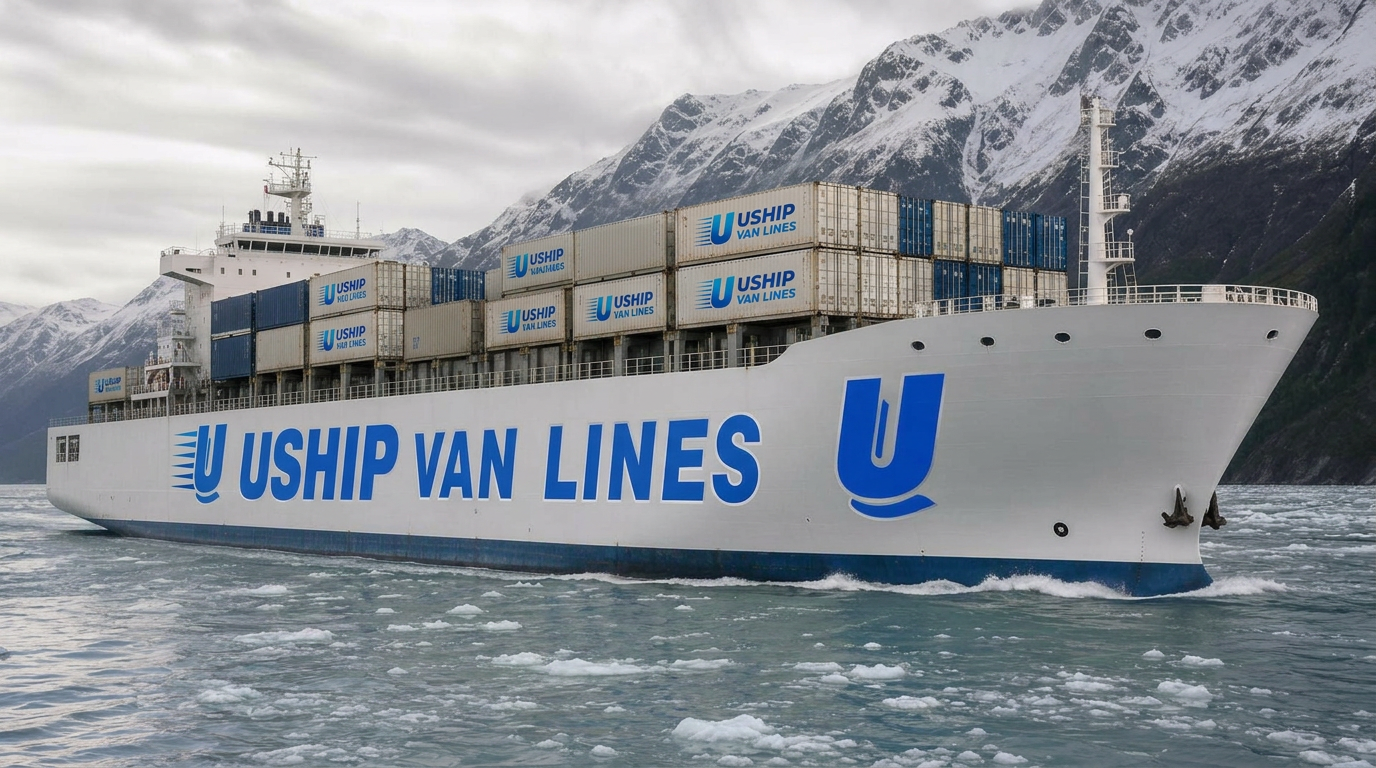
Moving from Maine to Alaska
Relocating from Maine to Alaska means crossing more than 4,000 miles and coordinating land, barge, and last-mile logistics through some of North America's most challenging terrain. Whether you're heading to Anchorage, Fairbanks, the Mat-Su Valley, or beyond, this move requires specialized carriers who understand Alaska barge schedules, customs protocols, and remote delivery realities.
Best Alaska & Hawaii Movers, powered by UShip Van Lines, connects you with vetted carriers experienced in Maine-to-Alaska routes. We handle the complexity—from pickup in Portland or Bangor to barge consolidation in Tacoma and final delivery across the Last Frontier. Request your free quote today to lock in your move timeline.
Route overview
Maine to Alaska: A Cross-Continental, Cross-Marine Journey
Moving from Maine to Alaska is one of the longest domestic relocations in the United States, requiring three distinct transportation phases. Your household goods travel by truck across the lower 48 states to a Pacific Northwest consolidation point (typically Tacoma, WA), then load onto a barge sailing north to the Port of Anchorage. From there, items are offloaded and trucked to your final Alaska destination—whether that's urban Anchorage, interior Fairbanks, the rapidly growing Mat-Su Borough, the Kenai Peninsula, or even bush communities accessible only by seasonal road or air.
This multi-modal journey typically spans 3–6 weeks door-to-door, depending on barge sailing schedules (which run weekly in summer, less frequently in winter), Maine pickup location, and Alaska destination accessibility. Unlike standard interstate moves, you're coordinating with longshoremen, customs (if crossing Canadian waters), and Alaska-based last-mile carriers familiar with gravel highways, winter conditions, and remote access challenges. Maine's relatively compact geography makes pickup straightforward, but the transcontinental haul and barge consolidation windows require careful planning and a carrier network experienced in Alaska logistics.
How the moving process works
How Your Maine-to-Alaska Move Works: Step by Step
-
Initial Survey and Booking (4–8 Weeks Before Move Date)
Your carrier conducts a virtual or in-home inventory of your Maine residence to calculate cubic footage and weight. You'll receive a binding or binding-not-to-exceed estimate covering land transport, barge fees, port handling, and Alaska delivery. Book early—barge space fills quickly in peak summer months. -
Pickup in Maine (Day 1)
Professional movers load your belongings in Portland, Bangor, Augusta, or elsewhere in Maine. Items are secured in a dedicated section of a long-haul truck or consolidated container, then begin the 3,000+ mile overland journey to the Pacific Northwest. -
Cross-Country Transit to Tacoma (Days 2–7)
Your shipment travels via I-90 or similar interstate corridors to Tacoma, WA, the primary Alaska barge consolidation hub. Transit time averages 5–7 days, depending on route and weather. Shipments are staged at a secure warehouse awaiting the next available barge sailing. -
Barge Consolidation and Customs Prep (Days 8–14)
Your goods are loaded into ocean-worthy containers alongside other Alaska-bound shipments. Carriers complete customs documentation (even though Alaska is a U.S. state, some barges transit Canadian waters, triggering brief customs protocols). Sailing schedules are published in advance—summer sailings depart weekly; winter sailings may be biweekly. -
Marine Voyage Tacoma → Port of Anchorage (Days 15–21)
The barge sails north through the Inside Passage or Gulf of Alaska, a 1,400-nautical-mile journey taking 6–8 days. Weather can extend this leg in winter. Containers remain sealed and climate-stable aboard the vessel. -
Port Offload and Alaska Customs Clearance (Days 22–25)
Upon arrival at the Port of Anchorage, containers are offloaded, inspected, and cleared by Alaska port authorities. Your carrier's Alaska partner retrieves your shipment and stages it for final delivery. -
Last-Mile Delivery in Alaska (Days 26–35)
A local Alaska trucker delivers to your new address. If you're in Anchorage or the Mat-Su Valley, delivery happens within 1–2 days. Fairbanks and interior locations add 1–3 days via the Parks Highway. Kenai Peninsula, Southeast Alaska (Juneau, Ketchikan—usually via separate barge or ferry), and bush destinations require additional coordination and may incur extra fees for gravel roads, seasonal access, or barge-to-plane transfers.
Estimated moving costs
What Does a Maine-to-Alaska Move Cost?
For a typical 2–3 bedroom household (8,000–12,000 lbs, approximately 800–1,200 cubic feet), expect to invest $8,500–$16,000 for a full-service move from Maine to Alaska. Studio or 1-bedroom apartments may range $5,000–$8,000, while larger 4+ bedroom homes can exceed $18,000–$25,000.
Key cost drivers include:
- Distance and Multi-Modal Complexity: You're paying for transcontinental trucking (3,000+ miles), barge freight (Tacoma–Anchorage), port handling fees at both ends, and Alaska last-mile delivery. Each leg has distinct pricing.
- Cubic Footage and Weight: Alaska movers charge by volume (cubic feet) or weight, whichever is greater. Barge rates are volume-sensitive—dense, compact loads cost less than bulky, low-density items.
- Barge Schedule and Peak Season: Summer (May–September) is peak moving season in Alaska, with higher demand and premium pricing. Winter moves (October–April) may offer modest discounts but face weather delays and reduced sailing frequency.
- Alaska Destination: Delivery to Anchorage or Wasilla is straightforward. Fairbanks, Kenai, Homer, or Southeast Alaska communities add $500–$2,000+ in last-mile fees. Bush locations requiring air freight or winter ice-road access can add $3,000–$10,000.
- Packing and Specialty Items: Full-service packing in Maine adds $800–$2,500. Vehicles shipped separately via auto barge cost $1,500–$3,500 per car. Pianos, safes, hot tubs, and antiques require custom crating and incur surcharges.
- Insurance: Basic carrier liability covers $0.60/lb. Full-value replacement insurance (recommended for Alaska's long, multi-modal journey) costs 1–3% of declared shipment value.
These are estimates, not guaranteed quotes. Your final cost depends on exact inventory, services selected, and real-time barge availability. Always request a detailed, itemized estimate and compare at least 2–3 vetted Alaska specialists.
Estimated transit times
How Long Does a Maine-to-Alaska Move Take?
Door-to-door transit from Maine to Alaska typically requires 21–42 days, broken down as follows:
- Maine Pickup to Tacoma Consolidation: 5–7 days overland trucking.
- Tacoma Staging and Barge Wait: 3–10 days, depending on sailing schedule and how closely your pickup aligns with the next departure. Summer sailings (weekly) minimize wait; winter sailings (biweekly or less) can extend this window.
- Tacoma to Port of Anchorage Barge Voyage: 6–8 days under normal conditions; storms or winter ice can add 1–3 days.
- Port Offload and Customs: 1–3 days for container retrieval and clearance.
- Last-Mile Delivery in Alaska: 1–7 days, depending on destination. Anchorage and Mat-Su: 1–2 days. Fairbanks: 2–4 days. Kenai, Homer, Southeast, or bush: 5–14 days, especially if weather or seasonal road closures intervene.
In practice: Plan for 4–5 weeks minimum in summer, 5–6+ weeks in winter. If you have a firm start date for work or school in Alaska, book your move 6–10 weeks in advance to secure barge space and buffer against delays. Carriers cannot guarantee exact delivery dates due to marine and weather variables, but experienced Alaska movers provide tight estimated windows and proactive tracking updates.
Regional logistics
Alaska-Specific Moving Logistics from Maine
Ports and Barge Routing:
Your shipment consolidates in Tacoma, WA, the primary barge hub for Alaska freight. Barges sail to the Port of Anchorage (the state's largest cargo port), where most household goods are offloaded. If your final destination is in Southeast Alaska (Juneau, Sitka, Ketchikan), shipments often route via separate barge or Alaska Marine Highway ferry—confirm routing with your carrier. Anchorage serves as the distribution point for road-accessible interior and peninsula destinations.
Customs and Documentation:
Alaska is a U.S. state, so no international customs apply—except if your barge transits Canadian waters (common for some Inside Passage routes). In those cases, sealed containers remain bonded through Canada, but carriers handle brief customs paperwork. You'll need a detailed inventory list, proof of residence, and sometimes vehicle titles if shipping cars. No passports or visas required, but have a government-issued ID and shipment documentation ready.
Vehicle Shipping:
Most Maine-to-Alaska movers coordinate separate auto transport. Your car is driven or trucked to Tacoma, then loaded onto a roll-on/roll-off (RoRo) barge or enclosed container. Cost: $1,500–$3,500 per vehicle. Transit time mirrors household goods (3–5 weeks). Drain fuel to ¼ tank or less per barge regulations, remove personal items (not covered by insurance), and expect Alaska-side delivery within 3–5 days of port arrival.
Last-Mile Realities:
Alaska's road system is limited. Anchorage, Mat-Su (Wasilla, Palmer), and Fairbanks are connected via paved highways (Glenn, Parks, Seward). Kenai Peninsula destinations (Soldotna, Homer) require the Seward or Sterling Highway—fully paved but weather-dependent in winter. Southeast Alaska communities (Juneau, Ketchikan) have no road connection to the mainland; shipments arrive by separate barge or ferry. Bush villages (Bethel, Nome, Kotzebue, Barrow) are off-road and require air freight or seasonal barge/ice-road delivery at significant added cost ($3,000–$10,000+). Confirm your carrier's last-mile capabilities and fees upfront.
Storage Options:
If your Alaska housing isn't ready, many carriers offer short-term storage in Tacoma (before barge) or Anchorage (after arrival). Costs range $150–$400/month for a typical household. Some movers include 30–60 days free storage in their quote; clarify terms to avoid surprises.
Seasonal considerations
Timing Your Maine-to-Alaska Move: Seasonal Realities
Spring (April–May):
Maine snow melts, Alaska thaws. Barge schedules ramp up from reduced winter frequency to weekly summer sailings by late May. Demand rises as families relocate before the Alaska school year ends or summer jobs begin. Book early—May is a sweet spot for better weather but not yet peak pricing. Expect occasional spring storms in the Gulf of Alaska that may delay barges 1–2 days.
Summer (June–August):
Peak season for Alaska moves. Weekly (sometimes twice-weekly) barge sailings, warmest weather, and full-service availability across all Alaska destinations. Roads to bush communities and the Kenai Peninsula are fully accessible. Expect premium pricing (10–20% above off-season), longer booking lead times (8–12 weeks recommended), and crowded port facilities. If you're moving for a summer job or seasonal work, this is your only practical window.
Fall (September–October):
Demand tapers as Alaska's brief summer ends and snowbirds head south. Barge frequency begins to decline in late October. Weather in the Gulf of Alaska becomes less predictable—storm systems can delay sailings. Pricing moderates slightly. Good window for retirees or remote workers with flexible timelines. Book by mid-August to guarantee a September sailing.
Winter (November–March):
Off-season for Alaska moving. Barge sailings drop to biweekly or monthly, and some routes (especially Southeast Alaska) pause entirely. Winter storms, ice, and reduced daylight hours slow every phase—Maine pickup in snow, cross-country trucking through mountain passes, rough Gulf of Alaska seas, and Alaska last-mile delivery on icy highways. Costs may drop 10–15%, but transit times extend to 6–8+ weeks. Bush and remote interior destinations may be inaccessible until spring. Only recommended if you have extreme flexibility and can wait for weather windows.
Why choose Best Alaska & Hawaii Movers
Why Best Alaska & Hawaii Movers for Your Maine-to-Alaska Move
- Alaska-Specialist Carrier Network: Powered by UShip Van Lines, we connect you exclusively with carriers who operate regular Maine-to-Alaska routes, understand barge schedules, and have established last-mile partners across Anchorage, Fairbanks, Mat-Su, Kenai, and beyond.
- Transparent, Multi-Modal Pricing: We break down every cost—land, barge, port fees, Alaska delivery—so you see exactly what you're paying for. No hidden surcharges, no surprise barge-wait fees.
- End-to-End Coordination: From your Maine front door to your Alaska driveway, one point of contact manages trucking, barge booking, customs paperwork, and final delivery. You don't juggle multiple vendors.
- Real-Time Tracking and Updates: Monitor your shipment's progress through each phase—overland, barge loading, sailing, port arrival, and Alaska delivery. We proactively communicate delays due to weather or port congestion.
- Vetted, Insured Carriers Only: Every mover in our network carries full FMCSA registration, marine cargo insurance, and Alaska-specific liability coverage. We verify credentials so you don't have to.
- Flexible Service Levels: Choose full-service packing and white-glove delivery, or save with self-pack and curbside options. We tailor solutions to your budget and timeline.