
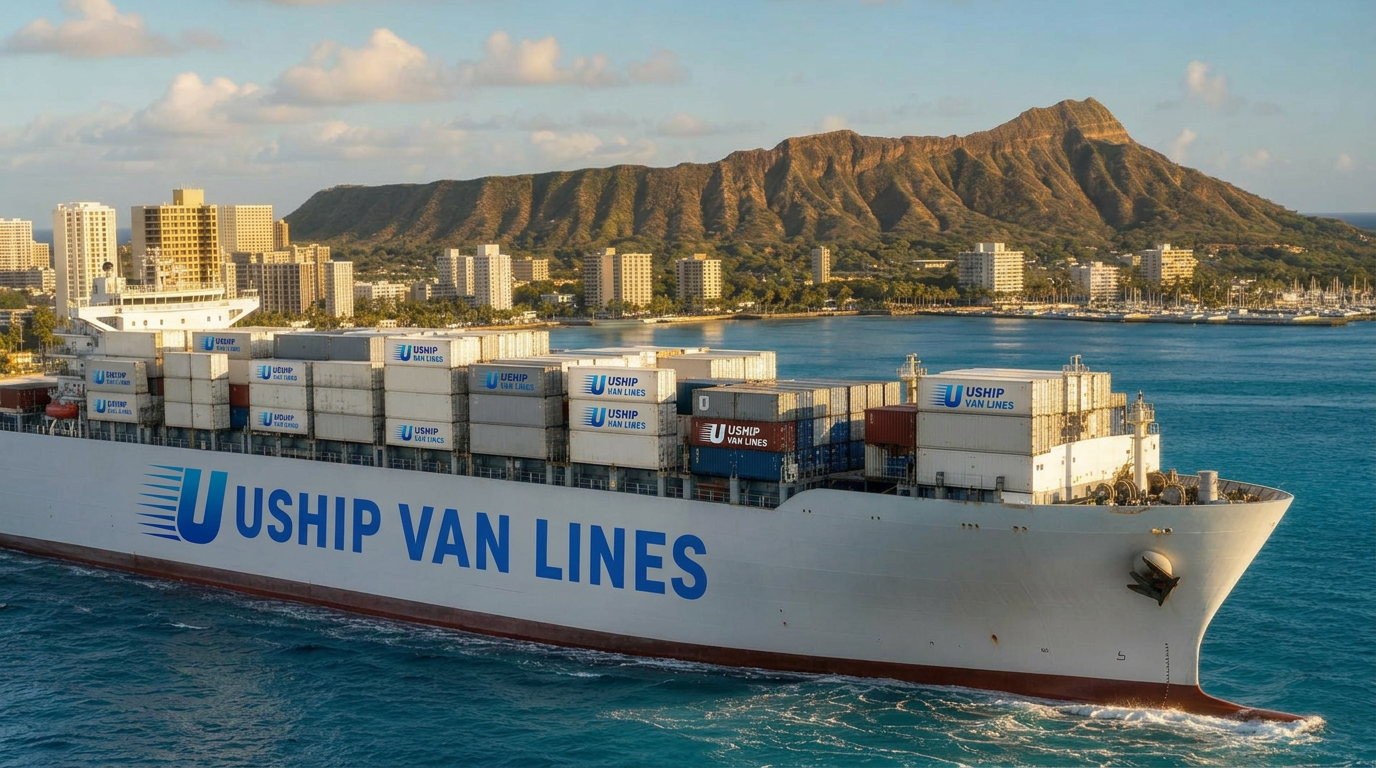
Moving from Hawaii to San Diego, CA
Relocating from the Hawaiian Islands to San Diego means navigating ocean shipping, port logistics, and mainland delivery—a fundamentally different process than a typical interstate move. Whether you're leaving Oahu, Maui, the Big Island, or Kauai, your household goods will travel by container ship to the West Coast before continuing south to San Diego, typically through Long Beach or Oakland.
Best Alaska & Hawaii Movers, powered by UShip Van Lines, specializes in these complex ocean-to-mainland routes. We coordinate every leg—island pickup, containerization, ocean freight, mainland receiving, and final delivery to your San Diego address. Ready to simplify your Hawaii-to-California move? Request a detailed quote tailored to your inventory and timeline.
Route overview
Route Overview: Hawaii to San Diego
The Hawaii-to-San Diego corridor is one of the most common mainland relocation routes from the islands, driven by military transfers to Naval Base San Diego, job relocations to the biotech and tech sectors, and families seeking California's mainland lifestyle with a similar coastal climate. Your shipment follows a multi-modal path: containerized pickup in Hawaii, ocean freight via Matson Navigation or Pasha Hawaii to a California port (typically Long Beach or Oakland), customs clearance and port handling, then overland trucking approximately 120–500 miles south to San Diego County.
Unlike direct interstate trucking, this route requires precise coordination between island-side movers, steamship lines, port operations, and mainland delivery teams. Total door-to-door transit typically spans 10–21 days depending on your origin island, sailing schedules, and whether you ship shared container (consolidation) or exclusive use. San Diego's proximity to Long Beach—the primary Hawaii freight gateway—often means faster final delivery than moves to Northern California or other western states.
Timing matters significantly. Peak moving season (May–September) coincides with high tourism, tighter container availability, and occasional port congestion. Hurricane season (June–November) can delay sailings, though major disruptions are rare. Planning 6–8 weeks ahead ensures you secure your preferred sailing date and allows time for vehicle shipping if needed, which follows a parallel but separate process through the same ports.
How the moving process works
How Your Hawaii-to-San Diego Move Works
-
Free In-Home or Virtual Survey: We assess your inventory—furniture, boxes, vehicles, specialty items—and provide a binding or not-to-exceed quote. For Hawaii moves, accurate cubic footage and weight estimates are critical, as ocean freight pricing differs from mainland trucking.
-
Scheduling and Container Reservation: Once you confirm, we reserve space on a Matson or Pasha sailing (weekly departures from Honolulu; less frequent from neighbor islands). We also coordinate pickup timing to align with the sailing cutoff, typically 3–5 days before departure.
-
Island Pickup and Packing: Our Hawaii-based crews arrive at your home, professionally pack fragile items if requested, load your belongings into a 20' or 40' ocean container (shared or exclusive), and transport the container to Honolulu, Kahului, Hilo, or Nawiliwili port depending on your island.
-
Ocean Transit to California: Your container sails to Long Beach (most common) or Oakland—approximately 5–7 days at sea. The steamship line handles all ocean logistics; we track the vessel and coordinate with our mainland partners.
-
Port Arrival and Customs Clearance: Upon arrival, the container clears U.S. Customs (usually routine for household goods, but agricultural inspections apply). It's then transferred to our mainland receiving facility or directly loaded onto a truck.
-
Overland Delivery to San Diego: A dedicated truck moves your shipment south—1–3 days depending on scheduling and whether it's a direct delivery or part of a regional consolidation route. San Diego's major corridors (I-5, I-15, I-805) are well-served, and most neighborhoods are accessible for full-size moving trucks.
-
Final Delivery and Unpacking: Our crew unloads at your San Diego residence, places furniture, and can unpack boxes if that service was included. We remove packing materials and complete a final walkthrough to ensure satisfaction.
Estimated moving costs
What Does a Hawaii-to-San Diego Move Cost?
For a typical 2–3 bedroom household (approximately 5,000–8,000 lbs or 800–1,200 cubic feet), expect to invest $5,500–$11,000 for a full-service door-to-door move. This range reflects shared container service; exclusive-use containers add $2,000–$4,000 but eliminate risk of delays from consolidating multiple shipments.
Key cost drivers include:
- Volume and weight: Ocean freight is priced by container space (cubic feet) and sometimes weight. Accurate inventory reduces surprises.
- Origin island: Neighbor island moves (Maui, Kauai, Big Island) incur inter-island barge fees to Honolulu ($400–$800) before the main ocean leg.
- Packing services: Professional packing of a full household adds $800–$1,800. Fragile-only packing is a mid-range option.
- Sailing schedule: Peak-season surcharges (summer) or expedited sailings increase costs by 10–20%.
- Access and distance: Difficult pickup/delivery locations (narrow roads, steep driveways, high-rise buildings without freight elevators) may require shuttle fees ($200–$600).
- Storage: If your San Diego residence isn't ready, warehouse storage runs $100–$250/month.
- Insurance: Full-value replacement coverage (recommended for ocean moves) costs approximately 1–2% of declared value.
Vehicle shipping is separate: $1,200–$1,800 per car Hawaii-to-California via roll-on/roll-off vessel. We coordinate this through trusted auto transport partners using the same ports.
We never lock you into a price until we understand your exact needs. Request a detailed quote—no obligation, no hidden fees—and we'll break down every cost component so you can budget with confidence.
Estimated transit times
How Long Does Hawaii to San Diego Take?
Typical door-to-door timeline: 10–21 days, broken down as follows:
- Island pickup to port delivery: 1–2 days (same day for Oahu; add 2–4 days for neighbor island barge to Honolulu)
- Container dwell at Hawaii port: 1–3 days (time between drop-off and vessel departure)
- Ocean transit: 5–7 days (Honolulu to Long Beach/Oakland; Matson express vessels are faster than slower freighters)
- Port processing and customs: 1–2 days (inspection, container unloading, transfer to truck)
- Overland delivery to San Diego: 1–3 days (Long Beach to San Diego is ~120 miles, often same-day or next-day; Oakland adds 1–2 days)
Faster options: Exclusive-use containers on express sailings can shave 3–5 days off the total, particularly if you avoid consolidation delays. Expect to pay a 25–40% premium.
Potential delays: Hurricane warnings (June–November) occasionally postpone sailings by 1–3 days. Port congestion during peak season or labor actions can add 2–5 days. Inter-island barge schedules (neighbor islands) run 2–3 times weekly, so timing your pickup precisely matters.
For time-sensitive moves—job start dates, lease expirations—book 6–8 weeks in advance and budget an extra 3–5 days cushion. We provide real-time tracking once your container is aboard the vessel, and our team communicates proactively if any leg experiences delays.
Regional logistics
Hawaii-Specific Moving Logistics
Port operations: Honolulu Harbor handles the vast majority of Hawaii household goods exports. Neighbor islands (Kahului/Maui, Hilo and Kawaihae/Big Island, Nawiliwili/Kauai) require an additional inter-island barge leg to Honolulu before the main ocean sailing, adding 2–4 days and $400–$800. Containers are inspected by USDA for restricted agricultural products—coffee, soil, certain plants—before mainland departure.
Vehicle shipping: Cars ship separately via Matson or Pasha roll-on/roll-off service, usually from the same port. Vehicles must be empty (no personal items inside due to customs rules), operable (or arranged for non-runner fees), and have less than ¼ tank of fuel. Transit time mirrors household goods: 7–10 days Hawaii to California, then delivery to San Diego within 1–3 days. We coordinate pickup and delivery timing to align with your household shipment when possible.
Restricted and prohibited items: Hawaii's agricultural regulations are strict. You cannot ship soil, plants (except with USDA permits), fresh produce, or certain seeds. Mainland-bound moves are less restrictive than Hawaii-inbound, but living plants often don't survive the container environment (temperature extremes, darkness). Pets travel as cargo via air—never in moving containers. We provide detailed prohibited-items lists during your survey.
Container options: Shared container (consolidation) is most economical; your goods share space with 1–3 other shipments, and the container moves when full. Exclusive use (full container load) gives you the entire 20' or 40' container, faster scheduling, and no risk of cross-shipment delays—ideal for larger households or time-sensitive moves.
Delivery access in San Diego: Most San Diego neighborhoods accommodate full-size moving trucks. Exceptions include older hillside communities (Mount Helix, Point Loma heights), narrow beach alleys (Mission Beach), and some condo complexes with restricted truck hours. High-rise buildings require freight elevator reservations (building management handles this; we coordinate timing). If a full truck can't access your street, we shuttle items via smaller vehicle—typically $200–$400.
Storage solutions: If your San Diego home isn't ready or you're house-hunting, we offer secure warehouse storage. Your container can be held at our facility and delivered when you're ready, billed monthly. Climate-controlled options are available for sensitive items (artwork, electronics, wooden furniture).
Seasonal considerations
Best Times to Move from Hawaii to San Diego
Peak season (May–September): Highest demand coincides with school breaks, military PCS season, and favorable weather. Container space fills quickly; book 8–10 weeks ahead. Prices rise 15–25%, and port congestion at Long Beach can add 2–4 days. Advantage: Consistent sailing schedules and minimal storm risk (hurricane season starts June but peaks August–October).
Hurricane season (June–November): The Central Pacific sees occasional tropical systems. While major port closures are rare, sailings may be delayed 1–3 days if a storm approaches. Matson and Pasha prioritize safety and reschedule proactively. If your move falls in this window, add flexibility to your timeline and avoid booking the absolute last sailing before a critical deadline.
Shoulder season (April, October): Excellent balance of moderate pricing, good availability, and reliable weather. April avoids spring break crowds; October catches the tail of hurricane season but benefits from post-summer rate drops (10–15% lower than July).
Off-peak (November–March): Lowest prices (sometimes 20–30% below peak), easiest scheduling, and faster port processing. Winter storms on the mainland rarely affect Southern California, and ocean conditions between Hawaii and the West Coast are generally calm. Holiday weeks (Thanksgiving, Christmas, New Year's) see brief demand spikes; avoid those specific windows for best rates.
San Diego-specific note: The city's mild year-round climate means no seasonal move-in challenges (unlike snow-belt destinations). However, summer tourism increases traffic congestion in coastal neighborhoods, potentially adding 1–2 hours to final delivery in areas like La Jolla, Pacific Beach, or Coronado.
Why choose Best Alaska & Hawaii Movers
Why Best Alaska & Hawaii Movers for Your Hawaii-to-San Diego Move
-
Hawaii-Mainland Specialists: We focus exclusively on Alaska and Hawaii non-contiguous moves, so we know the ports, the steamship lines, the regulations, and the challenges. This isn't a side service—it's our core expertise.
-
Single-Point Coordination: You work with one team from Hawaii pickup through San Diego delivery. We manage the steamship line, the port agents, the mainland trucking, and all communication—no handoffs, no confusion, no finger-pointing if something goes wrong.
-
Transparent, All-Inclusive Pricing: Our quotes include ocean freight, port fees, mainland delivery, and basic liability coverage. No surprise fuel surcharges, no hidden container handling fees, no fine print. You'll know the total investment before you commit.
-
Flexible Scheduling and Real-Time Tracking: We work around your timeline, not the other way around. Once your container sails, you receive vessel tracking information and proactive updates at every milestone—port departure, ocean transit, port arrival, truck dispatch, delivery window.
-
Powered by UShip Van Lines: Our mainland network leverages UShip's vetted carrier partnerships, giving you access to competitive rates and reliable drivers while maintaining our high service standards. Every truck is insured, every crew is trained, and every delivery is monitored.
-
Comprehensive Protection: We offer full-value replacement insurance (not just basic 60¢/lb coverage), so your belongings are truly protected during the ocean crossing and overland journey. Claims are handled directly by our team—fast, fair, and hassle-free.