
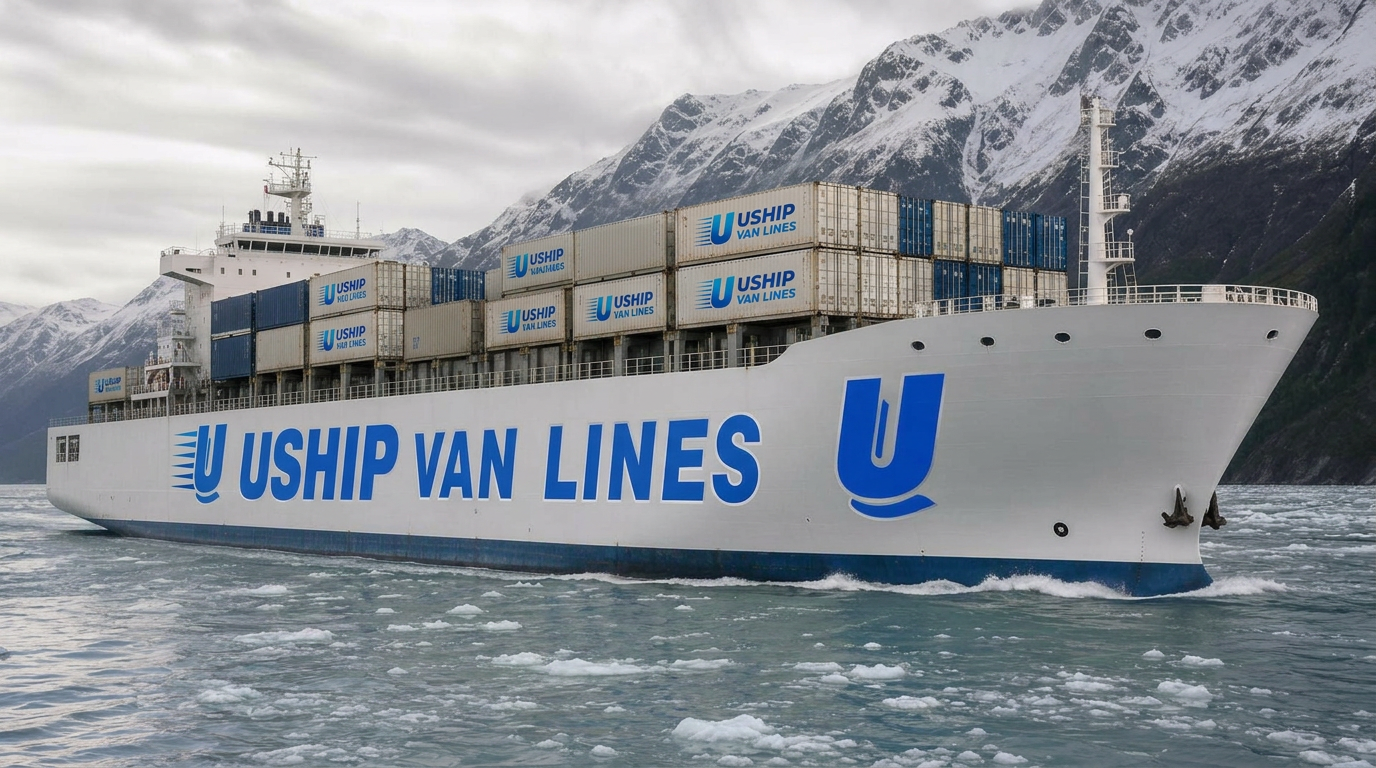
Moving from Arlington, TX to Alaska
Moving from Arlington, Texas to Alaska isn't your typical cross-country relocation—it's a complex journey spanning over 3,400 miles that requires specialized barge transport, multi-modal logistics, and careful coordination through Pacific Northwest ports. Whether you're relocating for military orders, career opportunities in oil and gas, or Alaska's legendary outdoor lifestyle, understanding the unique requirements of this route will help you plan a successful move.
Best Alaska & Hawaii Movers, powered by UShip Van Lines, specializes in Arlington-to-Alaska relocations, managing every detail from your Texas pickup through barge transit to final delivery in Anchorage, Fairbanks, the Mat-Su Valley, or even remote bush communities. Ready to start planning your Alaska adventure? Request your personalized moving quote today.
Route overview
The Arlington, TX to Alaska Moving Route
Your household goods travel from Arlington via long-haul truck to the Port of Tacoma, Washington—the primary consolidation point for Alaska-bound freight. This initial leg covers approximately 2,100 miles through Texas, Oklahoma, Colorado, Wyoming, Idaho, and Washington. Your belongings are then loaded onto commercial barge services (typically operated by carriers like Lynden Transport or TOTE Maritime) for the 1,500-nautical-mile voyage through the Inside Passage to the Port of Anchorage.
From Anchorage, final delivery depends on your exact destination. Moves to Anchorage itself, Eagle River, or the Mat-Su Valley (Wasilla, Palmer) involve relatively straightforward trucking. Deliveries to Fairbanks require an additional 360-mile haul along the Parks Highway. Remote communities in the Kenai Peninsula, Southeast Alaska, or bush locations may require additional barge legs, small aircraft, or seasonal ice road access.
This multi-modal journey typically takes 2–4 weeks door-to-door, with timing heavily influenced by barge schedules (usually weekly departures during summer, less frequent in winter), weather conditions, and your specific Alaska destination. Unlike continuous trucking moves, Alaska relocations require strategic planning around maritime schedules and Alaska's dramatic seasonal variations.
How the moving process works
How Your Arlington to Alaska Move Works
-
Initial Survey & Quote – Your move coordinator conducts a detailed inventory (virtual or in-home) of your Arlington residence, noting special items like vehicles, boats, or oversized furniture. We provide a comprehensive quote covering truck transport, barge fees, Alaska delivery, and any necessary storage.
-
Pre-Move Planning & Scheduling – We coordinate your pack/load date in Arlington with available barge departure windows from Tacoma (typically requiring 5–7 days lead time for trucking). You'll receive detailed guidance on prohibited items for Alaska (certain plants, soil, firewood), vehicle shipping options, and documentation requirements.
-
Arlington Pickup & Loading – Professional movers arrive at your Arlington home, pack your belongings (if you've selected full-service packing), and load everything into a climate-controlled truck. Your inventory is documented and wrapped for the long journey. Vehicles can be driven onto the truck or transported separately.
-
Overland Transit to Tacoma – Your shipment travels approximately 2,100 miles to the Port of Tacoma over 4–6 days. The truck delivers to our consolidation facility where your belongings are transferred to ocean-worthy containers or loaded as breakbulk cargo depending on shipment size.
-
Barge Transit to Alaska – Your goods board a commercial barge for the 5–7 day voyage to Anchorage (longer to Southeast Alaska ports). Barges operate year-round but run more frequently May–September. Your shipment is protected from marine conditions in sealed containers or covered cargo holds.
-
Port Processing & Customs Clearance – Upon arrival at the Port of Anchorage, your shipment is offloaded and cleared through any necessary inspections. Alaska has strict agricultural regulations, so certain items may require additional documentation or inspection.
-
Final Delivery in Alaska – A local Alaska truck picks up your shipment for final delivery. Anchorage-area deliveries occur within 1–3 days of barge arrival. Fairbanks and other interior locations add 1–2 days. Remote communities may require scheduling around weather, road conditions, or secondary barge/air transport—our team coordinates every detail to ensure safe arrival at your new Alaska home.
Estimated moving costs
What an Arlington to Alaska Move Costs
A typical 2–3 bedroom household moving from Arlington to Alaska ranges from $7,500 to $14,000 depending on shipment volume, exact destination, season, and service level. A modest 2-bedroom apartment (approximately 5,000–7,000 lbs) to Anchorage typically costs $7,500–$9,500, while a full 3-bedroom home (10,000–12,000 lbs) to Fairbanks or remote locations can reach $12,000–$14,000 or more.
Key cost drivers include:
- Shipment weight and volume – Alaska moves are priced primarily by weight/space since barge capacity is the limiting factor. Reducing volume saves significantly.
- Destination within Alaska – Anchorage and Mat-Su Valley are least expensive. Fairbanks adds $1,500–$2,500. Remote bush communities or Southeast Alaska islands can add $3,000+ due to additional barge legs or air freight.
- Barge schedules and season – Peak summer moves (May–August) sometimes carry premium pricing due to high demand. Winter moves (November–March) may offer slight discounts but face weather delays.
- Vehicle transport – Shipping a vehicle separately adds $1,800–$3,200 depending on size. Many customers drive to Alaska via the Alaska Highway as a cost-saving adventure.
- Packing services – Full-service professional packing adds $800–$1,800 but ensures proper protection for the multi-modal journey.
- Storage needs – If barge timing doesn't align perfectly with your Arlington move-out and Alaska move-in dates, temporary storage in Tacoma or Anchorage adds $150–$400/month.
- Insurance coverage – Enhanced valuation protection beyond basic carrier liability adds 1–2% of declared value but provides crucial peace of mind for this complex route.
These are representative estimates based on typical Arlington-to-Alaska moves. Every relocation is unique—request a detailed quote for precise pricing tailored to your specific inventory, timeline, and destination.
Estimated transit times
How Long Your Move Takes
Door-to-door transit from Arlington to Alaska typically requires 14–28 days, with the timeline broken down as follows:
- Arlington to Tacoma trucking: 4–6 days (2,100 miles overland)
- Port consolidation and barge loading: 2–4 days (dependent on barge schedule alignment)
- Tacoma to Anchorage barge voyage: 5–7 days at sea
- Port offloading and processing: 1–2 days
- Final Alaska delivery: 1–5 days depending on destination
Anchorage and Mat-Su Valley deliveries typically complete in 14–18 days total. Fairbanks adds 2–4 days for the interior haul, bringing totals to 18–22 days. Remote communities in the Kenai Peninsula, Southeast Alaska (Juneau, Ketchikan, Sitka), or bush locations can extend timelines to 21–28 days or longer when secondary barge transport or seasonal access restrictions apply.
Critical timing factors:
- Barge schedules are the primary constraint—summer departures (May–September) run weekly or twice-weekly; winter schedules (October–April) may be every 10–14 days
- Weather delays are common in fall/winter for both ocean crossings and Alaska ground transport
- Your flexibility on pickup and delivery dates directly impacts total timeline—rigid dates may require storage at one or both ends
- Holiday periods (Thanksgiving, Christmas, New Year's) can add 3–7 days due to reduced sailing schedules and port operations
For the smoothest experience, plan your Arlington move date working backward from your required Alaska arrival date, adding buffer time for weather and logistics. Most customers find 3–4 weeks of planning lead time ideal for this route.
Regional logistics
Alaska-Specific Moving Logistics
Port and Maritime Details: Your shipment routes through the Port of Tacoma, Washington—the primary gateway for Alaska freight. Goods travel via commercial barge services to the Port of Anchorage (the largest volume destination), or alternatively to ports in Southeast Alaska (Juneau, Ketchikan, Sitka) or Kodiak. These aren't passenger ferries—they're cargo barges carrying containers and vehicles. Your belongings travel in either private containers (for larger moves) or consolidated cargo holds (for smaller shipments), protected from marine conditions throughout the voyage.
Vehicle Shipping: Most customers moving from Arlington to Alaska either drive the Alaska Highway (a 4,000+ mile adventure through Canada, requiring passport and vehicle registration) or ship vehicles via the same barge as their household goods. Vehicle shipping adds $1,800–$3,200 depending on vehicle size. Vehicles must be nearly empty (1/4 tank of gas maximum, no personal items in cabin) and properly documented. Many families make the Alaska Highway drive a memorable road trip, arriving in Alaska days before their household goods and exploring along the way.
Restricted and Prohibited Items: Alaska has strict agricultural regulations to protect its unique ecosystems. You cannot bring most plants, soil, potting mix, or untreated firewood. Fresh produce should be consumed before the move or donated. Hazardous materials (paint, propane, ammunition, cleaning chemicals) cannot travel on barges—plan to dispose of these items before your Arlington pickup. Your move coordinator will provide a comprehensive prohibited items list during planning.
Documentation and Regulations: While moving from Texas to Alaska doesn't require customs (both are U.S. states), you'll need to update your driver's license within 90 days of establishing Alaska residency, register vehicles within 30 days, and may need to show proof of ownership for high-value items. Military members should coordinate with their transportation office for orders documentation. Keep important papers (birth certificates, vehicle titles, medical records, insurance policies) in your personal luggage, not the moving truck.
Remote and Bush Delivery: If your final destination is outside the road system (accessible only by plane, boat, or seasonal ice roads), specialized logistics apply. Communities like Nome, Bethel, Barrow (Utqiaġvik), or Southeast Alaska villages require secondary transport. Best Alaska & Hawaii Movers coordinates these complex deliveries, often involving air freight for immediate necessities and seasonal barge for bulk goods. Remote deliveries can add weeks to timelines and $3,000–$8,000 to costs, but we handle these specialized moves regularly.
Storage Options: Timing mismatches between your Arlington move-out and Alaska move-in are common with barge schedules. We offer secure storage at our Tacoma facility ($150–$250/month) or in Anchorage ($200–$350/month) to bridge gaps. Most customers need 1–4 weeks of storage. Some choose to store in Tacoma and schedule barge shipment for a specific Alaska arrival date that aligns with their new home availability.
Seasonal considerations
Best Times to Move from Arlington to Alaska
Summer (May–August) is peak moving season for Alaska relocations. Barge schedules are most frequent (often twice weekly from Tacoma), weather is most predictable, and Alaska road access is optimal. You'll find the most service availability and fastest transits—typically 14–20 days door-to-door. However, demand is highest, so book 6–8 weeks in advance and expect premium pricing. If you're moving for school starts or summer employment, early summer moves (May–June) often work better than late summer when everyone competes for capacity.
Fall (September–October) offers a sweet spot of reduced demand, potentially lower rates, and still-reasonable weather. Barge schedules begin to thin slightly, but weekly departures continue through October. Early fall is excellent for avoiding peak pricing while maintaining reliable timelines. Late October can see the beginning of winter weather impacts—early snowfall in Alaska mountain passes and rougher seas—so build extra buffer time into your schedule.
Winter (November–March) presents the most challenges but remains feasible year-round. Barge schedules reduce to every 10–14 days, and severe weather can delay both ocean crossings and Alaska ground transport. Winter storms in the Gulf of Alaska occasionally push barge transit to 8–10 days instead of the usual 5–7. However, moving companies often offer discounted rates during slow season, and if you have flexible timing and patience for weather delays, you can save 10–20% on total costs. Winter moves work well for military relocations on fixed orders or those buying Alaska real estate in the off-season.
Spring (April–May) sees increasing service frequency as carriers ramp up for summer. Ice breakup can temporarily impact some remote Alaska destinations in April, but major population centers remain accessible. Pricing begins to rise toward summer peaks, but you'll have better availability than high season. Spring moves are ideal if you want to arrive in Alaska as the landscape comes alive and before the summer tourism and construction rush.
Why choose Best Alaska & Hawaii Movers
Why Choose Best Alaska & Hawaii Movers for Your Arlington to Alaska Move
-
Alaska Specialists, Not Generalists – We focus exclusively on Alaska and Hawaii moves, managing the complex maritime logistics, barge coordination, and Last Frontier delivery challenges that general moving companies avoid or subcontract. Our team knows Alaska geography, seasonal patterns, port operations, and remote access solutions.
-
Transparent, All-Inclusive Pricing – Your quote includes every leg: Arlington pickup, overland trucking to Tacoma, barge freight, port handling, and Alaska delivery to your final destination. No surprise fees when your shipment reaches the port. We break down costs clearly so you understand exactly what you're paying for.
-
Powered by UShip Van Lines Network – Our partnership with UShip Van Lines gives us access to vetted carrier capacity nationwide, while our Alaska expertise ensures your move is managed by people who understand this unique route, not handed off to the lowest bidder.
-
End-to-End Coordination – One dedicated move coordinator manages your entire relocation from Arlington to Alaska, coordinating truck schedules, barge bookings, port logistics, and final delivery. You have a single point of contact who knows your shipment status at every stage—no passing between departments or contractors.
-
Year-Round Service Including Remote Locations – We move households to Alaska every week of the year, including winter months and remote communities that larger carriers won't touch. From Anchorage apartments to Fairbanks homes to bush villages, we handle the logistics that make Alaska moves uniquely challenging.